• Review: “The Great Gatsby”
  • Review: “Mud”
  • Review: “The Place Beyond the Pines”
  • Review: “Ginger & Rosa”
  • Review: “Stoker”
  • Review: “Side Effects”
  • Review: “Mama”
  • Review: “Zero Dark Thirty”
  • Review: “Gangster Squad”
  • Review: “Les Misérables”
  • Review: “This Is 40”
  • Review: “Any Day Now”
  • Review: “Anna Karenina”
  • Review: “Silver Linings Playbook”
  • Review: “Hitchcock”
  • Review: “Lincoln”
  • Review: “Life of Pi”
  • Review: “Flight”
  • Review: “Skyfall”
  • Review: “Argo”
  • Review: “The Perks of Being a Wallflower”
  • Review: “Looper”
  • Reviews: “Arbitrage” and “The Master”
  • Review: “The Words”
  • Review: “Celeste and Jesse Forever”
  • Review: “Lawless”
  • Review: “The Campaign”
  • Review: “Total Recall”
  • Review: “To Rome with Love”
  • Review: “The Dark Knight Rises”
  • Review: “Moonrise Kingdom”
  • Review: “Magic Mike”
  • Review: “The Amazing Spider-Man”
  • Review: “Brave”
  • Review: “Abraham Lincoln: Vampire Hunter”
  • Review: “Prometheus”
  • Review: “Snow White and the Huntsman”
  • Review: “Bernie”
  • Review: “The Dictator”
  • Review: “The Raven”
  • Reviews: “Salmon Fishing in the Yemen” and “Jiro Dreams of Sushi”
  • Review: “Chimpanzee”
  • Review: “The Cabin in the Woods”
  • Review: “American Reunion”
  • Review: “Detachment”
  • Review: “The Hunger Games”
  • Review: “Casablanca” (In Re-Release; 1 Night Only)
  • Review: “Silent House”
  • Review: “Wanderlust”
  • Review: “This Means War”
  • Review: “Safe House”
  • Review: “The Woman In Black”
  • Review: “The Grey”
  • Review: “Extremely Loud & Incredibly Close”
  • Review: “Contraband”
  • Review: “Shame” and “Young Adult”
  • Review: “War Horse”
  • Review: “The Girl with the Dragon Tattoo”
  • Review: “Like Crazy”
  • Review: “Hugo”
  • Review: “The Descendants”
  • Review: “My Week with Marilyn”
  • Review: “J. Edgar”
  • Review: “In Time”
  • Review: “Take Shelter”
  • Review: “The Thing”
  • Review: “The Ides of March”
  • Review: “Dream House”
  • Review: “50/50”
  • Review: “Moneyball”
  • Review: “Abduction”
  • Review: “Drive”
  • Review: “Contagion”
  • Review: “The Debt”
  • Review: “Our Idiot Brother”
  • Review: “The Help”
  • Review: “Fright Night”
  • Review: “Beginners”
  • Review: “Crazy Stupid Love”
  • Review: “Rise of the Planet of the Apes”

Colin Carman

~ Jane Austen Scholar & Culture Vulture

Colin Carman

Author Archives: colincarman

Review: “Life of Pi”

26 Monday Nov 2012

Posted by colincarman in Film Reviews

≈ 13 Comments

Tags

adventure, ang lee, animals, brokeback mountain, india, irrfan khan, life of pi, rafe spall, richard parker, spirituality, suraj sharma, tigers

“Pi of the Tiger”
Grade: A- (SEE IT)

POET MARK DOTY asks in his “Meditation” of 2005: “Isn’t the great power of animal eyes that we can’t read them?”

It’s a profound question and the crux of Ang Lee’s dazzling adaptation of Yann Martel’s 2001 novel, “Life of Pi.” The titular role is played by Suraj Sharma, in his screen debut, and growing up on the Bay of Bengal, Pi locks horns with his unspiritual father (also a zoo-owner in the Indian city of Pondicherry). When Pi gets too close to the Bengal tiger kept in a cage out back, his father admonishes: “The tiger is not your friend.  When you look into its eyes, you see only your own emotions reflected back at you.”  His father’s lesson is that the animal is not a projection of human feelings but something entirely other. To prove his point, he ties a goat to the bars of the cage so that his sons can see that nature is not human but viciously red in tooth and claw.  Due to a clerical error, the tiger has been named Richard Parker, which is the film’s central joke, but also a significant part of the philosophical problem on Pi’s plate.  Notions of the “other” arise from psychoanalytic theories of object relations; the Other signifies everything the Self is not and stands as an obstacle to unity and social cohesion. The animal may look human – it may even have a man’s name – but it is nothing of the sort.  How, then, will Pi learn to live alongside the unknown?

Because “Life of Pi” is a fable, its plot-line is easy to relay.  It’s also the ultimate fisherman’s tale inasmuch as it may all be made-up. The film’s frame-story involves an older Pi (Irrfan Khan) narrating his story of adventure to another storyteller, a young writer (played by Rafe Spall), inside his Montreal apartment.  As a child in Pondicherry, Pi was an omnivore when it came to world religions; he drifted from Christianity and Judaism to Hinduism and Islam.  What do you expect from a mystical little boy whose very name is an abstract mathematical equation?   On being a Catholic Hindu, Pi tells us: “We get to feel guilty in front of hundreds of gods.”

Pi proceeds to recount his father’s decision to abruptly move his family to Canada, animals and all, and the shipwreck that left him stranded on a lifeboat alongside a zebra, a hyena, an orangutan, and the dreaded tiger.  The biblical overtones should be obvious enough: here we have Pi’s Ark, Pi’s faith tested, and Pi’s Christ-like resilience in the face of godly abandonment and indifference.  This will be lost on children, which is part of the film’s versatility.  Kids will no doubt marvel at “Li of Pi” for years to come because of its technical achievements: incandescent jellyfish, torpedo-like flying fish, an island of meerkats and flesh-eating vegetation.  Adults, meanwhile, will prefer to see Pi’s plight as an allegory and regard the tiger, as William Blake once did, in symbolic terms.

Much has been made of its “Avatar”-like special effects, but “Life of Pi” is also consistent with James Cameron’s 2009 classic in other ways. “Avatar,” too, stages a battle between humans and the animal-like other (those blue dudes with dog-ears and tails in Cameron’s case). If the Other is something too often demonized and ultimately conquered, “Avatar” saw the corporate destruction of the Na’vi of Pandora as a tragedy.  “Life of Pi” doesn’t deny that the battle between self and other is a violent one, but it’s more interested in making peace with the beast.

As in “Brokeback Mountain” (Lee’s last great film), which forced American audiences to reckon with a form of romance they don’t normally see nor understand, “Life of Pi” looks into the abyss of all social relations.  In “Brokeback,” otherness resides in the unreadable eyes of the self-hating Ennis Del Mar (Heath Ledger) while in “Life of Pi,” that same haunting quality is right there in the eye of the tiger. Lee, who is nothing if not unsentimental, refuses to anthropomorphize the four-hundred-and-fifty-pound man-eater and “Life of Pi” is better for it.  Had Disney produced Martel’s book, the film would have ended with Pi and Tiger singing a duet but here, the tiger only stares with indifference and, without a word, slinks back into the jungle.

Review: “Flight”

19 Monday Nov 2012

Posted by colincarman in Film Reviews

≈ 2 Comments

Tags

addiction, alcohol, denzel washington, don cheadle, drama, drugs, flight, james badge dale, john goodman, kelly reilly, robert zemeckis

“Whiplash”

Grade: B+ (RENT IT)

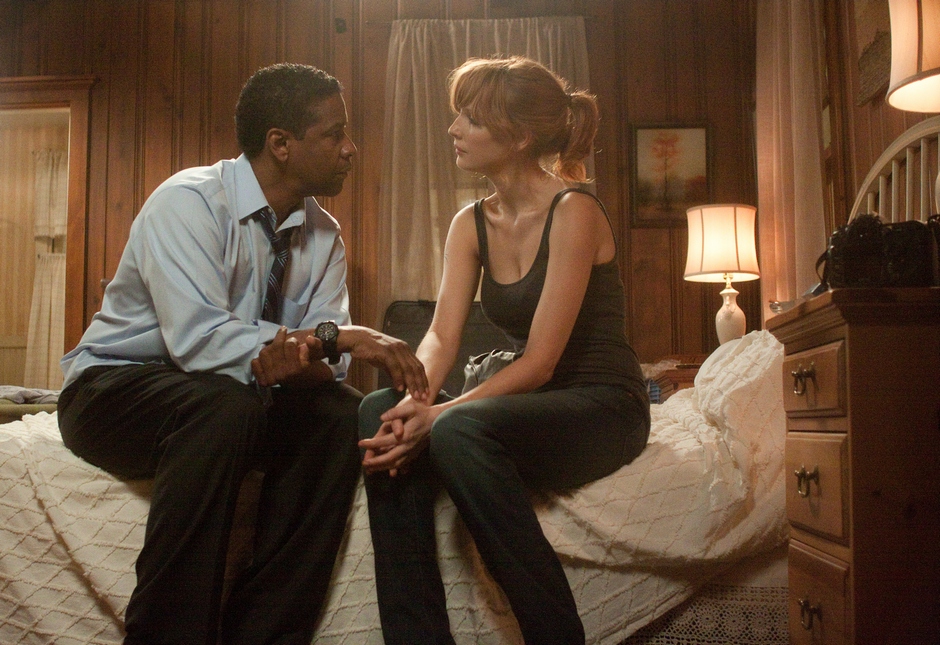
IF NOT FOR Denzel Washington’s soulful performance as an airline pilot, “Flight” might have never left the runway.  Make that a chain-smoking, vodka-guzzling airline pilot who wakes up, hung over in an Orlando motel room, but goes on to save the day after force-landing his plane in a field outside of Atlanta with 102 passengers aboard.  We’re used to seeing Washington in the stentorian sort of parts that win him Academy Awards, and this unlikely choice of a role will again keep him in the running for a third statue.  Washington is famous for his pearly smile and big-dog swagger, but here, he’s a man who, like the plane he flies, has lost what’s called all “vertical control.”

At the turbulent center of “Flight,” Whip Whitaker is the very definition of the anti-hero – or, the flawed warrior – and one that Washington has agonizingly brought to life. No one had to know that the Captain, who appeared sober when he boarded the plane that morning, was also high on cocaine, having partied into the early morning with one of his flight attendants.  That is, until a pesky toxicology report surfaces after the plane crashes, six lives are lost, and an investigation by the NationalTransportation Safety Board is opened on the causes of the accident.  Director Robert Zemeckis gave us possibly the most terrifying plane-crash scene in 2000’s “Castaway,” a film that similarly explores the painful truth that no man is an island, and “Flight” is a close second.  Zemeckis, known for the visual wizardry of “Back to the Future” and “Forrest Gump,” eschews the predictable aerial shots of the plane in a total nosedive for the pure panic within the cabin where a stewardess, knocked unconscious, ragdolls from floor to ceiling and passengers puke upside down.  The plane is later said to have dropped 4,800 feet per minute and you will feel every foot.

Sensitively scripted by John Gatis, “Flight” is about a different kind of nosedive, that is, Captain Whitaker’s ambivalent attempt to clear his name while, at the same time, cling to the addictive and destructive ways that led up to crash.  He has plenty of enablers around him, including his dealer (John Goodman) and lawyer (Don Cheadle), to ensure that he keeps off-track.  In big-budget Hollywood films such as this one, the twelve steps of rehab usually end in redemption, and “Flight” is no exception.  Whip’s guardian angel is another addict named Nicole (newcomer Kelly Reilly). Despite the fact that Zemeckis and Washington are famous for their flashiness, the most powerful scene in “Flight” is a virtually bare one: inside a hospital stairwell, sneaking a cigarette, Whip meets Nicole, still recovering from an overdose, and a cancer patient (James Badge Dale) from downstairs.  Each has been ravaged by disease in some way and Whitaker is forced, perhaps for the first time, to look at his casual disregard for his life and the lives of others.

When redemption does inevitably arrive in “Flight,” it’s played out in the most public and painful way possible and under the watchful eye of actress Melissa Leo as the Captain’s investigator.  Up until that point, the viewer knows what the public does not, that behind closed doors, the perceived hero behind the plane crash is, in fact, a deadbeat dad, a violent drunk, and in deep denial about his substance abuse.  Yes, he saved the day, but as many high-school drug counselors have been known to say, imagine what he could have accomplished had he not be out of his mind. In this way, “Flight” forces us to rethink some of the just-add-water heroization so prevalent in American culture post-911.   It also takes a hard, close look at addiction and its discontents.

Review: “Skyfall”

17 Saturday Nov 2012

Posted by colincarman in Film Reviews

≈ 23 Comments

Tags

007, action, adele, austin powers, ben winshaw, berenice marlohe, daniel craig, dr. evil, from russia with love, halle berry, james bond, javier bardem, madonna, naomie harris, octopussy, ola rapace, pierce brosnan, ralph fiennes, robert shaw, roger deakins, roger moore, sam mendes, sean connery, skyfall, spy, timothy dalton, ursula andress

“Gold Bond”

Grade: A-/B+ (SEE IT)

VAMPIRES, LINDSAY LOHAN, AGENT 007: some things never die. After the franchise flatliner that was 2008’s “Quantum of Solace,” James Bond bounces back to life in the Sam Mendes-directed “Skyfall.”  It’s staggering to think that 45 years ago, the fifth Bond film appeared under the title “You Only Live Twice,” starring its originator: the incomparable, martini-swilling Sean Connery.  He set the gold standard for a Bond as slyly confident undercover as he was under the covers. “Skyfall,” starring the sixth actor (Daniel Craig) to embody Ian Fleming’s hero of the British Secret Service, proves that Bond has more lives than that white cat on the lap of Dr. Evil. “You expect me to talk? Connery asked Goldfinger in the eponymous 1964 film.  “No. . .” replies Auric Goldfinger – all together now! – “I expect you to die.”

Not going to happen. The twenty-fourth Bond installment, “Skyfall” marks Craig’s third turn as 007 and the role, like his tailored silver suit, fits him like a glove. The action sequence that opens “Skyfall” – followed closely by the opening credits in which Adele belts the title song over an opus of a music video – plunges the viewer back into that world of improbable but entertaining stunts.  Set in Turkey, a fight atop a high-speed passenger train recalls the iconic fight scene of “From Russia with Love,” and Bond, like Bourne, appears to plunge to his death after Eve (Naomie Harris) takes a shot but misses.  The order comes from the all-seeing Judi Dench (as M) who won’t see her beloved Bond again until the offices of the MI6 are incinerated in a terrorist attack.  Ralph Fiennes, likely to serve a larger role in the forthcoming Bond films – Craig is contracted for two more – and Ben Winshaw (as the gadget-geek Q) are superb supporting cast members. Behind the camera, the cinematography of Roger (“No Country for Old Men”) Deakins is opulently lush, notably in the Macau chapter.

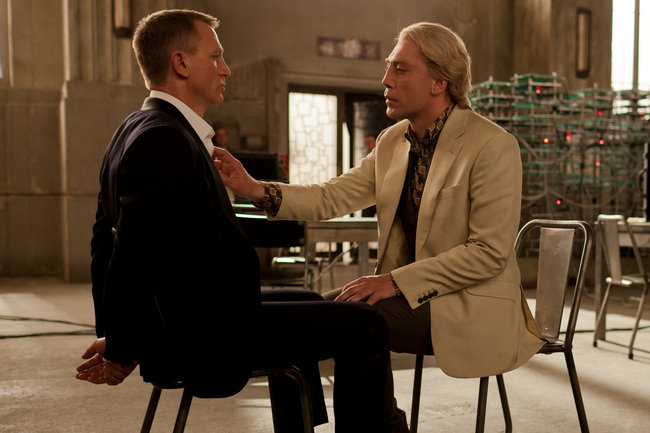
“Skyfall” could be the best Bondarama since Pierce Brosnan hang up his hat in 2002’s “Die Another Day.” That’s when Halle Berry rose, Ursula Andress-style, like a bikini’d nymph from the sea and Madonna offered a bizarre cameo as a lesbian fencing coach.  Ah, the Bondian world is a strange world indeed.  Recall the goofiness of the Roger Moore years when, in “Octopussy,” circus clowns were killed for smuggling Fabregé eggs and, in “Moonraker,” Bond orbited the earth in a space capsule.  Bond’s world is basically a hetero-male’s fantasy world designed for his pleasure.  Pussy Galore, Holly Goodhead; need we say more? That’s why the queering of Javier Bardem’s villainous Silva gives “Skyfall” a much-needed edge.  When Silva interrogates the agent, he draws in close, strokes Craig’s chiseled face and legs, and tells him not to be nervous as it’s his first time.  “What makes you think it’s my first time?” Bond shoots back.  The scene made the woman seated to my left uncomfortable – or was it the bottle of champagne she and her husband had stashed under the seat? – but the audience erupted in laughter.  Clearly, Mendes and screenwriters Neal Purvis, Robert Wade, and John Logan are having some fun with Bond’s archetypal straightness and forcing him (and us) to loosen up a little.

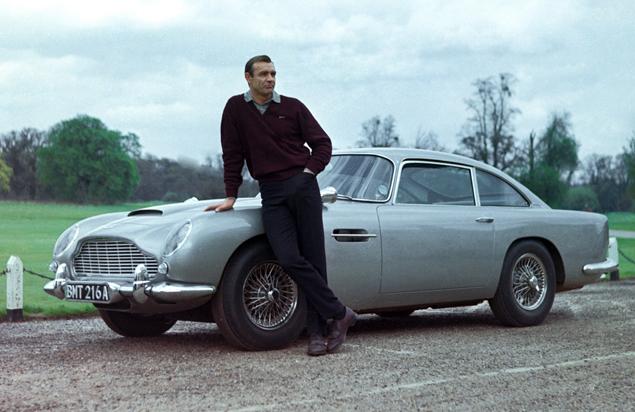
“Skyfall” also succeeds in large part because it looks back to the Cold War days – the reappearance of that classic chrome Aston Martin DB5 is a welcomed one – and because the conflict between Silva and MI6 is personally motivated. Bardem, whose yellowy wig is reminiscent of Robert Shaw’s peroxide coif in “From Russia with Love” (1963), was disfigured by another reckless call made by M and he’s out for revenge. Could Silva be based on Wiki-leaker Julian Assange?  He essentially duplicates the role of the killing machine he played in “No Country,” but he’s the right actor to simultaneously titillate and terrify.

Ever since Timothy Dalton took over as Bond in 1987’s “The Living Daylights,” an air of artificiality has hung over many of the later Bond films.  Product placement, mannequin-like models come (barely) to life, gadgets that are more Sky-Mall than “Skyfall” – many Bond flicks are like the golden corpses that litter 1964’s “Goldfinger,” roundly considered the best of the lot.   There is still no escaping some of these conventionalities.  Silva forces Bond to shoot a shot-glass, William Tell-style, off the head of a bleeding and bound Berenice Marlohe – a misogynistic spectacle indeed – and the final show-down at the Skyfall estate, where a young Bond grew up, is overlong and ultimately tedious.  Still, the backstory opens up some new territory for the franchise as it could continue to peer into Bond’s early years as an orphan in Scotland.

“Skyfall” is proof that a solid Bond – like a diamond – is forever.

Review: “Argo”

15 Monday Oct 2012

Posted by colincarman in Film Reviews

≈ 13 Comments

Tags

alan arkin, argo, ben affleck, bill clinton, bryan cranston, chris terrio, iran, iran hostage crisis, jimmy carter, john goodman, political thriller, tony mendez

“Not Without My Film Crew”

Grade: A- (SEE IT)

SO MANY FILMS purport to be “based on a true story” that the credit is now a cliché, a weak handshake at the start of a film that says: what you’re about to see is quote-unquote “true.”  “Argo,” which slaps this line onto its opening credits as well, is the only political thriller in recent memory to so seamlessly mesh the categories of historical veracity and Hollywood bogus, and that’s because “Argo” is the perfect mixture of fact and fiction, Middle Eastern unrest and California corniness.  Who would ever believe that the U.S. government actually attempted to solve the hostage crisis of the Carter administration by having its stranded citizens impersonate a Canadian film crew out scouting Iran?  They’re told to act like they’re making some “Barbarella”-esque sci-fi flick while, in actuality, they’re outrunning the watchful eye of the Ayatollah Khomeini?  Yet “Argo” calls forth another cliché: sometimes the truth is stranger than fiction.

With “Argo,” director Ben Affleck has left his native Boston – the setting for his first two crime films, “Gone Baby Gone” and “The Town” – for the international stage, specifically the Iran hostage crisis of 1979.  The film opens on a frenetic high point with Islamic militants storming the American Embassy in Tehran.  We watch nervously as American staffers scramble to incinerate classified documents and prepare for their inevitable capture.  Six staffers, however, manage to slip away and take refuge in the Canadian embassy, overseen by Victor Garber as Ambassador Ken Taylor.

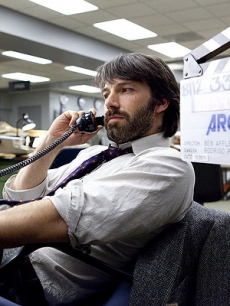
Soon after, damage control arrives in the form of Tony Mendez, a CIA expert in what’s known as “ex-filtration” (or getting out) and played by a Wookie’d Affleck himself in a shag haircut and beard.  As a period piece, “Argo” is meticulously vintage: soundtrack aside, it’s crammed with big frame glasses, Farah Fawcett hair, and butterfly collars.  Cigarette smoking is omnipresent, even on airplanes; so, too, is political conflict as U.S.-Iran relations sour fast and the prisoners’ hope for amnesty darkens.  Mendez’s superior is Jack O’Donnell (Bryan “Breaking Bad” Cranston in his first memorable film role) who doubts that Tony can pull it off, and for good reason: Tehran is a terrifying place with political dissidents hanging from construction cranes and irate merchants in the marketplace who threaten to ruin Mendez’s mission.

Back at home, the side-story set in Tinseltown is bright, funny, and serves to balance the intensities of the Tehran standoff.  As makeup artist John Chambers, there’s John Goodman alongside producer Lester Siegel (a typically cranky and jog-suited Alan Arkin).  Arkin, sharing a tender moment with Affleck before he’s Iran-bound, hears that the CIA man is estranged from his wife and ten-year-old son; will Mendez achieve his own form of homecoming?  His scenes with Goodman define comic relief; take, for example, Mendez’s first visit to Chambers’ movie trailer where he’s told: “Target audiences will hate it.”  “Who are they?” asks Affleck.  Goodman replies drolly: “People with eyes.”

Two other aspects of “Argo” make the plot, its excellent pacing, and nerve-wracking energy truly stick.  First, there’s the assembly of actors that Affleck cast as the six US staffers; each convey a genuine sense of purpose and panic.  Actors-turned-directors are especially attuned to good performers – Robert Redford and Sean Penn leap to mind – and Affleck is no exception.  His own performance is a bit of a puzzle, however; he’s often somber and understated, but he may have deliberately wanted his supporting cast, especially upstagers like Goodman and Arkin to take control. Second, Affleck is aided by a pulse-quickening script for which we not only have Bill Clinton to thank  – the President declassified the mission’s papers in the Nineties – but more importantly, Chris Terrio who based “Argo” on Mendez’s own account, “The Master of Disguise,” and a Wired article by Joshuah Bearman called “The Great Escape.”  Terrifically tense and taut, “Argo” is not just Affleck’s best directorial effort to date but one of 2012’s very best.  Make it your mission to see it.

Review: “The Perks of Being a Wallflower”

06 Saturday Oct 2012

Posted by colincarman in Film Reviews

≈ 5 Comments

Tags

drama, emma watson, ezra miller, gay, high school, logan lerman, melanie lynskey, paul rudd, stephen chbosky, the perks of being a wallflower, we need to talk about kevin

“Teenagers on the Verge of A Nervous Breakdown”

Grade: B- (RENT IT)

SOMETIMES WISE, SOMETIMES FUNNY, always infuriating, “The Perks of Being a Wallflower” is only a semi-success.  The source material is Stephen Chbosky’s eponymous coming-of-age novel, published in 1999 and adapted-directed by the author himself for the screen.  The film version of “The Perks” isn’t just a drama of adolescent angst but a retro playlist that, stuffed with Crowded House, The Smiths, and Cracker, alerts us to the film’s setting: Pittsburgh in the early Nineties.  Chbosky’s adaptation is a schizophrenic affair, however: admirably, it doesn’t shy away from the messiness of teenage sexuality, love and longing and yet many of its moment are so precious that they practically demand a collective “Aww” from the audience.  It’s a relief to not see much of the parents in “The Perks” though the kids, wise beyond their years, are too much like adults for the film to really strike a chord.  They’re already looking back.

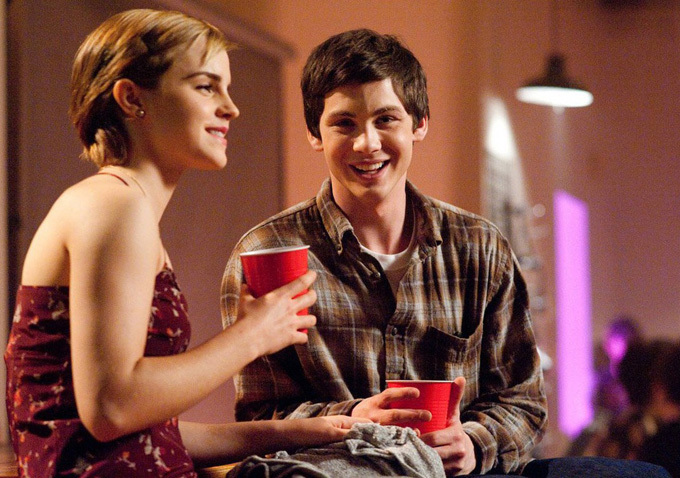
Our protagonist is Charlie (Logan Lerman), a burgeoning writer and nerdlet who has placed in Advanced English under the tutelage of Paul Rudd as a high school teacher supplying this freshman with Salinger and words of wisdom.  Charlie has survived two traumas: the suicide of his best friend and the  death of his aunt (Melanie Lynskey), which he may or may not have caused.  Flashbacks of that time  – a sure sign that a book is being compressed into film – swim in and out of focus.  After seeing an outlandish and openly gay upperclassman named Patrick act out in shop class, Charlie develops a fascination with his classmate and even scoots closer to him at a football game to introduce himself.  Enter Samantha as the third musketeer; she is played by a pixie-ish Emma Watson who has left Hogwarts behind for her first adult leading role only to be upstaged by Ezra Miller as stepbrother Patrick.  (Miller made our blood run cold as the sociopathic Kevin in last year’s “We Need to Talk About Kevin,” and he proves once again to be a fearless and funny scene-stealer.)  Patrick has been carrying on a secret relationship with a closeted quarterback and Sam has a reputation of sorts.  They welcome Charlie to what they describe as their “island of misfit toys.”

The three actors have terrific chemistry together despite the fact that their get-togethers and traditions are completely implausible.  Since when do high schoolers host Christmas parties only to exchange presents like antique typewriters and men’s suits?  Sam and Patrick say things like “It’s rock and roll!” and, taking over the school dance to bust a move to “Come on Eileen,” Patrick reels: “This is what fun looks like!”  The line lands with a thud only because American teenagers haven’t said such things without irony since they wore poodle-skirts and tuned in for “My Three Sons.”  The Nineties were never this nice.  Chbosky smartly undercuts such phony sentimentality at key moments, like when Charlie abruptly tells Sam that his friend shot himself or when he discovers Patrick and the quarterback kissing in an upstairs room, but like any act of nostalgia, “The Perks” is closer to how one might want to remember high school rather than the actual experience.  The Eucharist melts into a hit of LSD; Charlie is given pot brownies and admits he’s “baked like a cake.”  This is the stuff of real adolescence rather than the stuff that dreams are made of.  Less floweriness, more ferocity.

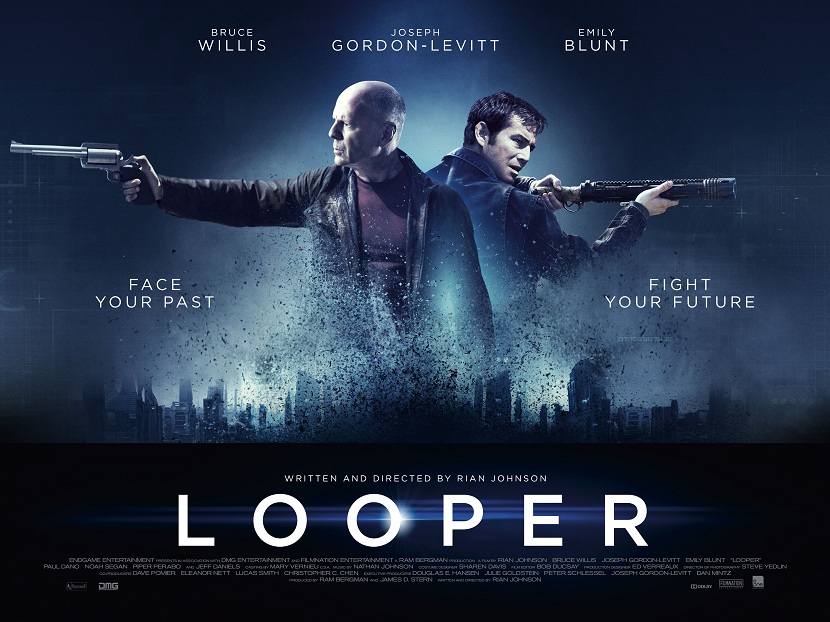
Review: “Looper”

30 Sunday Sep 2012

Posted by colincarman in Film Reviews

≈ 21 Comments

Tags

brick, bruce willis, emily blunt, george orwell, joseph gordon levitt, looper, paul dano, pierce gangon, piper perabo, rian johnson, science fiction

“Killing Time”

Grade: B+ (RENT IT)

 “IF YOU WANT a vision of the future,” George Orwell once remarked, “imagine a boot stamping on a human face – forever.”  If that’s a grim forecast, it’s also a strikingly apropos one in relation to “Looper,” a dystopic sci-fi flick from writer-director Rian Johnson (“Brick,” “The “Brothers Bloom”).  It’s the second best science fiction film of 2012, after the even loopier “Prometheus.”

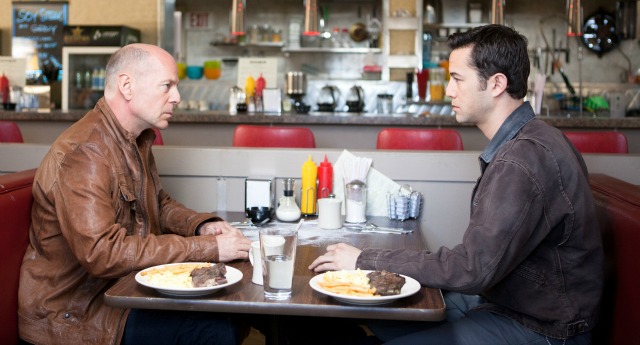
The face-stamping boot in “Looper” belongs to Bruce Willis (old Joe), a contract killer working for a crime syndicate in the future, who returns to the year 2044 to confront a younger version of himself (played by Joseph Gordon-Levitt).  Because time travel has been outlawed, young Joe is a bad guy (and a junkie), a “looper” hired to, as he puts it, “take out the future’s garbage.”  He works a remote corner of a cane-field in Kansas where his victims suddenly appear, hands-tied, head-bagged, ready for a shotgun blast to the chest.  The executions are carried out like clockwork until, of course, there’s a glitch in the “Terminator”-like system.

Unbeknownst to him, Joe’s bosses in the future have sent the old Joe back in time to be killed by the young Joe and effectively close the loop.  We never see the evil genius known as the Rainmaker, busy sending old loopers thirty years back in time to be shot down by their former selves.  Joe’s friend Seth (Paul Dano) suffers this gory fate early on in the film.  Watch as a young Seth is cut down, limb by limb, in the present, his wounds materializing in the future.  Don’t worry; the temporal antics of “Looper” won’t be on the test.

Johnson’s plot line is intricate whereas personal matters in “Looper” are fairly old-timey.  There’s a prostitute (Piper Perabo) who keeps the young Joe drugged and confused, and, in the farm house nearby his killing floor, a single mom named Sara (a butch Emily Blunt) keeping a close watch over her precocious son Cid (Pierce Gangon).  Could Cid be one of the three kids that the old Joe is dead-set on exterminating?  The uncanny Gangon has special powers, which I won’t reveal here, but he could be the creepiest kid on film since the tricycle-riding Danny Lloyd in Kubrick’s “The Shining.”  Blunt, meanwhile, who has the Midas touch in picking scripts, never gives a bad performance and she offers the film some much-need pathos.  She shelters Joe, from old Joe and from the truth, and in the end, young Joe returns the favor in a sacrificial last act.

The only misstep in “Looper” was a needless effort to make Gordon-Levitt look like Bruce Willis.  A plaster mold of Willis was cast to help the young actor resemble the iconic action film star.  Fitted with a putty nose and prosthetic upper-lip, young Joe looks more like a glass-eyed Howdy Doody doll than the moonlighting star of yesteryear.  And because science fiction is always already not the real world, this turns our anti-hero into something even further unreal and distracts the audience.  The gun violence is gratuitous as well, and though it happens off-screen, watching children getting shot at close range threw me for a loop.  It goes without saying that if the older version of myself in 2042 got in touch with me now, I’d be asking for stock tips, Super Bowl wins, Lotto numbers, and other money-making factoids, not whom to kill and when and where.  But that’s the real world not the movies.

“Prometheus” aside, “Looper” could be the most inventive science-fiction film of 2012; what is your vote for best action/sci-fi film of the year thus far?

Reviews: “Arbitrage” and “The Master”

24 Monday Sep 2012

Posted by colincarman in Film Reviews

≈ 7 Comments

Tags

amy adams, arbitrage, brit marling, cult, drama, irving berlin, joaquin phoenix, l. ron hubbard, laura dern, nate parker, nicholas jarecki, paul thomas anderson, philip seymour hoffman, richard gere, scientology, susan sarandon, the master, tim roth, tom cruise

“Cult of Personality”

“Arbitrage” (B+; SEE IT)

WHAT’S A BILLIONAIRE to do when he falls asleep at the wheel with his French mistress in the passenger seat?  This, after losing 400 million dollars in a failed investment and having to dodge questions by his only daughter (also his chief accountant), who suspects the books have been cooked.

What, also, happens when a half-mad and alcoholic veteran of World War II named Freddie Quell becomes the disciple of a charismatic cult leader named Lancaster Dodd, a man who lures him into his inner circle only to treat him like something of a lab rat?  Okay, make that his favorite lab rat.

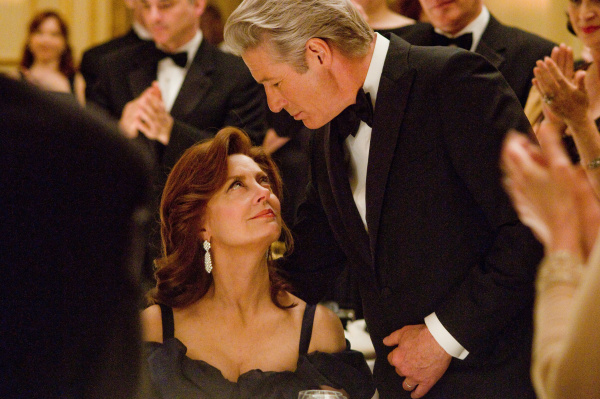
These are the twin dilemmas at the core of two superb new dramas, “Arbitrage” and “The Master,” respectively.  Crying out for Oscar gold, both are performance-driven films that revel in man’s fallibility and will to power.  In the former, Richard Gere plays Robert Miller, a great white shark of Wall Street in tailored suits and an elegant penthouse shared by wife Ellen (Susan Sarandon).  Her nightly mantra is “Working late again, honey?” when, in reality, she knows more than you (and husband Robert) think.  Miller has gone on deceiving Ellen and his investors long enough when a freak car accident turns his life (and luxury sedan) upside down.  Without a fixer like Michael Clayton of his own on speed-dial, he flees the scene and calls on Jimmy Grant (Nate Parker), the son of his chauffeur, to ferry him back to Manhattan and pretend as if nothing ever happened.

The live-in butler who sees Miller burning his clothes in a trash can later that night is nothing compared to NYPD detective Michael Bryer (played by Tim Roth), who doggedly pursues the billionaire with questions  and accusations.  Something of an Inspector Javier, he tells a fellow investigator: “He doesn’t get to walk just because he’s on CNBC.”  First-time director Nicholas Jarecki is the son of husband-and-wife commodity traders – his half brothers are also the documentarians responsible for “Why We Fight” and “Capturing the Friedmans” – which means that film and finance are what the Jarecki family do best.  Driven by Gere’s anti-hero, Jarecki’s plot is intriguingly layered but really no more complicated than your average episode of “The Good Wife” or “Law and Order.”  Instead “Arbitrage” is a character study, powered, as it is, by excellent pacing and a memorable performance by Richard Gere, long overlooked because of, well, his looks and box-office appeal.

Yet Gere, now a silvery 62, has challenged himself as of late – recall his happy hands in Chicago and the wounded rage of his cuckold in Unfaithful – and is no doubt deserving of film-acting’s highest honor for his dead-on embodiment of a hedge-fund manager trying to keep his castle from crumbling.  When he meets his daughter Brooke (Brit Marling) for a screaming match in Central Park, you will be convinced of this fact.  Watch also as Gere and Sarandon go for each other’s throats later in the film: dressed for another glamorous gala, Ellen is wielding a cocktail and divorce papers while husband Robert is still hiding the ribs he fractured and the forehead he sliced open during his auto accident.  Learning of Brooke’s disappointment in him, he informs Ellen: “The world is cold.”  Sarandon, dead-set on revenge, shoots back: “Then you’re going to need a warm coat.”

“The Master” (A; SEE IT)

BABY, IT’S COLD OUTSIDE, especially so in the dark and unsettling orbit of Paul Thomas Anderson’s latest stroke of genius, “The Master,” which is a different animal altogether though its characters are driven by the same sins – greed, hubris, betrayal – that make “Arbitrage” crackle.  Anderson doesn’t so much make films as he explodes the limits of first-grade filmmaking.  His style zigzags from work to work – how can the neon lubes and lotions of “Boogie Nights” and the hot petrol that oozes through “There Will Be Blood” come from the same source? – but his six feature films are united by a detailed attention to American men living in extremis.  Anderson sees the silver screen as a dissection pan.  Think of Dirk Diggler, the porn god, Barry Egan, the neurotic collector of coupons, Edward L. Doheny, the ruthless oil tycoon, and now, Lancaster Dodd who – Tom Cruise, plug your ears – is some unauthorized version of Scientology founder, L. Ron Hubbard, with his pseudo-scientific, spiritual movement he calls the Cause.  He promises his followers paradise and perfection, but he’s probably just preying on their insecurities, and in Freddie Quell, he’s found a veritable wellspring of weaknesses to exploit and control.  He subjects Quell (who won’t, or can’t be, quelled) to “The Process,” a Q-and-A session in which subjects cannot blink or look away from their interrogator.  Laura Dern plays a wealthy benefactor who keeps Dodd’s boat afloat and, for a little while, above the law.

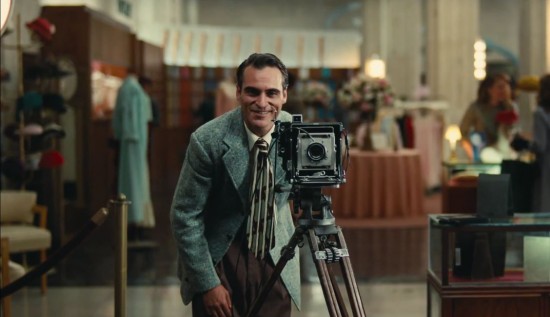
“The Master” is really a study of the disciple, Freddie, however.  After a brief hiatus from acting (and face-shaving), Joaquin Phoenix comes roaring back to the screen as the war-ravaged and shattered Freddie.  He looks markedly older than he did in 2005’s “Walk the Line,” and his face is a twisted wreck of anger and anguish.  Freddie is the id to Dodd’s super-ego: all animal, stinking of the alcoholic concoction he makes from paint thinner and cleaning supplies and looking for a fight as a department-store photographer.  He’s also a bully and in one confounding scene, strangles a man sitting for a portrait with his own necktie.  Anderson gives us the smiling faces of postwar American families, but this is not the America Freddie feels he can call home.  A military doctor, administering a Rorschach inkblot test – Freddie sees only sex and genitals – tells him presciently: There will be people “on the outside” who fail to understand you.

On the outside, he stumbles onto a cruise-liner and falls for Dodd, a figure of some sagacity but also somewhat sinister; he’s expertly rendered by the indomitable Philip Seymour Hoffman. I use the romantic “falls for” because the men’s relationship is another Rorschach test: you might see them as repressed lovers, frenemies, or even God and Lucifer locked in mortal conflict.  (The inclusion of the Irving Berlin song “Get Thee Behind Me Satan,” from 1936, alerts us to the metaphysical conflict at the heart of “The Master.”)   As Dodd’s wife, Peggy, Amy Adams is on hand to temper the men’s feelings for each other.  In another strange scene, we see a heavily pregnant Peggy seated naked in a living room chair while her husband’s other female followers flit around the room, also nude, while the men of the Cause look on with without any sign of desire or emotion.  That’s because all of the emotion, all of the animal energy, is found in Freddie who becomes his master’s fiercest defender and bulldog.  Question the science of Dodd’s practices at a polite social gathering and you’ll have Freddie waiting out back to slap you around for your irreverance.  “You like be told what to do,” Dodd tells Freddie at one point, which, crucially, tells us that “The Master” is about what makes the cult of personality really click.  It’s the dissection of Freddie Quell, but also a study in group psychology and the unspoken laws that make masters of very few and slaves of us all.  In fact, watching “The Master” feels like psychotherapy: slow and uncomfortable at times.

But what really makes “The Master” a masterwork is that, like any lasting work of art, it’s not so much a film, but an outcry.

Best Film of the Summer: “Beasts of the Southern Wild”

14 Friday Sep 2012

Posted by colincarman in Film Reviews

≈ 4 Comments

Tags

beasts of the southern wild, ben richardson, ben zeitlin, bob dylan, dwight henry, lucy alibar, quvenzhane wallis, september 11

“Swamped”

Grade: A- (SEE IT)

I’VE GOT BOB DYLAN on the brain this week, what with the release of his 35th studio album, “Tempest,” and upcoming visit to the Mile High City.  The dark prophet, now 71 years old, has been singing of rising sea-levels for some time now.  His 13-minute narration of the Titanic’s sinking (“Tempest”) is just an extension of 1964’s “The Times Are A’Changin’” – “Admit that the waters around you have grown” – and more recently, this forecast: “High water risin’/The shacks are slidin’ down/Folks lose their possessions/Folks are leaving town.”  Dylan peers into the future and sees only diaspora and disaster.

That last lyric of his comes from “High Water,” released on September 11, 2001, and it was eerily appropriate that on the eleventh anniversary of 9-11, I caught Benh Zeitlin’s “Beasts of the Southern Wild,” a sensation at both Sundance and Cannes and deservedly so.  This savage beauty of a film has all the bluesy magic of the late Dylan and shares his sense that humanity, on the brink of being swamped, should go on singin’ and dancin’.  Set in the Gulf of Mexico, “Beasts” is something of an eco-fable; the ragtag residents of a territory known as the Bathtub are bracing themselves for another disastrous storm.  Separated by a levee, they live close to the earth, so close, in fact, that they’re a bit beastly themselves: cinematographer Ben Richardson’s camera plunges us into the vats of writhing crawfish, chicken carcasses, and alligators stuffed with explosives.  “Beasts” is an exercise in magic realism that gets down in the muck and mire.  “Every animal is made of meat,” one of the Bathtub’s residents teaches the children, “It’s the buffet of the universe.”

At the eye of the storm is a motherless six-year-old named Hushpuppy (Quvenzhané Wallis) who occupies a filthy shack beside her father Wink (Dwight Henry).  Before she burns it down, her shack is decorated with sports jerseys and jawbones; she keeps a football helmet in the freezer, which she dons when lighting her stove with a blowtorch.  She has a preternatural connection with the animal world around her.  Putting her ear to the heart of a chickadee, she tells us “Sometimes they be talkin’ in codes.”  The little actress beat out 4,000 other girls to win the role and the fourth-grader will likely become the youngest actor ever nominated for an Academy Award.

“Beasts of the Southern Wild” is a survivalist tale: Wink is dying of drink and disease and Hushpuppy must soldier on in the face of poverty and climate change.  She is the embodiment of the human will, but in yellow underpants and rubber boots.  Her father calls her “little man” and the two square off with a brutal sort of love for each other.  Is Hushpuppy the real beast of Zeitlin’s film, which he based on Lucy Alibar’s stage play, “Juicy and Delicious”?  Or is it the herd of prehistoric boars she imagines roaming the bayou and shaking the very earth beneath her feet?   Equally beastly are the governmental workers who try to quarantine the Bathtub residents though they can’t, or won’t, be contained.  At a climactic moment, when Hushpuppy stands fearlessly before these beasts of her imagination, I was brought suddenly to tears.  The film’s raw emotionality is earned; its earthiness induces nausea.  I laughed, cried, and for 90 minutes, wanted to throw up; what more could you want from a film?

“Beasts” wants us to see the abjection of American life up-close and you’ll need an iron gut to stomach Zeitlin’s stroke of genius.  As Dylan once warned, “You better start swimmin’ or you’ll sink like a stone.”

Review: “The Words”

08 Saturday Sep 2012

Posted by colincarman in Film Reviews

≈ 7 Comments

Tags

ben barnes, bradley cooper, brian klugman, dennis quaid, drama, hemingway, jeremy irons, lee sternthal, nora amezeder, olivia wilde, the words, zoe saldana


“My Word!”

Grade: B- (RENT IT)

“DON’T YOU KNOW words ruin everything!”  That’s Dennis Quaid, as novelist Clay Hammond, in “The Words,” a morality play on the perils of plagiarism.  Written and directed by Brian Klugman and Lee Sternthal, “The Words” is also the title of Hammond’s newest novel, which tells the tale of a young writer named Rory Jansen (Bradley Cooper) struggling to find literary stardom.

If that sounds like a story-within-a-story,  that’s because “The Words” is a three-tiered narrative in which Hammond pulls the Thackeray-like strings,  giving a public reading of his new work and attracting the attention of his number one fan (Olivia Wilde).  Quaid duplicates the arrogant professor role he played in 2008’s “Smart People” – could this tepid performance be a form of self-plagiarism? – and his lifeless narration drains “The Words” of much of its energy.  Still, the tale he tells is an absorbing one:  rejection letter after rejection letter, Rory is turned away for writing books described by literary agents as too “interior.”  Honeymooning in Paris, he finds, while antiquing, a yellowed and unpublished manuscript sealed inside a suitcase.  That manuscript, which Rory promptly publishes as his own, is entitled “The Window Tears,” and it brings Rory immediate commercial and critical success.  Rory’s own number one fan is his randy wife Dora (Zoë Saldana) who believes wholeheartedly in her husband’s potential, that is, until his literary lie is revealed.  After reading Rory’s new novel, she tells him: “there are parts of you in this novel never seen before.”

The problem is that Rory’s best work yet has been seen before: by its actual author (a commanding Jeremy Irons) who comes out of the woodwork to confront Rory with his plagiarism.  Known as the Old Man, the Irons character has yet another tale to impart and he does so on a bench in Central Park.  This third narrative, told in flashbacks, is more urgent than the others because it’s undoubtedly his own: as a young man (played by Ben Barnes) in 1940s France, he wrote “The Window Tears” in the wake of his baby girl’s death only for the manuscript to be lost by his waitress wife (Nora Amezeder).  This inner-most story in “The Words” mirrors the real-life legend of Hemingway’s first wife who lost Papa’s unpublished writings in 1922 and because of it, lost Hemingway’s love and trust forever.

Since his breakout performance in “The Hangover,” Bradley Cooper has sobered up and partaken in more intelligent fare.  The problem is that for a film about the pitfalls of plagiarism and the pressures of originality, clichés abound.  Writers on screen are usually portrayed as selfish sadsacks, and Rory is no exception; he’s a well-groomed thirysomething still hitting his father up for money.  Given, however, his robust wardrobe, Cooper looks more like an assistant editor at Men’s Journal than he does a Franzenish raconteur.  Lukewarm, “The Words” is a noble effort with only modest results.   It’s as if “The Words,” which is neither boring nor exciting, was written in invisible ink.

Review: “Celeste and Jesse Forever”

01 Saturday Sep 2012

Posted by colincarman in Film Reviews

≈ 7 Comments

Tags

andy samburg, ari graynor, celeste and jesse forever, chris messina, comedy, divorce, eric christian olsen, rashida jones, romantic, will mccormack

“Love You, Mean It!”

Grade: A- (SEE IT)

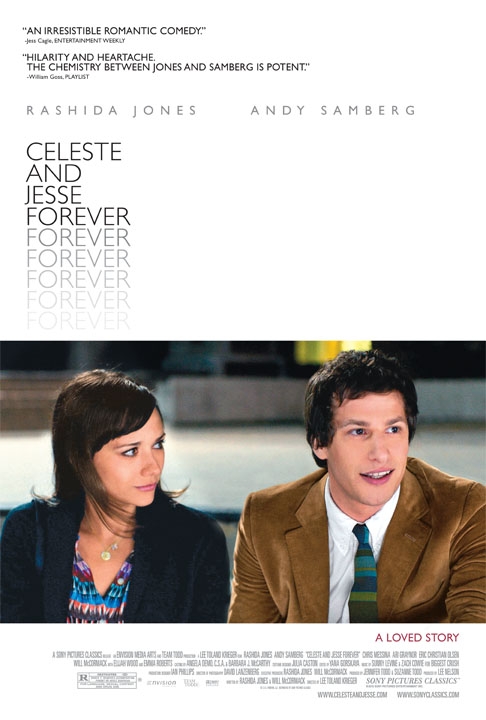
APPARENTLY IF YOU want to play a smart, complicated woman on screen – the kind Hollywood still has trouble conceiving – you have to write the role yourself.

That’s what Rashida Jones did, with a little help from her “Parks and Recreation” costar Will McCormack, to create the breakup comedy “Celeste and Jesse Forever.”  Not exactly a romance, Jones’ screenwriting debut is a charming and contemporary take on what’s become as common as matrimony itself: divorce (the amicable kind).  This film, which feels fresh and is stuffed with slang, centers on the neurotic Celeste: excessive exerciser, Facebook stalker, pot-smoking author of a book on declining American culture called “Shitegeist.”  If Celeste is an irritating character – deceiving herself that she’s actually over her ex – it’s because she feels relatably lifelike.

Directed by Lee Toland Krieger, “Celeste” was filmed in just 23 days for under $1 million.  Consequently, the performances have an honest, improvisational inflection as if the actors are actually friends.  That’s because they are: Jones and McCormack, who briefly dated in real life, would simulate sex acts using baby-corn and Chapstick when suffering from writer’s block.  Here, they have their fictional counterparts (Celeste and Jesse) do the same while in the car and at the wedding of friends Tucker (Eric Christian Olsen) and Beth (Ari Graynor), the latter of whom abruptly leaves a dinner because she objects to the divorced couple’s closeness.  There’s nothing but truth-telling in “Celeste and Jesse Forever”; “I go to yoga to meet girls” confesses Celeste’s love-interest Paul (the always dependable Chris Messina).  Namaste!

Andy Samburg (“I Love You, Man”) plays Jesse, an oversensitive visual artist living in Celeste’s spare room and suspended in a kind of romantic abeyance while the ink on the divorce papers dries. Ex-wifey is none too happy when Jesse  rebounds in a matter of months and, we’re told, “puts a baby in a lady.”  When Celeste phones Jesse to help her assemble an IKEA purchase, the two turn to red wine and reminiscing.  We all know where that leads.  Rewind to when we first met the hipster couple at the film’s opening and we’re not exactly sure what Celeste and Jesse mean to each other as they drive around Los Angeles, cracking inside jokes with their scorched-earth sense of humor.  Jesse reminds his soon-to-be-ex-wife that she dislikes the sight of architect Frank Gehry’s Disney Hall, that blasted tuna can of a landmark and an important metaphor for the couple’s romantic life: open and messy and, well, kinda’ lovely.

← Older posts
Newer posts →

Unknown's avatar

Recent Posts

  • Review: “Monsters: The Lyle and Erik Menéndez Story” (Netflix; 2024)
  • Sign Posts!
  • What Killed Jane Austen?
  • Was Austen a Holy Roller?
  • 5 Objects of Vivid Interest

Enter your email address to subscribe to this blog and receive notifications of new posts by email.

Join 256 other subscribers

Top Posts & Pages

  • Colin Carman

Jane Austen

action alien alpha dog amanda seyfried animals anton yelchin blue valentine bradley cooper brad pitt bromance carey mulligan charlize theron chawton christina hendricks christopher plummer colin farrell comedy crazy stupid love crime daniel craig dickens dracula drama emma stone england ewan mcgregor family frankenstein freud gay george clooney hampshire hbo horror jack russell terrier Jane Austen jessica chastain john lithgow joseph gordon levitt jude law kurt cobain mad men madonna mansfield park mary shelley matthew mcconaughey michael fassbender naomi watts oscars paris paul rudd philip seymour hoffman poetry politics portsmouth pride and prejudice romantic romantic comedy ryan gosling science fiction september 11 sex shakespeare shelley steven soderbergh summer blockbuster the hangover the help the social network thriller tim burton true blood twilight vampires viola davis

Blog Stats

  • 55,918 hits
  • RSS - Posts
  • RSS - Comments

Colin Carman Twitter

Tweets by ColinCarman

Colin Carman

Colin Carman

Archives

  • January 2025
  • July 2019
  • May 2013
  • April 2013
  • March 2013
  • February 2013
  • January 2013
  • December 2012
  • November 2012
  • October 2012
  • September 2012
  • August 2012
  • July 2012
  • June 2012
  • May 2012
  • April 2012
  • March 2012
  • February 2012
  • January 2012
  • December 2011
  • November 2011
  • October 2011
  • September 2011
  • August 2011
  • July 2011

Blogroll

  • Cinema Train
  • Dan the Man's Movie Reviews
  • Fogs' Movie Reviews

Category Cloud

Film Reviews Jane Austen Poems and Plogs (Poem-Blogs) Uncategorized

Blog at WordPress.com.

  • Subscribe Subscribed
    • Colin Carman
    • Join 171 other subscribers
    • Already have a WordPress.com account? Log in now.
    • Colin Carman
    • Subscribe Subscribed
    • Sign up
    • Log in
    • Report this content
    • View site in Reader
    • Manage subscriptions
    • Collapse this bar
 

Loading Comments...