
• Review: “The Great Gatsby”
  • Review: “Mud”
  • Review: “The Place Beyond the Pines”
  • Review: “Ginger & Rosa”
  • Review: “Stoker”
  • Review: “Side Effects”
  • Review: “Mama”
  • Review: “Zero Dark Thirty”
  • Review: “Gangster Squad”
  • Review: “Les Misérables”
  • Review: “This Is 40”
  • Review: “Any Day Now”
  • Review: “Anna Karenina”
  • Review: “Silver Linings Playbook”
  • Review: “Hitchcock”
  • Review: “Lincoln”
  • Review: “Life of Pi”
  • Review: “Flight”
  • Review: “Skyfall”
  • Review: “Argo”
  • Review: “The Perks of Being a Wallflower”
  • Review: “Looper”
  • Reviews: “Arbitrage” and “The Master”
  • Review: “The Words”
  • Review: “Celeste and Jesse Forever”
  • Review: “Lawless”
  • Review: “The Campaign”
  • Review: “Total Recall”
  • Review: “To Rome with Love”
  • Review: “The Dark Knight Rises”
  • Review: “Moonrise Kingdom”
  • Review: “Magic Mike”
  • Review: “The Amazing Spider-Man”
  • Review: “Brave”
  • Review: “Abraham Lincoln: Vampire Hunter”
  • Review: “Prometheus”
  • Review: “Snow White and the Huntsman”
  • Review: “Bernie”
  • Review: “The Dictator”
  • Review: “The Raven”
  • Reviews: “Salmon Fishing in the Yemen” and “Jiro Dreams of Sushi”
  • Review: “Chimpanzee”
  • Review: “The Cabin in the Woods”
  • Review: “American Reunion”
  • Review: “Detachment”
  • Review: “The Hunger Games”
  • Review: “Casablanca” (In Re-Release; 1 Night Only)
  • Review: “Silent House”
  • Review: “Wanderlust”
  • Review: “This Means War”
  • Review: “Safe House”
  • Review: “The Woman In Black”
  • Review: “The Grey”
  • Review: “Extremely Loud & Incredibly Close”
  • Review: “Contraband”
  • Review: “Shame” and “Young Adult”
  • Review: “War Horse”
  • Review: “The Girl with the Dragon Tattoo”
  • Review: “Like Crazy”
  • Review: “Hugo”
  • Review: “The Descendants”
  • Review: “My Week with Marilyn”
  • Review: “J. Edgar”
  • Review: “In Time”
  • Review: “Take Shelter”
  • Review: “The Thing”
  • Review: “The Ides of March”
  • Review: “Dream House”
  • Review: “50/50”
  • Review: “Moneyball”
  • Review: “Abduction”
  • Review: “Drive”
  • Review: “Contagion”
  • Review: “The Debt”
  • Review: “Our Idiot Brother”
  • Review: “The Help”
  • Review: “Fright Night”
  • Review: “Beginners”
  • Review: “Crazy Stupid Love”
  • Review: “Rise of the Planet of the Apes”

Colin Carman

~ Jane Austen Scholar & Culture Vulture

Colin Carman

Tag Archives: world war I

Review: “Extremely Loud & Incredibly Close”

26 Thursday Jan 2012

Posted by colincarman in Film Reviews

≈ 10 Comments

Tags

asperger's syndrome, david foster wallace, drama, eric roth, extremely loud & incredibly close, jeffrey, jeffrey wright, john updike, jonathan safran foer, max von sydow, sandra bullock, september 11, stephen daldry, thomas horn, tolkien, tom hanks, viola davis, world war I

“Building a Mystery”

Grade: B (RENT IT)

IT’S BEEN A dark decade for America. Our economy crumbled in the terrifying, twin shadows cast by the events of September 11, 2001, or as it’s remembered in Stephen Daldry’s new drama, “Extremely Loud & Incredibly Close,” the “worst day.”  The film begins in the wake of that worst day as Oskar Schell, our 11-year-old protagonist and wunderkind, attends his father’s funeral alongside mother Linda (a muted Sandra Bullock in mournful beige).  The Schells are interring the empty casket of father Thomas (played by Tom Hanks in flashbacks) and, seated apart inside a limousine, strike us as not the closest mother and son.  “Extremely Loud & Incredibly Close” is about the hard work of recovering that interpersonal closeness, of living loudly in the face of seemingly insurmountable loss.  A victim of the 9/11 attacks, Thomas leaves behind a key, and like Chekov’s gun, that key has to open something by the last act.  It comes with the cryptic word “Black,” and soon enough, with the names of 472 New York residents named Black, Oskar sets out to unlock the mystery.  Along the way he meets a fine supporting cast including Viola Davis (“The Help”), Jeffrey Wright (“The Ides of March”), and Max von Sydow (in an Oscar-nominated role as the speechless “Renter” and Oskar’s guardian angel).
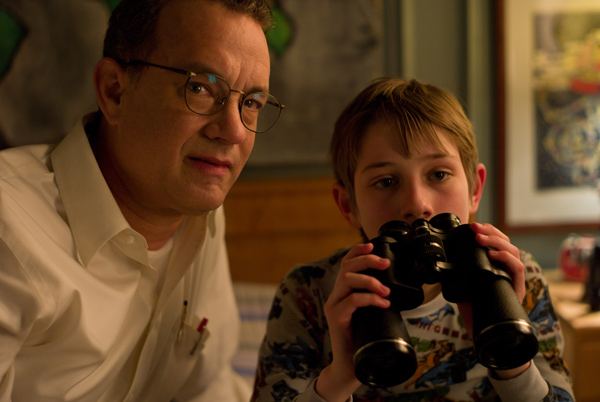
In Oskar’s memories of his father, Thomas Schell towers over him like a demigod: a map-maker who builds puzzles for his prodigy son to solve, an intellectual who searches The New York Times each morning for grammatical typos, a jeweler who leaves behind the ultimate treasure-hunt (another cartographic conundrum involving a mythical “Sixth Borough”) for his son to solve.   Mr. Hanks remains one of cinema’s most likeable leading men, and buried, as he is here, by the rubble of Oskar’s grief, his warm presence radiates throughout.  The warmly-lit interior of the Schells’ Upper West Side apartment is a refuge from the senseless world outside and within it, father and son wage a war of oxymorons with Thomas shouting “Now then” and “Found missing” to little Oscar’s retort: “Jumbo shrimp!”

In adapting the 2005 novel by Jonathan Safran Foer, screenwriter Eric Roth (“Forrest Gump,” “The Insider”) retains much of the high jinks and gimmickry – close-ups of elephants tears, YES and NO written on palms, even the flip-book that concluded the novel and sent the image of a falling man back up into the World Trade Center – that divided readers of the novel, which delivered on David Foster Wallace’s call to construct postmodern narratives with an unironic heart.  Yet the most affecting scene of the film is its sparest: an angry Oskar, confounded by the senselessness of his dad’s death, tells Linda: “I wish it had been you.”  We’re not a little shocked when Linda doesn’t strike him but responds with “So do I.”  If only Roth had preserved the conclusion to Foer’s novel in which Oskar finally understands his mother’s own ordeal, telling us, on the page: “Her looking over me was a complicated as anything ever could be.  But it was also incredibly simple.  In my only life, she was my mom, and I was her son.”

And the page is where Foer’s Oskar Schell belongs because on screen, he comes across as petulant and not a little irritating.  As Oskar, newcomer Thomas Horn over-enunciates his lines and lacks the warm relatability that an actor like Hanks has in spades.  He comes across as that precocious little boy who sidles up to the adults table at family functions to show off his knowledge of Tolkien and trigonometry, the one whose mother has to politely ask him to play with the other children.  There’s a suggestion that Oskar suffers from Asperger’s syndrome, but it’s never developed and it’s a shame because his most puzzling behaviors, like hiding the answering machine on which his father left his final messages and replacing it with a new one to keep his mother in the dark, make no sense on the screen whereas the literary Oskar, as the novel’s narrator, is easier to sympathize with.

Foer’s novel wasn’t to everyone’s liking – described as “overextended and sentimentally watery,” it took a drubbing by the late great John Updike in a 2005 review in The New Yorker ­– but it’s naïve to think that a fictionalization involving September 11th survivors could ever please everyone.

It’s not, as many have alleged, that “Extremely Loud & Incredibly Close” is exploitative.  Rather, it’s manipulative and especially so on screen, stripped of the pacifistic and political dimensions of Foer’s novel, which forced us to bring a brain and heart.  Daldry’s reductive take on that work asks only that we bring our Kleenex.

Review: “War Horse”

26 Monday Dec 2011

Posted by colincarman in Film Reviews

≈ 10 Comments

Tags

battle of somme, black beauty, celine buckens, emily watson, horses, janusz kaminski, jeremy irvine, nick stafford, niels arestrup, peter mullan, saving private ryan, seabiscuit, secretariat, shakespeare, spielberg, the godfather, war, war horse, world war I

“More than the Somme of Its Parts?”
Grade: C+ (Rent It)

WHEN WILL HOLLYWOOD stop horsing around?  From “Black Beauty” and “The Black Stallion” to “Seabiscuit” and “Secretariat,” equus ferus caballus, otherwise known as “the horse,” is rivaled only by our other favorite quadruped, the dog, for sheer screen time.  Wouldn’t the lasting power of “The Godfather” be somewhat diminished had studio head Jack Woltz awakened not to the severed head of his racehorse buried in those satin sheets but to a headless Fido or Rufus?

Early on in the new Spielbergian spectacle called “War Horse” a British soldier named Perkins tells Albert, as he’s forced to let his beloved horse head off to war, “He’s a horse – not a dog!”  And there’s a difference: one is allowed to share its master’s bed and the other remains a beast of burden, capable of dazzling strength and speed but always left out in the rain.

It seems as if wherever “War Horse” has galloped, it’s garnered awards.  When British playwright Nick Stafford adapted the original 1982 novel by Michael Morpurgo for the stage, he met instantaneous critical and commercial success, winning a Laurence Olivier Award for Best New Play in 2008 and the Tony Award for Best Play in 2011.  The stage production continues to pack theatres in London and New York.

Now there’s the major motion picture adaptation by Steven Spielberg, his first directorial effort since 2008’s “Indiana Jones and the Kingdom of the Crystal Skull” (more horses).  With a script by Lee Hall and Richard Curtis, Spielberg’s version is just the kind of visual intoxicant we come to expect from his bigger-than-life aesthetic.  The on-screen “War Horse” is also meticulous.  With the photographic help of longtime collaborator, Janusz Kaminski, Spielberg brings each locale to life.  When we’re in the English countryside, the hillsides pop in verdant greens whereas, later, in the rat-infested trenches of war-ravaged France, bullets whistle past and soldiers explode with all the sound and fury of the Normandy invasion scenes in a far more powerful anti-war film by Mr. Spielberg: “Saving Private Ryan” (1998).

The war horse of the title is a half-thoroughbred named Joey, purchased at the film’s start by a dipsomaniac named Ted Narracott (Peter Mullan).  Ted is still traumatized by his own service to the British Empire in the Boer Wars.  Taking a deep and intimate liking to Joey, Ted’s son Albert (a glow-in-the-dark Jeremy Irvine) sets out to break Joey’s wild nature.  Alongside Emily Watson as his mother Rosie, Albert inhabits a rural town in Devon so small that nearly every villager comes to watch as Albert puts Joey to the plow.  From there, the plot is a fairly simple one: bridging cultures and breaking down the barriers constituent of warfare, Joey repeatedly changes hands and owners: from English to German hands with a brief stop along the way in a French farm operated by a jam-maker (a stirring Niels Arestrup) and his angelic granddaughter (Celine Buckens).  Still, the charms of “War Horse” are chiefly visual: the most striking scene involves little more than a confrontation between Joey and a tank, all life and organicism on one side and steely death on the other.

Weaker yet, there’s something not a little perverse about representing World War I, in which an astounding 8,700,000 lives were violently lost (including 780,000 British – nearly a entire generation of English men), through the eyes of a boy and his horse.  This is the great trauma of the twentieth century in which poison gas was introduced at the Second Battle of Ypres and the British use of tanks on the Somme (both in 1915).  The great moral and political potential of fiction is that it can be used to teach us something about history, even if it exists in the background, but “War Horse” relegates history too much to the sidelines and, paradoxically, uses the cacophonous battlefield to shake the viewer out of its default setting: sentimentality.

It’s all eerily similar to Shakespeare’s Richard III who, deranged and defeated, has lost sight of what’s truly important when he hobbles across stage, shouting: “A horse! A horse! My kingdom for a horse!”

Unknown's avatar

Recent Posts

  • Review: “Monsters: The Lyle and Erik Menéndez Story” (Netflix; 2024)
  • Sign Posts!
  • What Killed Jane Austen?
  • Was Austen a Holy Roller?
  • 5 Objects of Vivid Interest

Enter your email address to subscribe to this blog and receive notifications of new posts by email.

Join 256 other subscribers

Top Posts & Pages

  • Colin Carman
  • Review: "Monsters: The Lyle and Erik Menéndez Story" (Netflix; 2024)
  • Review: "Crazy Stupid Love"

Jane Austen

action alien alpha dog amanda seyfried animals anton yelchin blue valentine bradley cooper brad pitt bromance carey mulligan charlize theron chawton christina hendricks christopher plummer colin farrell comedy crazy stupid love crime daniel craig dickens dracula drama emma stone england ewan mcgregor family frankenstein freud gay george clooney hampshire hbo horror jack russell terrier Jane Austen jessica chastain john lithgow joseph gordon levitt jude law kurt cobain mad men madonna mansfield park mary shelley matthew mcconaughey michael fassbender naomi watts oscars paris paul rudd philip seymour hoffman poetry politics portsmouth pride and prejudice romantic romantic comedy ryan gosling science fiction september 11 sex shakespeare shelley steven soderbergh summer blockbuster the hangover the help the social network thriller tim burton true blood twilight vampires viola davis

Blog Stats

  • 55,662 hits
  • RSS - Posts
  • RSS - Comments

Colin Carman Twitter

Tweets by ColinCarman

Colin Carman

Colin Carman

Archives

  • January 2025
  • July 2019
  • May 2013
  • April 2013
  • March 2013
  • February 2013
  • January 2013
  • December 2012
  • November 2012
  • October 2012
  • September 2012
  • August 2012
  • July 2012
  • June 2012
  • May 2012
  • April 2012
  • March 2012
  • February 2012
  • January 2012
  • December 2011
  • November 2011
  • October 2011
  • September 2011
  • August 2011
  • July 2011

Blogroll

  • Cinema Train
  • Dan the Man's Movie Reviews
  • Fogs' Movie Reviews

Category Cloud

Film Reviews Jane Austen Poems and Plogs (Poem-Blogs) Uncategorized

Blog at WordPress.com.

  • Subscribe Subscribed
    • Colin Carman
    • Join 171 other subscribers
    • Already have a WordPress.com account? Log in now.
    • Colin Carman
    • Subscribe Subscribed
    • Sign up
    • Log in
    • Report this content
    • View site in Reader
    • Manage subscriptions
    • Collapse this bar
 

Loading Comments...