• Review: “The Great Gatsby”
  • Review: “Mud”
  • Review: “The Place Beyond the Pines”
  • Review: “Ginger & Rosa”
  • Review: “Stoker”
  • Review: “Side Effects”
  • Review: “Mama”
  • Review: “Zero Dark Thirty”
  • Review: “Gangster Squad”
  • Review: “Les Misérables”
  • Review: “This Is 40”
  • Review: “Any Day Now”
  • Review: “Anna Karenina”
  • Review: “Silver Linings Playbook”
  • Review: “Hitchcock”
  • Review: “Lincoln”
  • Review: “Life of Pi”
  • Review: “Flight”
  • Review: “Skyfall”
  • Review: “Argo”
  • Review: “The Perks of Being a Wallflower”
  • Review: “Looper”
  • Reviews: “Arbitrage” and “The Master”
  • Review: “The Words”
  • Review: “Celeste and Jesse Forever”
  • Review: “Lawless”
  • Review: “The Campaign”
  • Review: “Total Recall”
  • Review: “To Rome with Love”
  • Review: “The Dark Knight Rises”
  • Review: “Moonrise Kingdom”
  • Review: “Magic Mike”
  • Review: “The Amazing Spider-Man”
  • Review: “Brave”
  • Review: “Abraham Lincoln: Vampire Hunter”
  • Review: “Prometheus”
  • Review: “Snow White and the Huntsman”
  • Review: “Bernie”
  • Review: “The Dictator”
  • Review: “The Raven”
  • Reviews: “Salmon Fishing in the Yemen” and “Jiro Dreams of Sushi”
  • Review: “Chimpanzee”
  • Review: “The Cabin in the Woods”
  • Review: “American Reunion”
  • Review: “Detachment”
  • Review: “The Hunger Games”
  • Review: “Casablanca” (In Re-Release; 1 Night Only)
  • Review: “Silent House”
  • Review: “Wanderlust”
  • Review: “This Means War”
  • Review: “Safe House”
  • Review: “The Woman In Black”
  • Review: “The Grey”
  • Review: “Extremely Loud & Incredibly Close”
  • Review: “Contraband”
  • Review: “Shame” and “Young Adult”
  • Review: “War Horse”
  • Review: “The Girl with the Dragon Tattoo”
  • Review: “Like Crazy”
  • Review: “Hugo”
  • Review: “The Descendants”
  • Review: “My Week with Marilyn”
  • Review: “J. Edgar”
  • Review: “In Time”
  • Review: “Take Shelter”
  • Review: “The Thing”
  • Review: “The Ides of March”
  • Review: “Dream House”
  • Review: “50/50”
  • Review: “Moneyball”
  • Review: “Abduction”
  • Review: “Drive”
  • Review: “Contagion”
  • Review: “The Debt”
  • Review: “Our Idiot Brother”
  • Review: “The Help”
  • Review: “Fright Night”
  • Review: “Beginners”
  • Review: “Crazy Stupid Love”
  • Review: “Rise of the Planet of the Apes”

Colin Carman

~ Jane Austen Scholar & Culture Vulture

Colin Carman

Author Archives: colincarman

Best Picture Prediction: “The Artist”

28 Saturday Jan 2012

Posted by colincarman in Film Reviews

≈ 8 Comments

Tags

berenice bejo, best picture, citizen kane, comedy, jack russell terrier, james cromwell, jean dujardin, martin scorsese, michel hazanavicius, oscars, sunset boulevard, the artist, uggy the dog

“Silence Please!”

Grade: A- (SEE IT)

I CAN THINK of plenty of reasons – five, in fact – that “The Artist” collected a total of ten Oscar nominations for February’s ceremony and why it’s a likely Best Picture winner.  The only film, nomination-wise, from 2011 to outdo “The Artist” is Martin Scorsese’s “Hugo,” another nostalgic crowd-pleaser similarly interested in the advent of cinema and the rising tide of talkies in 1927.  In a class all its own, however, Michel Hazanavicius’s silent black-and-white film is a valentine to vintage Hollywood and shines for these five, fine reasons:

  1. Best Actor nominee Jean Dujardin as matinee idol George Valentin and Best Supporting Actress nominee Bérénice Bejo as starlet Peppy Miller.  The two form a fast friendship early on in “The Artist” and moving in opposite directions, Valentin can’t make the leap from silent film to talkies whereas Peppy becomes the 1920’s version of Hollywood’s it-girl.  It’s staggering to think that Dujardin and Bejo needn’t even speak to create chemistry as memorable as this.  In one dazzling sequence, Valentin sees only her legs below a screen and begins to match the pep in Peppy’s step; in another, the two cross paths on a staircase right out of Billy Wilder’s “Sunset Boulevard” (1950), equally obsessed with megalomaniacal actors from a bygone era.
  2. Uggy the Dog!  If Dujardin and Bejo aren’t already the year’s most attractive duo, there’s scene-stealer Uggy as the leading man’s loyal friend.   It was a busy year for Uggy, who also appeared in “Water for Elephants.”  He’s now ten years old and, according to owner Omar von Muller, retiring after the Oscar ceremony.  Animal tricks are about as low-brow as it gets but when Uggy plays dead in “The Artist,” it’s a metaphor for his master’s demise.  Plus “The Artist” transports us to the era when a pooch walking on his hind legs had audiences enthusing: That’s entertainment!
  3. The sudden sound in the dream scene.  Give me any vociferous action movie from 2011 – yes, “The Green Hornet” or “I Am Number Four” – and the number one most startling moment on film last year is the sudden intrusion of sound into “The Artist.”  I know that the cardinal sin of any creative writing class is to end a story with the ol’ it-was-only-a-dream line, but here, the eruption of a dog barking, a telephone ringing, and human laughter echoes the film’s exuberant heart.
  4. Everything’s a metaphor.  In the hands of a lesser director, “The Artist” would run out of steam if the plotline weren’t so universal.  But Hazanavicius gives us a movie-within-a-movie with Dujardin sinking fast in quicksand.   Given that he’s stuck in the age of silent film in a city that would like to bury him, the metaphor is obvious enough.  Isn’t the film itself a comment on the perils of resisting change?  “I’m not a puppet!” Valentin declares, “I’m an artist!”
  5. Finally, a feast for film geeks.  As Valentin’s driver Clifton, James Cromwell recalls the hired help, again, from Wilder’s “Sunset Boulevard” while the score by Ludovic Bource reverberates with echoes of Hitchcock’s “Vertigo” composer Bernard Herrmann.  There are traces, too, of “Citizen Kane.”  Music is, of course, vital in a film without dialogue.  Dartmouth professor James A. W. Heffernan once wrote “movies speak mainly to the eyes,” but “The Artist” speaks to the eyes, ears, and heart.

Review: “Extremely Loud & Incredibly Close”

26 Thursday Jan 2012

Posted by colincarman in Film Reviews

≈ 10 Comments

Tags

asperger's syndrome, david foster wallace, drama, eric roth, extremely loud & incredibly close, jeffrey, jeffrey wright, john updike, jonathan safran foer, max von sydow, sandra bullock, september 11, stephen daldry, thomas horn, tolkien, tom hanks, viola davis, world war I

“Building a Mystery”

Grade: B (RENT IT)

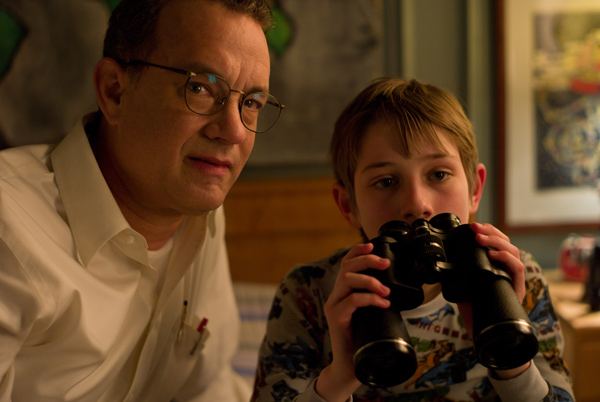
IT’S BEEN A dark decade for America. Our economy crumbled in the terrifying, twin shadows cast by the events of September 11, 2001, or as it’s remembered in Stephen Daldry’s new drama, “Extremely Loud & Incredibly Close,” the “worst day.”  The film begins in the wake of that worst day as Oskar Schell, our 11-year-old protagonist and wunderkind, attends his father’s funeral alongside mother Linda (a muted Sandra Bullock in mournful beige).  The Schells are interring the empty casket of father Thomas (played by Tom Hanks in flashbacks) and, seated apart inside a limousine, strike us as not the closest mother and son.  “Extremely Loud & Incredibly Close” is about the hard work of recovering that interpersonal closeness, of living loudly in the face of seemingly insurmountable loss.  A victim of the 9/11 attacks, Thomas leaves behind a key, and like Chekov’s gun, that key has to open something by the last act.  It comes with the cryptic word “Black,” and soon enough, with the names of 472 New York residents named Black, Oskar sets out to unlock the mystery.  Along the way he meets a fine supporting cast including Viola Davis (“The Help”), Jeffrey Wright (“The Ides of March”), and Max von Sydow (in an Oscar-nominated role as the speechless “Renter” and Oskar’s guardian angel).

In Oskar’s memories of his father, Thomas Schell towers over him like a demigod: a map-maker who builds puzzles for his prodigy son to solve, an intellectual who searches The New York Times each morning for grammatical typos, a jeweler who leaves behind the ultimate treasure-hunt (another cartographic conundrum involving a mythical “Sixth Borough”) for his son to solve.   Mr. Hanks remains one of cinema’s most likeable leading men, and buried, as he is here, by the rubble of Oskar’s grief, his warm presence radiates throughout.  The warmly-lit interior of the Schells’ Upper West Side apartment is a refuge from the senseless world outside and within it, father and son wage a war of oxymorons with Thomas shouting “Now then” and “Found missing” to little Oscar’s retort: “Jumbo shrimp!”

In adapting the 2005 novel by Jonathan Safran Foer, screenwriter Eric Roth (“Forrest Gump,” “The Insider”) retains much of the high jinks and gimmickry – close-ups of elephants tears, YES and NO written on palms, even the flip-book that concluded the novel and sent the image of a falling man back up into the World Trade Center – that divided readers of the novel, which delivered on David Foster Wallace’s call to construct postmodern narratives with an unironic heart.  Yet the most affecting scene of the film is its sparest: an angry Oskar, confounded by the senselessness of his dad’s death, tells Linda: “I wish it had been you.”  We’re not a little shocked when Linda doesn’t strike him but responds with “So do I.”  If only Roth had preserved the conclusion to Foer’s novel in which Oskar finally understands his mother’s own ordeal, telling us, on the page: “Her looking over me was a complicated as anything ever could be.  But it was also incredibly simple.  In my only life, she was my mom, and I was her son.”

And the page is where Foer’s Oskar Schell belongs because on screen, he comes across as petulant and not a little irritating.  As Oskar, newcomer Thomas Horn over-enunciates his lines and lacks the warm relatability that an actor like Hanks has in spades.  He comes across as that precocious little boy who sidles up to the adults table at family functions to show off his knowledge of Tolkien and trigonometry, the one whose mother has to politely ask him to play with the other children.  There’s a suggestion that Oskar suffers from Asperger’s syndrome, but it’s never developed and it’s a shame because his most puzzling behaviors, like hiding the answering machine on which his father left his final messages and replacing it with a new one to keep his mother in the dark, make no sense on the screen whereas the literary Oskar, as the novel’s narrator, is easier to sympathize with.

Foer’s novel wasn’t to everyone’s liking – described as “overextended and sentimentally watery,” it took a drubbing by the late great John Updike in a 2005 review in The New Yorker ­– but it’s naïve to think that a fictionalization involving September 11th survivors could ever please everyone.

It’s not, as many have alleged, that “Extremely Loud & Incredibly Close” is exploitative.  Rather, it’s manipulative and especially so on screen, stripped of the pacifistic and political dimensions of Foer’s novel, which forced us to bring a brain and heart.  Daldry’s reductive take on that work asks only that we bring our Kleenex.

Review: “Contraband”

19 Thursday Jan 2012

Posted by colincarman in Film Reviews

≈ 13 Comments

Tags

action, al pacino, baltasar kormakur, caleb landry jones, contraband, giovanni ribisi, kate beckinsale, mark wahlberg, new orleans, panama, the godfather

“Smuggling with the Enemy”

Grade: C+ (SKIP IT)

“Just when I thought I was out, they pull me back in.”

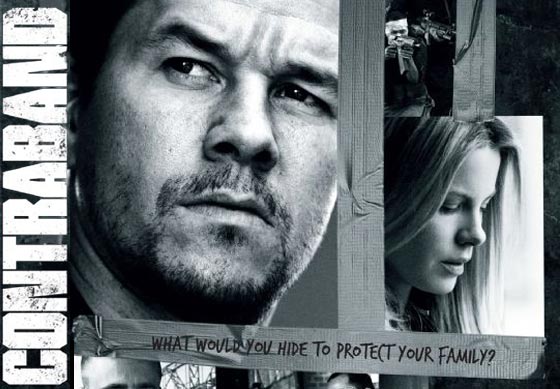
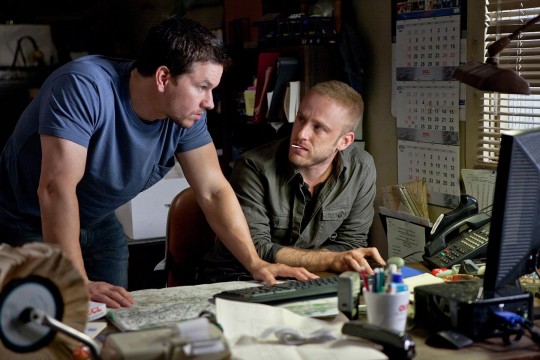
That’s not Mark Wahlberg, of course, but Al Pacino in “The Godfather III” and it might just as well serve as the premise of the new action(less) film “Contraband” with Wahlberg as Chris Farrady, an ex-smuggler from New Orleans who’s gone legit for the sake of his hairdresser wife (played by Kate Beckinsale in cheap highlights) and two young sons.

We don’t go to the movies to see former criminals go straight, so it comes as no surprise when all four family members are soon staring down the barrel of a gun.  (And poor Beckinsale takes a beating in this film, from pistols and fists to fenders and a cement mixer.)  Chris’s quiet life working in security quickly crumbles after his dipshit of a brother-in-law (Caleb Landry Jones) bungles a hand-off and ex-con Tim Brigg (Giovanni Ribisi) comes back to town, demanding his money or else.  Chris will have to carry off one last heist to repay Brigg and protect his family.  “Contraband” suffers from the same moral problem that beleaguered “Inception”: it’s hard to root for thieves, so the film struggles to keep Chris out of the cocaine and heroin trade he traverses, insisting instead that it’s those Andrew Jacksons on starch-free paper he’s really after.

As one half of the film’s villainous pair of con-men, Ribisi (“Boiler Room,” “Lost in Translation”) can always be counted on for a performance freshly inspired and here he affects a voice that’s half helium and half hatred.  Before the two wage war against each other, Wahlberg visits his corner-bar and pleads for a reprieve: “Do you know how many passes I gave your brother?”  The reptilian Ribisi replies: “I hated my brother.”  Performances aside, the plot of “Contraband” is bafflingly improbable.  Once Chris sets sail to Panama City to carry out the heist, all kinds of unanswered questions are raised: are the transport-ships that travel the Panama Canal really this easy to hop aboard?  Who knew tanker ships carrying imports were as easy to penetrate as your local Denny’s?  Paintings by Jackson Pollock are so vulnerable to thieves that they can be rolled up like painter’s drop cloths?  Director Baltasar Kormakur, who starred and produced in the 2008 Icelandic original entitled “Reykjavik-Rotterdam,” has a problem with momentum as “Contraband” never leaves the port.

January is customarily the dumping ground for major studio release for two reasons: first, after the first of the year, ticket-buyers are looking at their Christmas credit card bills and cutting back and second, most are still trying to catch up with the Oscar-bound films from the previous fall.  “Contraband” is exactly the kind of film to release while no one’s really looking.  Fresh off the boat in Panama, Wahlberg utters the film’s most telling lines in this exchange with a  Panamanian druglord alarmed that Chris isn’t happy with the product: “No bueno?”

“No,” says Wahlberg, “No fucking bueno.”

The Best and Worst Films of 2011

02 Monday Jan 2012

Posted by colincarman in Film Reviews

≈ 9 Comments

Tags

aaron sorkin, amanda seyfried, brad pitt, bridesmaids, charlize theron, christopher plummer, comedy, crazy stupid love, drama, drive, ewan mcgregor, george clooney, hugo, jason reitman, jessica chastain, joel shumacher, justin timberlake, kristen wiig, martin scoresese, michael fassbender, moneyball, nicolas cage, nicole kidman, oscars, owen wilson, paris, ryan gosling, sarah jessica parker, sean penn, shailene woodley, take shelter, taylor lautner, the descendants, the help, The Ides of March, the tree of life, thriller, trespass, woody allen, young adult

THE BEST FILMS OF 2011:

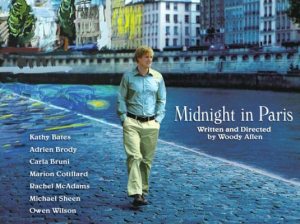
1.       “Midnight in Paris” (written and directed by Woody Allen) – Whoever thought you’d someday utter the words “Woody Allen” and “magical” in the same sentence?  After all, it’s been a long time since his “The Purple Rose of Cairo” (1985).  America’s greatest living filmmaker gives us not just his biggest box-office hit in forty years but the longest running movie of 2011.  A delightfully literary meditation on time travel and the Lost Generation.  No one can assemble a cast like Allen; Owen Wilson channels Allen without parodying his jokes and gestures in the City of Lights.

2.      “Drive” (directed by Nicolas Winding Refn) – This ultra-violent vehicle for Ryan Gosling, as the anonymous “Driver,” is a rough patch of LA noir, vicious and thrilling.  It also solidifies Gosling as the most versatile leading man to watch – politically mercurial in “The Ides of March” and a sartorial stallion in the comedy “Crazy Stupid Love” – in 2011.  “Drive” is on track to become a lasting cult favorite.

3.      “Take Shelter” (dir. by Jeff Nichols) – A harrowing meditation on paranoia and climate anxiety with the indomitable Michael Shannon (a sure-fire contender for the Best Actor Oscar) as an Ohio man coming apart.  Jessica Chastain (“The Help,” “The Debt”) was the ingénue of 2011, giving here, as a foil to her bubbly Southern belle in “The Help,” a restrained performance as the wife of a man either mentally ill or clairvoyant.  You decide.  Another powerful psychodrama, set in the heartland, from the writer-director of “Shotgun Stories.”

4.      “The Tree of Life” (written and directed by Terrence Malick) –  It appears only the “little things” in life matter to Malick (“Badlands,” “The Thin Red Line”).  His moving meditation on childhood, love, family, dinosaurs, Texas, the cosmos that had Americans demanding a refund must be worth the price of admission.  Believe it or not, in 2011, many movie-houses had to enforce their NO-REFUND policy for those left dazed and confused by 2011’s only poem-on-film (also the Palme d’Or winner at Cannes).  Costar Sean Penn even admitted that he had no real idea what Malick’s movie is about.  Actors!  Like any thoughtful work of art, it demands a lot from its viewer, but this tree’s roots stretch far and wide.

5.      “Bridesmaids” (dir. by Paul Feig) – Sure, it’s the female “Hangover” – replete with scatological slip-ups and crudely sexual candor – but “Bridesmaids” will get you to the church on time and, potentially, buzzed on the drive there.  Kristen Wiig dropped the over-the-top personae she brings to life on “Saturday Night Live” and surrounded herself with a hilarious ensemble cast that turned the chick-flick genre on its head.  That image alone of Wiig riding the automatic gate to Don Draper’s love pad is comic gold.

6.      “The Descendants” (directed by Alexander Payne) – After reading George Clooney boast to Rolling Stone that he’d be “surprised” if “The Descendants” didn’t go on to become a Best Picture nominee, I went into a showing of Alexander Payne’s new dramedy with my critical force-field up.  Yet its achingly honest tone and gallows humor eventually win you over.  Clooney’s light is less intense than newcomer Shailene Woodley as his truth-telling daughter.  The family bonds forged here feel real rather than Hollywood hokum.

7.      “Beginners” (dir. by Mike Mills) – It’s hard to believe that the man who, nearly fifty years ago, played Georg van Ludwig Von Tropp in “The Sound of Music” has the gumption, not to mention the joie de vivre, to play a newly widowed man who belatedly comes out of the closet.  Playing Plummer’s son, Ewan McGregor is on hand to scratch his head and find love (and roller-skate) for himself.  Mike (“Thumbsucker”) Mills based the comedy on his father’s own coming out and cancer.  A more cross-generational cancer comedy than the also entertaining “50/50.”

8.      “Young Adult” (dir. by Jason Reitman) – After stumbling with “Jennifer’s Body,” Oscar-winning screenwriter Diablo Cody (“Juno”) reestablishes herself by drawing up the virtually unlikable Mavis Gary, a “prom queen psychopath bitch” (lovingly described by a fellow native of Mercury, Minnesota unhappy to see her back in town and trying to break up a marriage).  Theron embodies another kind of “Monster” while Patton Oswalt delivers the laughs as a self-described “fat geek” who shares the most surprising love scene of ’11 with a wine-stained, cutlet-wearing Theron.

9.      “Hugo” (dir. by Martin Scorsese) – While contemporary Steven Spielberg stretched himself thin with “The Adventures of Tintin” and the mawkish “War Horse,” Martin Scorsese focused his attention – his 3-D attention, no less – on his first children’s film.  “Hugo” has a timeless feel, capturing the hurly-burly of an urchin inhabiting the walls of a Parisian train station and the advent of the motion picture in the age of Georges Méliès.  Is there anything Martin Scorsese can’t do? Oh, that’s right: comedy (see, or don’t see, his “After Hours” of 1985).

10.     “Moneyball” (dir. by Bennett Miller) – After last year’s “The Social Network,” screenwriter Aaron Sorkin hits another home-run with Brad Pitt  as Oakland A’s general manager Billy Beane.  Even a sports-phobe like myself could connect with a script this dizzy with details and  dialogue for grown-ups.  It’s probably time Pitt picks up his first Best Actor Oscar and why not for a willful film that venerates all of you who think outside the box – or better yet, the diamond?

THE (VERY) WORST FILMS of 2011:

1.    “Abduction” – Sorry, Twi-hards, but Jacob Black of the Twilight Saga film series committed a serious error here in the lobotomizing tale of a kid raised, unbeknownst to him, by secret agents.  Lautner is far from ready for his close-up, Mr. DeMille.  He has the vacant, Neanderthalic gaze of Kim Kardashian’s short-lived husband, Kris Humphries.  If only “Abduction” had felt as short as that marriage.

2.    “In Time” – A perfectly acceptable script from Andrew Niccol (“Gattaca”) was marred by the calling-it-in acting style of Justin Timerblake who, like Taylor Lautner, is best kept in the chorus.  Costar Amanda Seyfried resembles a dyspeptic goldfish as she and Timberlake chase across rooftops, trying to beat the clock in “In Time.”  An acting malfunction.

3.    “Shame” – For some inexplicable reason, Michael Fassbender is being praised for playing a Manhattan professional addicted to sex in the impotent “Shame.”  Never has sexuality been so boring, characters so undeveloped, and a narrative so negligible as in Steve McQueen’s self-serious sophomore effort.  If the audience isn’t laughing derisively by the time Brandon descends into an inferno of gay bars and Sapphic three-ways, they’re not paying attention.  I returned to the lobby to dispense liquid butter directly into my eyeballs to blur this nightmare of a “drama.”  Shameful, indeed.

4.  “I Don’t Know How She Does It” – The one-note Sarah Jessica Parker fails to mix it up a bit (again) in this wannabe feminist twaddle.  Parker plays Kate Reddy, a finance executive juggling professionalism and pampers.  If only Charlotte, Miranda, and Samantha had helped with babysitting duties, we might not have had to once again sympathize with the saccharine sentimentality of white woman bourgeois guilt.  Far from a breadwinner, this is a bread-loser that confirms the old adage that indeed you can’t have it all.

5.  “Trespass” – What was Nicole Kidman thinking to team up with the execrable Nicolas Cage and hit-or-miss director Joel Shumacher (“Dying Young,” “Phone Booth”)?  Cage plays a businessman and diamond-dealer victimized, alongside wife Kidman, during a sadistic house invasion.  If it’s pointless violence you’re after, “Trespass” has more than enough gore to go around.  If you play this loudly in your house, your neighbors will likely call the police due to its vociferous gunfire and relentless female shrieking.

In a year belonging to Woody Allen, it’s worth remembering a line from “Annie Hall” (1977).  (It’s a classic older than I am with insights immemorial.)  In the following, replace “television shows” with “movies,” especially the soulless “Trespass”:

Annie, in California: “It’s so clean out here.”

Alvy (Allen): “They don’t throw their garbage away. They turn it into television shows.”

Review: “Shame” and “Young Adult”

31 Saturday Dec 2011

Posted by colincarman in Film Reviews

≈ 3 Comments

Tags

4 non blondes, carey mulligan, charlize theron, comedy, cracker, diablo cody, drama, hunger, inglourious basterds, james badge dale, jason reitman, jennifer's body, michael fassbender, minnesota, new york, patrick wilson, patton oswalt, sex addiction, shame, steve mcqueen, the lemonheads, young adult

“Adults Behaving Badly”

Grade: “Shame” (D+/SKIP IT) and “Young Adult” (B+/SEE IT)

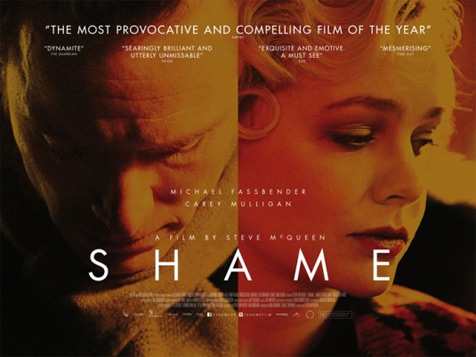
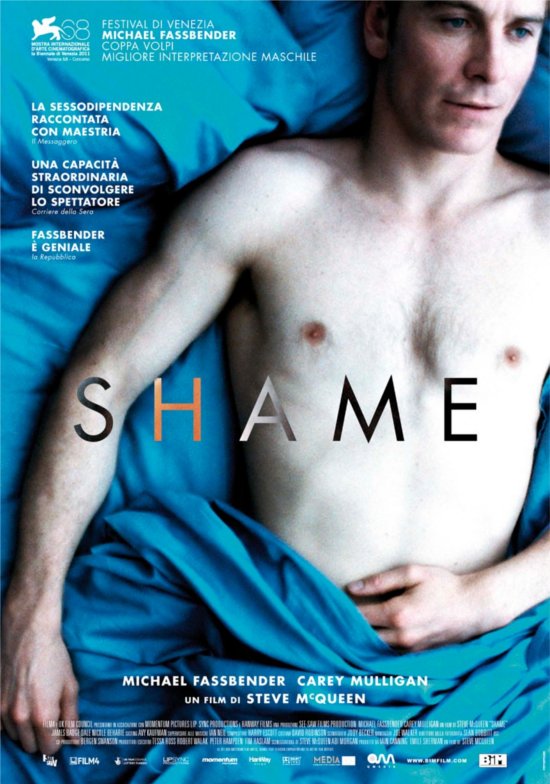
IT’S EITHER FEAST or famine for British artist-turned-filmmaker Steve McQueen.  His last film, the nakedly honest “Hunger” of 2008, involved the 1981 Irish hunger strike while his latest, “Shame,” is a melodrama of excess, appropriately set in the city of too-much-ness: Manhattan.  The star of both those films, Michael Fassbender (“Inglourious Basterds,” “A Dangerous Method”) plays Brandon, a handsome professional addicted to sex.  When his sister Sissy (played by Carey Mulligan) comes to town, he’s forced to confront the error of his ways and with deadening effects.  Just as Brandon loses his stamina when canoodling with a woman he actually likes and admires, “Shame” is an impotent flick – a noodley, unfulfilling affair.

Perhaps the most remarkable thing about “Shame” is that it’s NC-17.   My own 9:30 screening was preceded by a word of caution from a well-meaning usher, dispatched to tell us that the film is “intense” and that we may want to visit the bar upstairs before it closes at 10 PM.  “Shame” will no doubt spur the urge to drown your sorrows.  With a plot so thin it’s diaphanous, “Shame” follows Brandon from the depths of the subway, where he makes eyes at a beautiful stranger, to the towering heights of his office space where it’s unclear what Brandon does for a living, except that his hard drive has been confiscated by his employers.  His womanizing boss (James Badge Dale) gives him a mere slap on the wrist, calling his Internet history “filthy,” but happily joins him during his late-night sexcapades.

Brandon’s home life is no less troubling: sister Sissy beds his boss right before his eyes and her wrists are scarred from previous suicide attempts.  She’s also an aspiring singer, and we’re subjected to Ms. Mulligan’s painful rendition of “New York, New York” inside a lazily-lit lounge.  It’s also, aptly, her only number in a one-note film lacking any dimensionality.  Gone are such plot devices as rising action and character development.  The great irony of “Shame,” a film purportedly about sex addiction, is that it’s missing a climax.

Sex addiction remains a contentious matter.  Is it a real affliction or a cop-out for those lacking self-control?  Who else but the very beautiful could decry the problem of too much sex?  “Shame” sheds little to no light on this question.  If the red-flag of compulsion is a destructive impact on one’s professional and personal life, Brandon’s erotic preoccupations fail to qualify.  Only a puritan would treat Brandon’s love of pornography (unquenched by his onanistic trips to the men’s bathroom while at work) with such shock and revulsion.  Even more shameful is the way gay sexuality is inserted into Brandon’s downward spiral.  “Shame” suggests that Brandon has only truly hit rock bottom once he enters a red-lit gay bar, desperate for gratification, followed up by a threesome with two women.  The heavy orchestral music that accompanies Brandon’s conquests makes the whole affair laughably lugubrious.  As a Garden State native, I take particular offense to Sissy’s remark to Brandon, “We’re not bad people – We just come from a bad place,” since that place is New Jersey.  First, Snookie – now this.


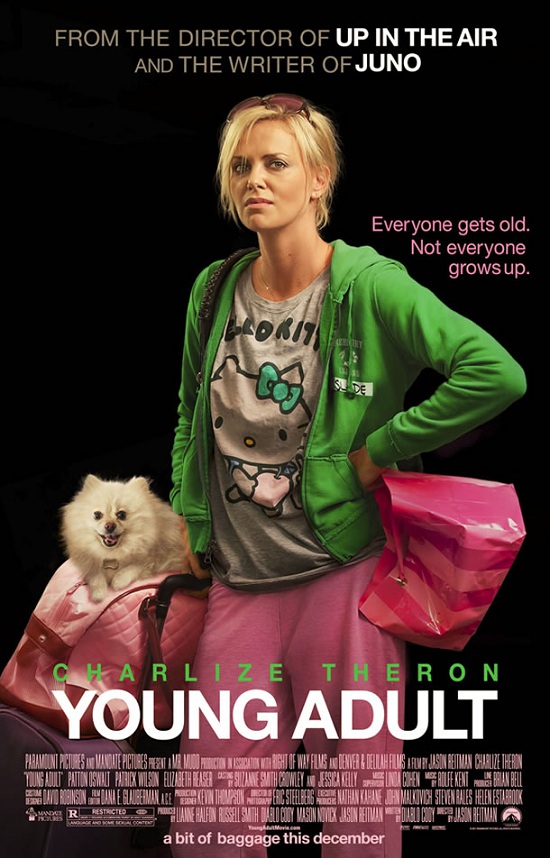
IF IT’S CHARACTER and complexity you’re looking for –real people with real interiorities – look no further than Diablo Cody’s acerbic new comedy, “Young Adult” starring an unsmiling and spectacular Charlize Theron.  Like the protagonist of “Shame,” Theron’s character repeatedly wakes up, face-down, in her high-rise apartment.  She’s another rudderless and lonely thirtysomething for whom the thrill is gone.  She’s Mavis Gary, the high school prom queen who left her hometown of Mercury, Minnesota for Minneapolis (admiringly dubbed the “Mini-Apple” by locals).  Mercury residents think Mavis leads a glamorous life as a writer of young adult novels, but instead, she inhabits a dreary apartment littered with Diet Coke cans, pee-pads for her Pomeranian named Dolce, and a TV always tuned to the E! channel.  Upon learning that her old beau, Buddy Slade (played by a scruffy Patrick Wilson), has become a new father, she drops what she’s doing – including the one-night-stand still asleep in her bed – to win him back.  Mavis is driven by delusion, so much so that you’ll want to throttle her.  “Buddy Slade and I are meant to be together,” she insists, “and I’m here to get him back.”

A proud and aspiring homewrecker, Mavis is one of the most unforgettable female figures of the year.  Cody’s script flies in the face of every romantic comedy convention since her anti-heroine, Mavis, isn’t just flawed but ferociously unlikable: about as warm as the tundra, narcissistic, and like many of Cody’s characters, especially those in her uneven foray into horror (2009’s “Jennifer’s Body”), downright mean.  When Mavis runs into an old classmate, Matt Freehauf (a perfect Patton Oswalt) at a dive bar called Woody’s, she remembers Matt only as the “hate crime guy” who was brutally attacked by jocks – his leg and pelvis shattered by a crowbar – and replies coldly to his misfortune: “Didn’t you get to miss a lot of school for that?”

As in all of Diablo Cody’s scripts, the devil is in the details: a love of slang, socially awkward moments, and the banalities that define American life (its Pizza Huts, its Hampton Inns, its broken computer printers).  Director Jason Reitman (“Up in the Air,” “Thank You For Not Smoking”) also directed Cody’s breakout, “Juno,” and his keen sense of pacing and comic timing serves her script well, once again.  No one looks more out of place than the impossibly beautiful Theron inside a generic sports bar, but Reitman manages to go beneath that surprising surface.  When Mavis’s humanity finally emerges, at a Slade family party that she predictably turns upside down, you genuinely feel for her as some details of her and Buddy’s past come, kicking and screaming, to light.

Of all the Nineties tunes wafting through this little gem of a film (Cracker’s “Low,” 4 Non Blonde’s “What’s Up”), “It’s a Shame About Ray” by the Lemonheads may be the most telling.  It’s a shame about “Shame” but “Young Adult” is a full-grown work.

Review: “War Horse”

26 Monday Dec 2011

Posted by colincarman in Film Reviews

≈ 10 Comments

Tags

battle of somme, black beauty, celine buckens, emily watson, horses, janusz kaminski, jeremy irvine, nick stafford, niels arestrup, peter mullan, saving private ryan, seabiscuit, secretariat, shakespeare, spielberg, the godfather, war, war horse, world war I

“More than the Somme of Its Parts?”
Grade: C+ (Rent It)

WHEN WILL HOLLYWOOD stop horsing around?  From “Black Beauty” and “The Black Stallion” to “Seabiscuit” and “Secretariat,” equus ferus caballus, otherwise known as “the horse,” is rivaled only by our other favorite quadruped, the dog, for sheer screen time.  Wouldn’t the lasting power of “The Godfather” be somewhat diminished had studio head Jack Woltz awakened not to the severed head of his racehorse buried in those satin sheets but to a headless Fido or Rufus?

Early on in the new Spielbergian spectacle called “War Horse” a British soldier named Perkins tells Albert, as he’s forced to let his beloved horse head off to war, “He’s a horse – not a dog!”  And there’s a difference: one is allowed to share its master’s bed and the other remains a beast of burden, capable of dazzling strength and speed but always left out in the rain.

It seems as if wherever “War Horse” has galloped, it’s garnered awards.  When British playwright Nick Stafford adapted the original 1982 novel by Michael Morpurgo for the stage, he met instantaneous critical and commercial success, winning a Laurence Olivier Award for Best New Play in 2008 and the Tony Award for Best Play in 2011.  The stage production continues to pack theatres in London and New York.

Now there’s the major motion picture adaptation by Steven Spielberg, his first directorial effort since 2008’s “Indiana Jones and the Kingdom of the Crystal Skull” (more horses).  With a script by Lee Hall and Richard Curtis, Spielberg’s version is just the kind of visual intoxicant we come to expect from his bigger-than-life aesthetic.  The on-screen “War Horse” is also meticulous.  With the photographic help of longtime collaborator, Janusz Kaminski, Spielberg brings each locale to life.  When we’re in the English countryside, the hillsides pop in verdant greens whereas, later, in the rat-infested trenches of war-ravaged France, bullets whistle past and soldiers explode with all the sound and fury of the Normandy invasion scenes in a far more powerful anti-war film by Mr. Spielberg: “Saving Private Ryan” (1998).

The war horse of the title is a half-thoroughbred named Joey, purchased at the film’s start by a dipsomaniac named Ted Narracott (Peter Mullan).  Ted is still traumatized by his own service to the British Empire in the Boer Wars.  Taking a deep and intimate liking to Joey, Ted’s son Albert (a glow-in-the-dark Jeremy Irvine) sets out to break Joey’s wild nature.  Alongside Emily Watson as his mother Rosie, Albert inhabits a rural town in Devon so small that nearly every villager comes to watch as Albert puts Joey to the plow.  From there, the plot is a fairly simple one: bridging cultures and breaking down the barriers constituent of warfare, Joey repeatedly changes hands and owners: from English to German hands with a brief stop along the way in a French farm operated by a jam-maker (a stirring Niels Arestrup) and his angelic granddaughter (Celine Buckens).  Still, the charms of “War Horse” are chiefly visual: the most striking scene involves little more than a confrontation between Joey and a tank, all life and organicism on one side and steely death on the other.

Weaker yet, there’s something not a little perverse about representing World War I, in which an astounding 8,700,000 lives were violently lost (including 780,000 British – nearly a entire generation of English men), through the eyes of a boy and his horse.  This is the great trauma of the twentieth century in which poison gas was introduced at the Second Battle of Ypres and the British use of tanks on the Somme (both in 1915).  The great moral and political potential of fiction is that it can be used to teach us something about history, even if it exists in the background, but “War Horse” relegates history too much to the sidelines and, paradoxically, uses the cacophonous battlefield to shake the viewer out of its default setting: sentimentality.

It’s all eerily similar to Shakespeare’s Richard III who, deranged and defeated, has lost sight of what’s truly important when he hobbles across stage, shouting: “A horse! A horse! My kingdom for a horse!”

Review: “The Girl with the Dragon Tattoo”

23 Friday Dec 2011

Posted by colincarman in Film Reviews

≈ 8 Comments

Tags

atticus ross, christopher plummer, daniel craig, david fincher, fight club, millennium series, nazi, robin wright, rooney mara, seven, steve zaillian, stieg larson, sweden, the game, the girl with the dragon tattoo, the social network, trent reznor, yorick van wageningen

“Stockholm Syndrome”

Review: “The Girl with the Dragon Tattoo”

Grade: B+ (Rent It)

SHE’S AN ANGRY ward of the state.  She’s a goth hacker who can crack high-security codes and passwords like they’re fortune cookies.  She’s got more hardware in her face than C-3PO.  She wears a charming little T-shirt, while rolling out of bed after a one-night-stand with some chick from the club, which reads: “Fuck You You Fucking Fuck.”

She’s Lisbeth Salander, the femme fatale and titular girl in the American film adaptation of Stieg Larson’s best-selling page-turner “The Girl with the Dragon Tattoo.”  When Larson died at the age of 50 in Stockholm in 2004, after climbing seven flights of stairs to his office because the elevator wasn’t working, he left behind three completed but unpublished manuscripts collectively called the “Millennium Series.”  It’s worth remembering that the first in the series was originally titled Män som hatar kvinnor (or “Men Who Hate Women”) before being rebranded in the American book market.  Larson’s crime novel is an indictment of the sleazy industrialists who run modern-day Sweden, but it’s also, to a larger extent, a drama of misogyny wherein women are raped and killed for sport and men seemingly get away with murder.  That’s where Lisbeth, as the dark avenger, and sidekick Mikael Blomkivst (played by Daniel “007” Craig) come in.  As a financial journalist, Mikael is the muckraker who plays by the rules while Lisbeth operates above the law.  He tells Lisbeth: “I want you to help me catch a killer of women.”

By 2011, the plot of “The Girl with the Dragon Tattoo” should already be familiar since Larson’s storyline is not just well-read but much-discussed.  (My 94-year-old grandmother may have never read such detailed scenes of S&M torture had a friend and fellow bridge-player not leant her a paperback copy.) The screenplay is by Oscar-winning Steve Zaillian (“Schindler’s List,” “Awakenings”) and though, at a protracted 158 minutes, it runs a bit long, it distills Larson’s novel into its bare essentials: Lisbeth’s rape/revenge on her legal guardian Bjurman (Yorick van Wageningen), Martin Vanger’s confession as he prepares to kill the novel’s hero Mikael, and that haunting last image of Lisbeth seeing Mikael stroll off with his editor Erika (Robin Wright), leaving Lisbeth out in the snow, all alone on her motorcycle.

In short, the narrative begins in media res: after losing a libel suit, Mikael is hired by the patriarch of the Vanger dynasty, Henrik Vanger (played by Christopher Plummer) to write the family history and solve the murder/disappearance of his grandniece Harriet.  The Vangers reside on a private island and their family tree is rotten to the core: father/daughter incest, rape, not to mention Nazism and generations of secrets and lies.  In a parallel plot resides Lisbeth who, deemed by legally insane after setting her father on fire, comes to help Mikael solve the mystery and in the process, soften a bit and ultimately save the day.

“The Girl with the Dragon Tattoo” is benefited by two tremendous talents in and behind the scenes: first, there’s newcomer Rooney Mara (“The Social Network”) as Lisbeth.  She’s simply captivating, a living-breathing switchblade.  Then there’s the Knight of Noir, David Fincher, who demands that it either be snowing or perpetually midnight in “The Girl with the Dragon Tattoo.”  The amber flashbacks of the Vangers circa 1965 recall the equally tragic past of the Van Orton family in “The Game” (1997).  Scenes of sexual torture hearken back to the queasiness of “Seven” (1995) and “Fight Club” (1999).  There’s also an eerily electronic score by Trent Reznor and Atticus Ross, the former of whom already won an Oscar for scoring last year’s “The Social Network” (also directed by Fincher).

Given these top-shelf ingredients, and Larson’s potboiler at the center of it all, it was hard to go wrong.  “The Girl with the Dragon Tattoo” is a slick and moody adaptation, cool but not chilling.  Perhaps Lisbeth’s tattoo artist says it best when he warns the girl, his gun buzzing, “This is really gonna hurt.”

Review: “Like Crazy”

15 Thursday Dec 2011

Posted by colincarman in Film Reviews

≈ 2 Comments

Tags

alex kingston, anton yelchin, blue valentine, drake doremus, felicity jones, like crazy, oliver muirhead, twilight

“What We Talk About When We Talk About Love”

Review: “Like Crazy”

Grade: C+ (Rent It) 

THERE’S A REASON why the romance “Like Crazy,” from director Drake Doremus, has been hanging around the multiplex long after its October release: it’s artful and earnest, and while “The Twilight Saga: Breaking Dawn” fills two to three auditoriums a night, zombifying the nation, there’s a smaller, simpler love story just around the corner.  It’s from the young director who brought us “Spooner” in 2009 and “Douchebag” in 2010.  Doremus’s latest, “Like Crazy,” picked up the Grand Jury Prize for dramatic feature at this year’s Sundance Film Festival, and while it’s hardly a perfect film – nor is it very crazy – it does contain some tender moments.  What’s not to love about a girl who drinks whiskey, reads e.e. cummings, and a boy who shares her love of Paul Simon’s “Graceland” and gives a handmade chair as a gift (the inscription reading, underneath the seat, “LIKE CRAZY”)?

Sorry, Twi-hards, no bare-chested werewolves here: instead, Mr. Doremus, shooting in hand-held digital and without a script, gives us Jacob and Anna.  Anton Yelchin (“Fright Night”) plays Jacob, a furniture designer living in Santa Monica, and the fresh-faced Felicity Jones (“Brideshead Revisited,” “The Tempest”) plays his English idol.  The two meet at UCLA and during a class presentation, Anna discusses the history of journalism.  Talk of “alternative narratives” inside the classroom alerts us to the film’s interest in non-conventional storytelling.  Whole portions of the pair’s love affair are left out, along with actors who are sometimes shot out-of-view.  The trouble arises when Anna violates her student visa by staying the summer, an innocent mistake that creates a world of legal troubles for the couple.  She returns to London and the two are condemned to that agonizing oxymoron of an emotional state known as the “long-distance relationship.”

“Like Crazy” is preoccupied on every level by the relation between propinquity and distance, past and present.   When Jacob visits Anna and her parents (the charming Oliver Muirhead and Alex Kingston) in England, he feels the pressure of time since any long-distance affair is love on the clock.  Where Jacob and Anna eventually wind up, “Like Crazy” doesn’t ultimately tell us, and the lack of resolution after a final shower scene – reminiscent of a finer love story, similarly interested in alternative narratives, “Blue Valentine” – smacks of directionlessness.  Lacking a real ending, or even the suggestion of the couple’s fate, “Like Crazy” circles the drain in its final minutes, unsure of where it should flow.  Mr. Doremus’s romance is trying to break your heart, but it stymies more than it satisfies.

Review: “Hugo”

09 Friday Dec 2011

Posted by colincarman in Film Reviews

≈ 4 Comments

Tags

a trip to the moon, asa butterfield, ben kingsley, chloe grace moretz, george melies, goodfellas, hugo, hugo cabret, jude law, let me in, lumiere brothers, martine scoresese, robert richardson, sacha baron cohen, taxi driver

“Such Stuff As Dreams Are Made On”

Review: “Hugo”

Grade: A- (SEE IT)

WHAT DO YOU get when you combine Martin (“Mean Streets,” “Raging Bull”) Scorsese and Brian Selznick’s 2007 children’s book about a twelve-year-old orphan named Hugo who lives behind the clocks in Paris’s Gare Montparnasse?  A kid gangster in a beret who, “Taxi Driver”-style, flashes his handgun while asking repeatedly: “You talkin’ to me?  You talkin’ to me?  Well, you must be talking to me cuz I’m the only one here”?

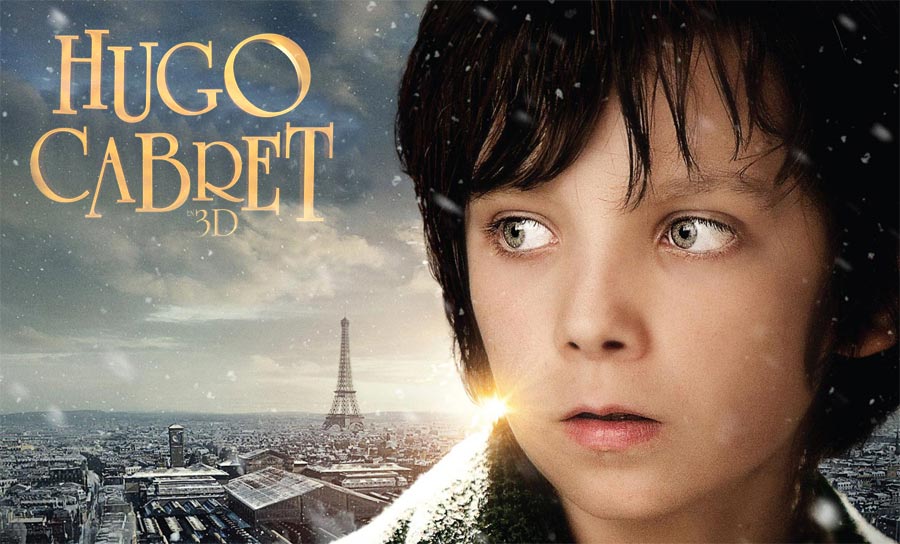
Nah, you get the most miraculous children’s film of 2011, and in large part because Hugo Cabret (a soulful Asa Butterfield) is the only one there, pathetically so, though post-war Paris buzzes all around him.  Little Cabret is a ragamuffin whose clockmaker father (Jude Law) has left him all alone inside the walls of this bustling metro.  Reminiscent of the famously long and unbroken tracking shot in which Henry Hill enters the Copacabana nightclub in “Goodfellas,” the camera glides through the human traffic inside the Montparnasse.  Hot on Hugo’s trail is the station manager (a mustachioed Sacha Baron Cohen) and his Doberman Pinscher named Maximilian; the two police the station and send Hugo scurrying, mouse-like, back inside the building’s walls.

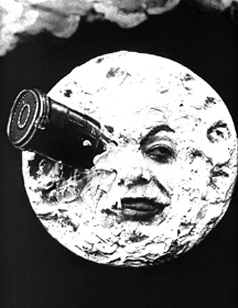
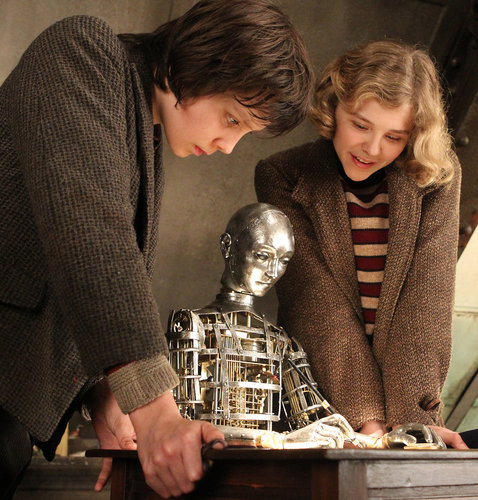
Beyond the film’s resplendent opening sequence, shot kaleidoscopically and from a child’s point of view by cinematographer Robert Richardson, a mystery soon emerges when the automaton left to Hugo by his father needs a heart-shaped key to activate itself.  Enter Isabelle, the goddaughter of a curmudgeony toy-shop owner inside the station played by Chloe Grace Moretz (the vampiric girl in the best horror movie of the 2010s: “Let Me In”) who embarks on a quest not just through Paris’s cinemas and film libraries but through film history itself.  The two go tripping through the images of early moving pictures: trains steaming toward the screen that make movie-goers jump out of their seats, trick films such as “Le Voyage Dans Le Lune” (“A Trip to the Moon”) of 1902, with its iconic rocket-in-the-eye-of-the-moon image and Venuses in lobster claws.

But makes “Hugo” really tick is that it’s also a loving splash of historical fiction.  Though Isabelle calls her godfather Pappa Georges, he is, in fact, an legend in hiding:  the film-pioneer Georges Méliès (a stern Ben Kingsley) now living incognito and hiding, like his nemesis Hugo, in plain sight.  After Hugo steals from his toy-shop, Méliès swipes Hugo’s notebook, replete with Da Vinci-like blueprints, in return.  The year 1895 was something of an annus mirabilis for Méliès (1861-1938) since, just after Christmas, it was the first time the Paris public saw a film projection.  Alongside the Lumiére Brothers, Méliès pioneered the new medium of moving pictures, but by the early thirties, had shriveled into the tedium of domestic life.  When Hugo and Isabelle set out to discover the secret past of “Pappa Georges,” they enter the rabbit-hole of movie history, a fitting journey for the first true family film from Mr. Scoresese (whose efforts to preserve and restore classic films are well-known).  Restoration is what this film is about: finding the heart to activate the automaton, an obvious analogue with the stuck-in-time Méliès, also much in need of revival.

Speaking of his father, Hugo tells Isabelle rapturously: “He went into a dark room and saw a rocket go into the eye of the moon.  The movies are a dream in the middle of the day.”  That’s a pretty apt description “Hugo” itself; he’s the little horologist that could.

Review: “The Descendants”

29 Tuesday Nov 2011

Posted by colincarman in Film Reviews

≈ 2 Comments

Tags

alexander payne, comedy, drama, george clooney, hawaii, jack nicholson, jim rash, judy greer, kaui hart hemmings, nat faxon, patricia hastie, shailene wooley, shakespeare, the descendants

“Welcome to Paradise?”

Grade: A- (SEE IT)

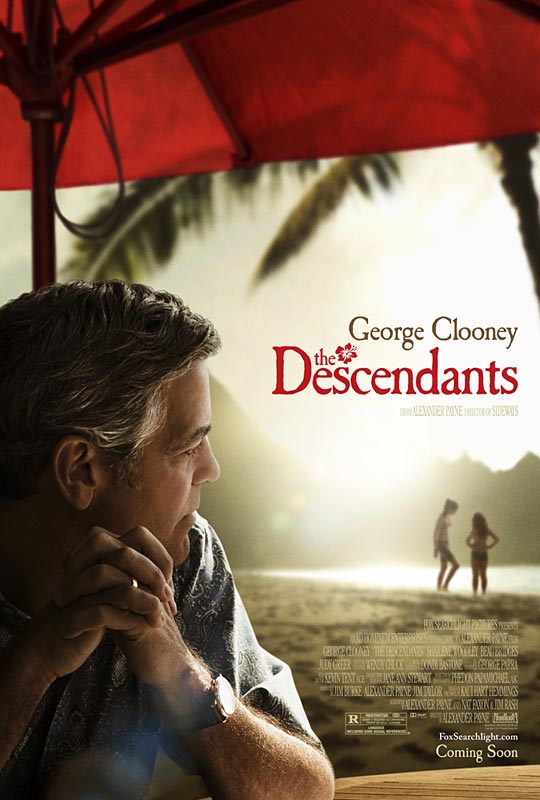
NOT SINCE THE invention of the kitchen food-processor has a vegetable endured such abuse.  In Alexander Payne’s affecting new tragicomedy, “The Descendants,” an unfaithful thrill-seeker of wife named Elizabeth (Patricia Hastie) lies comatosed in a Honolulu hospital while various family members stomp their feet and shout at her.  Even her lover’s wife (a mousy and marvelous Judy Greer) comes around, bearing flowers with seemingly good intentions, and soon rages against the dying woman.  The lasting notion of Payne’s drama is that Elizabeth is a blank screen upon which her family members project their worst ideas about her.  Because she never speaks, because she’s prematurely sent to what Hamlet famously called that “undiscovered country, from whose bourn/No traveler returns,” her own side of the story remains the great missing puzzle piece behind her infidelity and ensuing family fracture.

Elizabeth’s husband, Matt King, a real estate lawyer subtly played by George Clooney, has a long list of grievances, principally that their 17-year-old daughter Alex (Shailene Woodley) spotted her with another man not long before the boating accident that put her in a persistent vegetative state.  A bikini’d Alex returns from rehab, angry and adolescent, and in a nod to “The Graduate,” sinks to the bottom of a leaf-strewn swimming pool upon hearing that her mom will soon be taken off life-support.  Left to fill Elizabeth’s shoes is a cuckolded Clooney who tells us in the film’s opening voice-over: “I’m the back-up parent, the understudy.” Going to the movies means that more often than not, Humpty-Dumpty families have to put themselves back together again – that’s what fiction means – but “The Descendants” is so sardonically real, so life-like, in its representation of modern families that the predictable reconciliation in the final reel doesn’t feel forced or fantastical.  It can be as quotidian and Friday-night as watching “The March of the Penguins” on the sofa while sharing ice cream as a family.

Based on his previous two knock-outs, “About Schmidt” and “Sideways,” Mr. Payne is a master of loco-description, bringing particular places (and all their eccentricities) to life. (This is the dramedy filmmaker, after all, who made an everyman out of the usually larger-than-life Jack Nicholson.)  Just as Nebraska and California wine-country were central to those earlier films, the lush landscape of Hawaii, particularly Kauai, is hardly backdrop in “The Descendants.”  The hibiscus patterns, beach-bums, and Tommy Bahamas are all there, but stripped of their far-off exoticism.  For once, Hawaii on screen is a place you don’t want to someday visit.  Clooney utters the film’s most powerful analogy: “A family is an archipelago, part of the same whole but drifting apart.”

Working from Payne’s (and Nat Faxon and Jim Rash’s) of adaptation of a novel by Kaui Hart Hemmings, the plot is devastatingly domestic: after Elizabeth’s accident, Matt has to lead a gaggle of children and friends toward coming to terms with her loss.  When daughter Alex informs him of the affair, he runs flat-footedly in loafers to a nearby house to demand the truth from Elizabeth’s closest friends.   In “The Descendants,” Clooney is buoyed by the best ensemble cast of the year:  as the flippant Alex, Ms. Woodley (“The Secret Life of the American Teenager”) is a revelation; so, too, is Robert Forster who, as Elizabeth’s doting father, appears in only two scenes and fills each with his wounded rage.  After a word of warning, he cold-cocks Alex’s teenage boyfriend, Sid, who, in a lesser film, would have remained a stoner stereotype but here instead shares a brief bit of dialogue with a sleepless Matt about his own grief.  It’s these realistic touches that make “The Descendants” hard, like family, to shake off.

← Older posts
Newer posts →

Unknown's avatar

Recent Posts

  • Review: “Monsters: The Lyle and Erik Menéndez Story” (Netflix; 2024)
  • Sign Posts!
  • What Killed Jane Austen?
  • Was Austen a Holy Roller?
  • 5 Objects of Vivid Interest

Enter your email address to subscribe to this blog and receive notifications of new posts by email.

Join 256 other subscribers

Top Posts & Pages

  • Colin Carman
  • Review: "Life of Pi"
  • Review: "Crazy Stupid Love"
  • Gone Girls!

Jane Austen

action alien alpha dog amanda seyfried animals anton yelchin blue valentine bradley cooper brad pitt bromance carey mulligan charlize theron chawton christina hendricks christopher plummer colin farrell comedy crazy stupid love crime daniel craig dickens dracula drama emma stone england ewan mcgregor family frankenstein freud gay george clooney hampshire hbo horror jack russell terrier Jane Austen jessica chastain john lithgow joseph gordon levitt jude law kurt cobain mad men madonna mansfield park mary shelley matthew mcconaughey michael fassbender naomi watts oscars paris paul rudd philip seymour hoffman poetry politics portsmouth pride and prejudice romantic romantic comedy ryan gosling science fiction september 11 sex shakespeare shelley steven soderbergh summer blockbuster the hangover the help the social network thriller tim burton true blood twilight vampires viola davis

Blog Stats

  • 56,132 hits
  • RSS - Posts
  • RSS - Comments

Colin Carman Twitter

Tweets by ColinCarman

Colin Carman

Colin Carman

Archives

  • January 2025
  • July 2019
  • May 2013
  • April 2013
  • March 2013
  • February 2013
  • January 2013
  • December 2012
  • November 2012
  • October 2012
  • September 2012
  • August 2012
  • July 2012
  • June 2012
  • May 2012
  • April 2012
  • March 2012
  • February 2012
  • January 2012
  • December 2011
  • November 2011
  • October 2011
  • September 2011
  • August 2011
  • July 2011

Blogroll

  • Cinema Train
  • Dan the Man's Movie Reviews
  • Fogs' Movie Reviews

Category Cloud

Film Reviews Jane Austen Poems and Plogs (Poem-Blogs) Uncategorized

Blog at WordPress.com.

  • Subscribe Subscribed
    • Colin Carman
    • Join 171 other subscribers
    • Already have a WordPress.com account? Log in now.
    • Colin Carman
    • Subscribe Subscribed
    • Sign up
    • Log in
    • Report this content
    • View site in Reader
    • Manage subscriptions
    • Collapse this bar
 

Loading Comments...