• Review: “The Great Gatsby”
  • Review: “Mud”
  • Review: “The Place Beyond the Pines”
  • Review: “Ginger & Rosa”
  • Review: “Stoker”
  • Review: “Side Effects”
  • Review: “Mama”
  • Review: “Zero Dark Thirty”
  • Review: “Gangster Squad”
  • Review: “Les Misérables”
  • Review: “This Is 40”
  • Review: “Any Day Now”
  • Review: “Anna Karenina”
  • Review: “Silver Linings Playbook”
  • Review: “Hitchcock”
  • Review: “Lincoln”
  • Review: “Life of Pi”
  • Review: “Flight”
  • Review: “Skyfall”
  • Review: “Argo”
  • Review: “The Perks of Being a Wallflower”
  • Review: “Looper”
  • Reviews: “Arbitrage” and “The Master”
  • Review: “The Words”
  • Review: “Celeste and Jesse Forever”
  • Review: “Lawless”
  • Review: “The Campaign”
  • Review: “Total Recall”
  • Review: “To Rome with Love”
  • Review: “The Dark Knight Rises”
  • Review: “Moonrise Kingdom”
  • Review: “Magic Mike”
  • Review: “The Amazing Spider-Man”
  • Review: “Brave”
  • Review: “Abraham Lincoln: Vampire Hunter”
  • Review: “Prometheus”
  • Review: “Snow White and the Huntsman”
  • Review: “Bernie”
  • Review: “The Dictator”
  • Review: “The Raven”
  • Reviews: “Salmon Fishing in the Yemen” and “Jiro Dreams of Sushi”
  • Review: “Chimpanzee”
  • Review: “The Cabin in the Woods”
  • Review: “American Reunion”
  • Review: “Detachment”
  • Review: “The Hunger Games”
  • Review: “Casablanca” (In Re-Release; 1 Night Only)
  • Review: “Silent House”
  • Review: “Wanderlust”
  • Review: “This Means War”
  • Review: “Safe House”
  • Review: “The Woman In Black”
  • Review: “The Grey”
  • Review: “Extremely Loud & Incredibly Close”
  • Review: “Contraband”
  • Review: “Shame” and “Young Adult”
  • Review: “War Horse”
  • Review: “The Girl with the Dragon Tattoo”
  • Review: “Like Crazy”
  • Review: “Hugo”
  • Review: “The Descendants”
  • Review: “My Week with Marilyn”
  • Review: “J. Edgar”
  • Review: “In Time”
  • Review: “Take Shelter”
  • Review: “The Thing”
  • Review: “The Ides of March”
  • Review: “Dream House”
  • Review: “50/50”
  • Review: “Moneyball”
  • Review: “Abduction”
  • Review: “Drive”
  • Review: “Contagion”
  • Review: “The Debt”
  • Review: “Our Idiot Brother”
  • Review: “The Help”
  • Review: “Fright Night”
  • Review: “Beginners”
  • Review: “Crazy Stupid Love”
  • Review: “Rise of the Planet of the Apes”

Colin Carman

~ Jane Austen Scholar & Culture Vulture

Colin Carman

Tag Archives: drama

Review: “Flight”

19 Monday Nov 2012

Posted by colincarman in Film Reviews

≈ 2 Comments

Tags

addiction, alcohol, denzel washington, don cheadle, drama, drugs, flight, james badge dale, john goodman, kelly reilly, robert zemeckis

“Whiplash”

Grade: B+ (RENT IT)

IF NOT FOR Denzel Washington’s soulful performance as an airline pilot, “Flight” might have never left the runway.  Make that a chain-smoking, vodka-guzzling airline pilot who wakes up, hung over in an Orlando motel room, but goes on to save the day after force-landing his plane in a field outside of Atlanta with 102 passengers aboard.  We’re used to seeing Washington in the stentorian sort of parts that win him Academy Awards, and this unlikely choice of a role will again keep him in the running for a third statue.  Washington is famous for his pearly smile and big-dog swagger, but here, he’s a man who, like the plane he flies, has lost what’s called all “vertical control.”

At the turbulent center of “Flight,” Whip Whitaker is the very definition of the anti-hero – or, the flawed warrior – and one that Washington has agonizingly brought to life. No one had to know that the Captain, who appeared sober when he boarded the plane that morning, was also high on cocaine, having partied into the early morning with one of his flight attendants.  That is, until a pesky toxicology report surfaces after the plane crashes, six lives are lost, and an investigation by the NationalTransportation Safety Board is opened on the causes of the accident.  Director Robert Zemeckis gave us possibly the most terrifying plane-crash scene in 2000’s “Castaway,” a film that similarly explores the painful truth that no man is an island, and “Flight” is a close second.  Zemeckis, known for the visual wizardry of “Back to the Future” and “Forrest Gump,” eschews the predictable aerial shots of the plane in a total nosedive for the pure panic within the cabin where a stewardess, knocked unconscious, ragdolls from floor to ceiling and passengers puke upside down.  The plane is later said to have dropped 4,800 feet per minute and you will feel every foot.

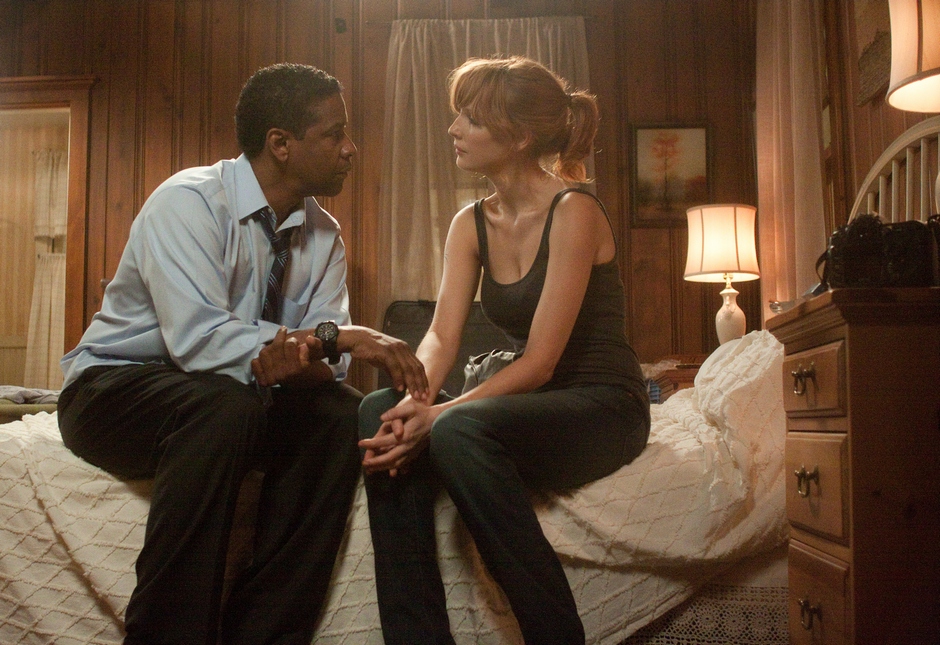
Sensitively scripted by John Gatis, “Flight” is about a different kind of nosedive, that is, Captain Whitaker’s ambivalent attempt to clear his name while, at the same time, cling to the addictive and destructive ways that led up to crash.  He has plenty of enablers around him, including his dealer (John Goodman) and lawyer (Don Cheadle), to ensure that he keeps off-track.  In big-budget Hollywood films such as this one, the twelve steps of rehab usually end in redemption, and “Flight” is no exception.  Whip’s guardian angel is another addict named Nicole (newcomer Kelly Reilly). Despite the fact that Zemeckis and Washington are famous for their flashiness, the most powerful scene in “Flight” is a virtually bare one: inside a hospital stairwell, sneaking a cigarette, Whip meets Nicole, still recovering from an overdose, and a cancer patient (James Badge Dale) from downstairs.  Each has been ravaged by disease in some way and Whitaker is forced, perhaps for the first time, to look at his casual disregard for his life and the lives of others.

When redemption does inevitably arrive in “Flight,” it’s played out in the most public and painful way possible and under the watchful eye of actress Melissa Leo as the Captain’s investigator.  Up until that point, the viewer knows what the public does not, that behind closed doors, the perceived hero behind the plane crash is, in fact, a deadbeat dad, a violent drunk, and in deep denial about his substance abuse.  Yes, he saved the day, but as many high-school drug counselors have been known to say, imagine what he could have accomplished had he not be out of his mind. In this way, “Flight” forces us to rethink some of the just-add-water heroization so prevalent in American culture post-911.   It also takes a hard, close look at addiction and its discontents.

Review: “The Perks of Being a Wallflower”

06 Saturday Oct 2012

Posted by colincarman in Film Reviews

≈ 5 Comments

Tags

drama, emma watson, ezra miller, gay, high school, logan lerman, melanie lynskey, paul rudd, stephen chbosky, the perks of being a wallflower, we need to talk about kevin

“Teenagers on the Verge of A Nervous Breakdown”

Grade: B- (RENT IT)

SOMETIMES WISE, SOMETIMES FUNNY, always infuriating, “The Perks of Being a Wallflower” is only a semi-success.  The source material is Stephen Chbosky’s eponymous coming-of-age novel, published in 1999 and adapted-directed by the author himself for the screen.  The film version of “The Perks” isn’t just a drama of adolescent angst but a retro playlist that, stuffed with Crowded House, The Smiths, and Cracker, alerts us to the film’s setting: Pittsburgh in the early Nineties.  Chbosky’s adaptation is a schizophrenic affair, however: admirably, it doesn’t shy away from the messiness of teenage sexuality, love and longing and yet many of its moment are so precious that they practically demand a collective “Aww” from the audience.  It’s a relief to not see much of the parents in “The Perks” though the kids, wise beyond their years, are too much like adults for the film to really strike a chord.  They’re already looking back.

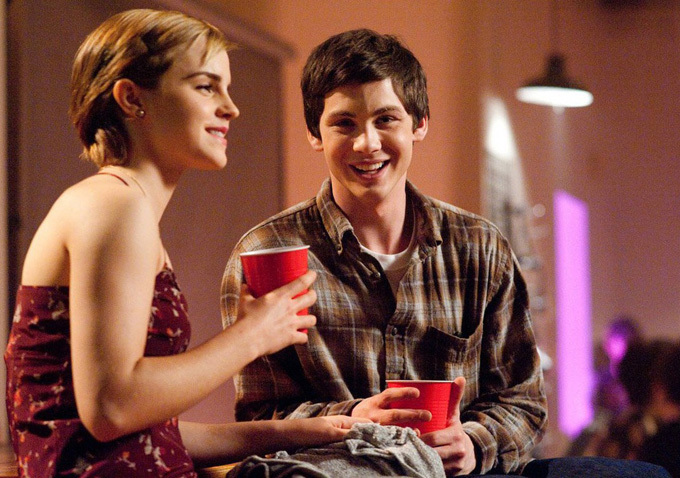
Our protagonist is Charlie (Logan Lerman), a burgeoning writer and nerdlet who has placed in Advanced English under the tutelage of Paul Rudd as a high school teacher supplying this freshman with Salinger and words of wisdom.  Charlie has survived two traumas: the suicide of his best friend and the  death of his aunt (Melanie Lynskey), which he may or may not have caused.  Flashbacks of that time  – a sure sign that a book is being compressed into film – swim in and out of focus.  After seeing an outlandish and openly gay upperclassman named Patrick act out in shop class, Charlie develops a fascination with his classmate and even scoots closer to him at a football game to introduce himself.  Enter Samantha as the third musketeer; she is played by a pixie-ish Emma Watson who has left Hogwarts behind for her first adult leading role only to be upstaged by Ezra Miller as stepbrother Patrick.  (Miller made our blood run cold as the sociopathic Kevin in last year’s “We Need to Talk About Kevin,” and he proves once again to be a fearless and funny scene-stealer.)  Patrick has been carrying on a secret relationship with a closeted quarterback and Sam has a reputation of sorts.  They welcome Charlie to what they describe as their “island of misfit toys.”

The three actors have terrific chemistry together despite the fact that their get-togethers and traditions are completely implausible.  Since when do high schoolers host Christmas parties only to exchange presents like antique typewriters and men’s suits?  Sam and Patrick say things like “It’s rock and roll!” and, taking over the school dance to bust a move to “Come on Eileen,” Patrick reels: “This is what fun looks like!”  The line lands with a thud only because American teenagers haven’t said such things without irony since they wore poodle-skirts and tuned in for “My Three Sons.”  The Nineties were never this nice.  Chbosky smartly undercuts such phony sentimentality at key moments, like when Charlie abruptly tells Sam that his friend shot himself or when he discovers Patrick and the quarterback kissing in an upstairs room, but like any act of nostalgia, “The Perks” is closer to how one might want to remember high school rather than the actual experience.  The Eucharist melts into a hit of LSD; Charlie is given pot brownies and admits he’s “baked like a cake.”  This is the stuff of real adolescence rather than the stuff that dreams are made of.  Less floweriness, more ferocity.

Reviews: “Arbitrage” and “The Master”

24 Monday Sep 2012

Posted by colincarman in Film Reviews

≈ 7 Comments

Tags

amy adams, arbitrage, brit marling, cult, drama, irving berlin, joaquin phoenix, l. ron hubbard, laura dern, nate parker, nicholas jarecki, paul thomas anderson, philip seymour hoffman, richard gere, scientology, susan sarandon, the master, tim roth, tom cruise

“Cult of Personality”

“Arbitrage” (B+; SEE IT)

WHAT’S A BILLIONAIRE to do when he falls asleep at the wheel with his French mistress in the passenger seat?  This, after losing 400 million dollars in a failed investment and having to dodge questions by his only daughter (also his chief accountant), who suspects the books have been cooked.

What, also, happens when a half-mad and alcoholic veteran of World War II named Freddie Quell becomes the disciple of a charismatic cult leader named Lancaster Dodd, a man who lures him into his inner circle only to treat him like something of a lab rat?  Okay, make that his favorite lab rat.

These are the twin dilemmas at the core of two superb new dramas, “Arbitrage” and “The Master,” respectively.  Crying out for Oscar gold, both are performance-driven films that revel in man’s fallibility and will to power.  In the former, Richard Gere plays Robert Miller, a great white shark of Wall Street in tailored suits and an elegant penthouse shared by wife Ellen (Susan Sarandon).  Her nightly mantra is “Working late again, honey?” when, in reality, she knows more than you (and husband Robert) think.  Miller has gone on deceiving Ellen and his investors long enough when a freak car accident turns his life (and luxury sedan) upside down.  Without a fixer like Michael Clayton of his own on speed-dial, he flees the scene and calls on Jimmy Grant (Nate Parker), the son of his chauffeur, to ferry him back to Manhattan and pretend as if nothing ever happened.

The live-in butler who sees Miller burning his clothes in a trash can later that night is nothing compared to NYPD detective Michael Bryer (played by Tim Roth), who doggedly pursues the billionaire with questions  and accusations.  Something of an Inspector Javier, he tells a fellow investigator: “He doesn’t get to walk just because he’s on CNBC.”  First-time director Nicholas Jarecki is the son of husband-and-wife commodity traders – his half brothers are also the documentarians responsible for “Why We Fight” and “Capturing the Friedmans” – which means that film and finance are what the Jarecki family do best.  Driven by Gere’s anti-hero, Jarecki’s plot is intriguingly layered but really no more complicated than your average episode of “The Good Wife” or “Law and Order.”  Instead “Arbitrage” is a character study, powered, as it is, by excellent pacing and a memorable performance by Richard Gere, long overlooked because of, well, his looks and box-office appeal.

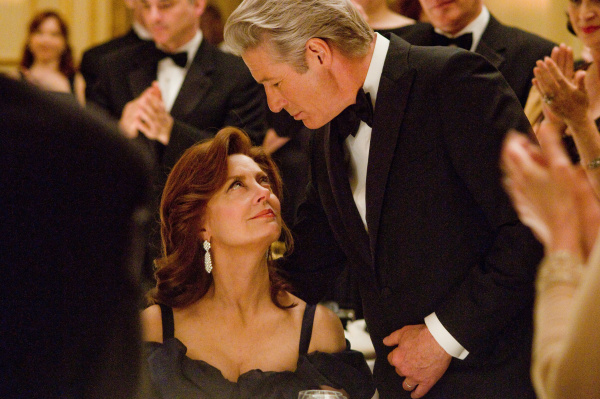
Yet Gere, now a silvery 62, has challenged himself as of late – recall his happy hands in Chicago and the wounded rage of his cuckold in Unfaithful – and is no doubt deserving of film-acting’s highest honor for his dead-on embodiment of a hedge-fund manager trying to keep his castle from crumbling.  When he meets his daughter Brooke (Brit Marling) for a screaming match in Central Park, you will be convinced of this fact.  Watch also as Gere and Sarandon go for each other’s throats later in the film: dressed for another glamorous gala, Ellen is wielding a cocktail and divorce papers while husband Robert is still hiding the ribs he fractured and the forehead he sliced open during his auto accident.  Learning of Brooke’s disappointment in him, he informs Ellen: “The world is cold.”  Sarandon, dead-set on revenge, shoots back: “Then you’re going to need a warm coat.”

“The Master” (A; SEE IT)

BABY, IT’S COLD OUTSIDE, especially so in the dark and unsettling orbit of Paul Thomas Anderson’s latest stroke of genius, “The Master,” which is a different animal altogether though its characters are driven by the same sins – greed, hubris, betrayal – that make “Arbitrage” crackle.  Anderson doesn’t so much make films as he explodes the limits of first-grade filmmaking.  His style zigzags from work to work – how can the neon lubes and lotions of “Boogie Nights” and the hot petrol that oozes through “There Will Be Blood” come from the same source? – but his six feature films are united by a detailed attention to American men living in extremis.  Anderson sees the silver screen as a dissection pan.  Think of Dirk Diggler, the porn god, Barry Egan, the neurotic collector of coupons, Edward L. Doheny, the ruthless oil tycoon, and now, Lancaster Dodd who – Tom Cruise, plug your ears – is some unauthorized version of Scientology founder, L. Ron Hubbard, with his pseudo-scientific, spiritual movement he calls the Cause.  He promises his followers paradise and perfection, but he’s probably just preying on their insecurities, and in Freddie Quell, he’s found a veritable wellspring of weaknesses to exploit and control.  He subjects Quell (who won’t, or can’t be, quelled) to “The Process,” a Q-and-A session in which subjects cannot blink or look away from their interrogator.  Laura Dern plays a wealthy benefactor who keeps Dodd’s boat afloat and, for a little while, above the law.

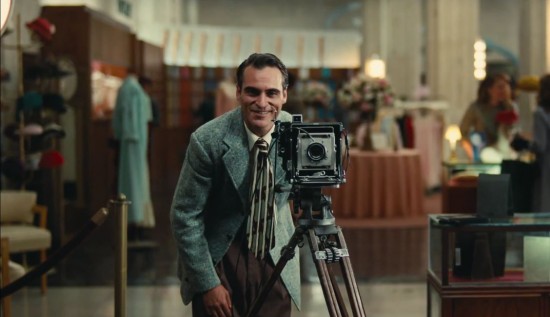
“The Master” is really a study of the disciple, Freddie, however.  After a brief hiatus from acting (and face-shaving), Joaquin Phoenix comes roaring back to the screen as the war-ravaged and shattered Freddie.  He looks markedly older than he did in 2005’s “Walk the Line,” and his face is a twisted wreck of anger and anguish.  Freddie is the id to Dodd’s super-ego: all animal, stinking of the alcoholic concoction he makes from paint thinner and cleaning supplies and looking for a fight as a department-store photographer.  He’s also a bully and in one confounding scene, strangles a man sitting for a portrait with his own necktie.  Anderson gives us the smiling faces of postwar American families, but this is not the America Freddie feels he can call home.  A military doctor, administering a Rorschach inkblot test – Freddie sees only sex and genitals – tells him presciently: There will be people “on the outside” who fail to understand you.

On the outside, he stumbles onto a cruise-liner and falls for Dodd, a figure of some sagacity but also somewhat sinister; he’s expertly rendered by the indomitable Philip Seymour Hoffman. I use the romantic “falls for” because the men’s relationship is another Rorschach test: you might see them as repressed lovers, frenemies, or even God and Lucifer locked in mortal conflict.  (The inclusion of the Irving Berlin song “Get Thee Behind Me Satan,” from 1936, alerts us to the metaphysical conflict at the heart of “The Master.”)   As Dodd’s wife, Peggy, Amy Adams is on hand to temper the men’s feelings for each other.  In another strange scene, we see a heavily pregnant Peggy seated naked in a living room chair while her husband’s other female followers flit around the room, also nude, while the men of the Cause look on with without any sign of desire or emotion.  That’s because all of the emotion, all of the animal energy, is found in Freddie who becomes his master’s fiercest defender and bulldog.  Question the science of Dodd’s practices at a polite social gathering and you’ll have Freddie waiting out back to slap you around for your irreverance.  “You like be told what to do,” Dodd tells Freddie at one point, which, crucially, tells us that “The Master” is about what makes the cult of personality really click.  It’s the dissection of Freddie Quell, but also a study in group psychology and the unspoken laws that make masters of very few and slaves of us all.  In fact, watching “The Master” feels like psychotherapy: slow and uncomfortable at times.

But what really makes “The Master” a masterwork is that, like any lasting work of art, it’s not so much a film, but an outcry.

Review: “The Words”

08 Saturday Sep 2012

Posted by colincarman in Film Reviews

≈ 7 Comments

Tags

ben barnes, bradley cooper, brian klugman, dennis quaid, drama, hemingway, jeremy irons, lee sternthal, nora amezeder, olivia wilde, the words, zoe saldana


“My Word!”

Grade: B- (RENT IT)

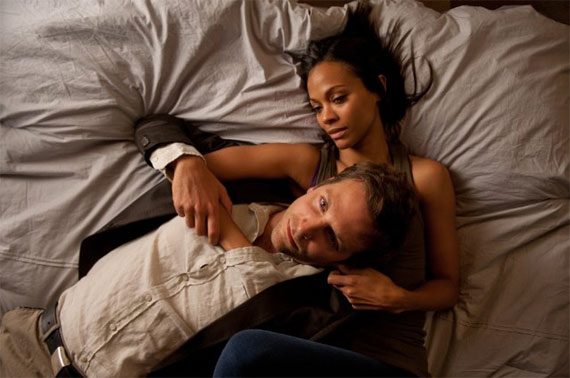
“DON’T YOU KNOW words ruin everything!”  That’s Dennis Quaid, as novelist Clay Hammond, in “The Words,” a morality play on the perils of plagiarism.  Written and directed by Brian Klugman and Lee Sternthal, “The Words” is also the title of Hammond’s newest novel, which tells the tale of a young writer named Rory Jansen (Bradley Cooper) struggling to find literary stardom.

If that sounds like a story-within-a-story,  that’s because “The Words” is a three-tiered narrative in which Hammond pulls the Thackeray-like strings,  giving a public reading of his new work and attracting the attention of his number one fan (Olivia Wilde).  Quaid duplicates the arrogant professor role he played in 2008’s “Smart People” – could this tepid performance be a form of self-plagiarism? – and his lifeless narration drains “The Words” of much of its energy.  Still, the tale he tells is an absorbing one:  rejection letter after rejection letter, Rory is turned away for writing books described by literary agents as too “interior.”  Honeymooning in Paris, he finds, while antiquing, a yellowed and unpublished manuscript sealed inside a suitcase.  That manuscript, which Rory promptly publishes as his own, is entitled “The Window Tears,” and it brings Rory immediate commercial and critical success.  Rory’s own number one fan is his randy wife Dora (Zoë Saldana) who believes wholeheartedly in her husband’s potential, that is, until his literary lie is revealed.  After reading Rory’s new novel, she tells him: “there are parts of you in this novel never seen before.”

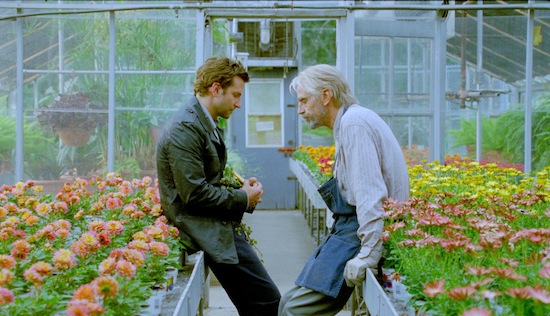
The problem is that Rory’s best work yet has been seen before: by its actual author (a commanding Jeremy Irons) who comes out of the woodwork to confront Rory with his plagiarism.  Known as the Old Man, the Irons character has yet another tale to impart and he does so on a bench in Central Park.  This third narrative, told in flashbacks, is more urgent than the others because it’s undoubtedly his own: as a young man (played by Ben Barnes) in 1940s France, he wrote “The Window Tears” in the wake of his baby girl’s death only for the manuscript to be lost by his waitress wife (Nora Amezeder).  This inner-most story in “The Words” mirrors the real-life legend of Hemingway’s first wife who lost Papa’s unpublished writings in 1922 and because of it, lost Hemingway’s love and trust forever.

Since his breakout performance in “The Hangover,” Bradley Cooper has sobered up and partaken in more intelligent fare.  The problem is that for a film about the pitfalls of plagiarism and the pressures of originality, clichés abound.  Writers on screen are usually portrayed as selfish sadsacks, and Rory is no exception; he’s a well-groomed thirysomething still hitting his father up for money.  Given, however, his robust wardrobe, Cooper looks more like an assistant editor at Men’s Journal than he does a Franzenish raconteur.  Lukewarm, “The Words” is a noble effort with only modest results.   It’s as if “The Words,” which is neither boring nor exciting, was written in invisible ink.

Review: “Detachment”

03 Tuesday Apr 2012

Posted by colincarman in Film Reviews

≈ 5 Comments

Tags

adrien brody, albert camus, blythe danner, christina hendricks, drama, edgar allan poe, james caan, marcia gay harden, sami gayle, tim blake nelson, tony kaye

“No Sub Left Behind”

Grade: C (SKIP IT)

HELL ISN’T RED.  Hell isn’t rocky nor is the inferno fiery and subterranean.  Hell, as Tony Kaye’s overwrought new drama, “Detachment,” would have us believe, is a public high school classroom somewhere in the greater New York area.  Few of us need to be reminded that high school can be a hateful place, but “Detachment” provides us with one substitute teacher’s perspective on the crumbling public education system in America today.   Adrien Brody plays Mr. Henry Barth and with his Modigliani mug – the pencil-thin head and nose thrice broken – gives his best performance in a decade.  “I’m a substitute teacher,” says Henry, “There’s really no responsibility to teach.  The responsibility is to maintain order and to make sure no one is killed in your classroom.”  And he isn’t kidding.  The students in “Detachment” kick, curse, leave their bras at home, kill defenseless animals in the gym, even commit suicide in public places.

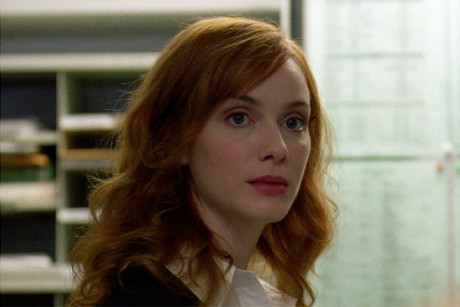
The hyperbolic “Detachment” is a let-down for fans of Tony (“American History X”) Kaye but a sigh of relief for fans of Adrien Brody insofar as the leading man, since winning the Best Actor Oscar in 2002 for Polanski’s “The Pianist,” has followed a career-plan on loan to him from Nicolas Cage: win movie-acting’s highest trophy – and Brody is the youngest actor to do so at age 29 – and subsequently fritter your legitimacy away on cine-trash for the multiplex.  With the exception of that comical cameo as Salvador Dali in “Midnight in Paris” – “Rhinoceros!” – Brody has gifted us these god-awfuls: “The Jacket,” “Splice,” and “Predators.”  Yet he’s the sympathetic center of Kaye’s edu-drama, informed by Marcia Gay Harden (as Carol, the school’s principal) that “you will find many of your students functioning under their grade level.”  That’s understatement.  A faculty of great actors – James Caan, Blythe Danner, Tim Blake Nelson, and Christina “Mad Men” Hendricks – aren’t just underpaid teachers but zookeepers.  In one outrageous scene, Lucy Liu flies off the handle and tells a drop-out that her life will become a “carnival of pain.”  Henry’s life only worsens after 3:15: his grandfather repeatedly wets himself in a nursing facility, confesses to incest,while a prostitute named Erica (played by a cherubic Sami Gayle) whom he generously allows to live in his apartment keeps using that apartment as a brothel.  Kids, these days!

Kaye’s screed on how used-and-abused our teachers are in this country’s public schools is tarnished by over-the-top moments and distracting bits such as first-person testimonials – who exactly is Brody talking to in these interview cut-aways? – and animated sequences in which birds fly and towers crumble.  To give us a real sense of the existential hole in which Henry lives, Kaye opens his film with an epigraph from Camus and ends with a passage from Poe in which we’re heavy-handedly told that the House of Usher is really a metaphor.  “You’ve always been so closed off,” Henry’s grandfather says of Henry’s detachment.  “Why is that?”  Beyond Henry’s opaque character, everything in this film is over attached, pedantic and like Henry’s pupils, in-your-face.   A film with big ideas but excruciating execution, “Detachment” is not so much drama but diatribe.

Review: “Casablanca” (In Re-Release; 1 Night Only)

21 Wednesday Mar 2012

Posted by colincarman in Uncategorized

≈ 4 Comments

Tags

casablanca, classic, drama, humphrey bogart, ingrid bergman, oscars, paul henreid, romantic, world war II

Grade: A (SEE IT)

HERE’S LOOKING AT YOU, KID.

Yet 1942’s “Casablanca” (winner of three Academy Awards, including Best Picture) isn’t a kid anymore.  Tonight, to celebrate the film’s 70th anniversary, Turner Classic Movies will screen, for one night only, a digitally re-mastered edition of the classic World War II romantic drama and mainstay of Top 10 Classic Films lists.  “Casablanca” isn’t just the perfect film; it’s an iconic collection of top-shelf actors (Bogie, Bergman, Rains, Henreid, Lorre), a superb script, perfect pacing, music, melodrama, comedy…say when!

If you can’t visit Rick’s Café Américain tonight, be sure to rent a copy, which is just as well: TCM’s screening includes an introduction by Robert Osborne and commentary by that senile satyr otherwise known as Hugh Hefner (hardly worth the price of admission).  The observations of Osborne are surely worth taking in, but at this point, “Casablanca” and its basket of quotable sayings have already worked their way into popular culture: the misquoted “Play it again, Sam,” “Louis, I think this is the beginning of a beautiful friendship” (which cleverly comes at the film’s ending), and of course, “We’ll always have, Paris.”  Fortunately for film buffs, we’ll always have “Casablanca” for five, fine reasons on which you can rely:

  1. SPANNING THE GLOBE.  There are arguably thirty-five nationalities represented in “Casablanca,” the most cosmopolitan classic of all time.  At a surprisingly modern pace, it moves from Vichy-occupied Morocco to Paris with talk of America, Germany, and Bulgaria in between.  Not only are Rick and Ilsa different nationalities, united by their hatred for the Gestapo, the interracial closeness between the couple and their portable musician, Sam (played by drummer Dooley Wilson) is also forward-thinking for its time.  “Casablanca” transcends most, if not all, geopolitical borders.
  2. MAX STEINER’S MUSIC.  Described by Louis as the “most beautiful woman to ever visit Casablanca,” the luminous Bergman plays Ilsa Lund, a Norwegian ex-lover of club-owner Rick Blaine.  It’s the music that transports her and the house pianist Sam whose take on the 1930s song “As Time Goes By” sends her into a forlorn dream-state.  Enter an enraged Rick, saying “Sam!  I thought I told you never to play that –”  From there, the score by Max Steiner moves to melodramatic orchestration but incorporates bits and pieces of “As Times Goes By.”  Still, that wasn’t enough to win Steiner an Oscar for Best Original Score that year.  But that’s okay, Steiner also lost after writing the music for that little picture called “Gone with the Wind” (1939).  Heard of it?
  3. LOVE AMONG THE RUINS.  One of the many charms of “Casablanca” is that intelligently intertwines wartime politics and romance.   When the film went into general release in January of 1943, Americans already knew the city’s name because of the Casablanca conference, a meeting between Roosevelt and Churchill; the Office of War Information kept the film from troops stationed in North Africa, worried that it would stir up resentment toward Vichy supporters.  “Your business is politics,” Rick tells Captain Louis Renault and his cohorts, leaving the table.  “My business is running a saloon.”  The irony, however, is that as hard as he tries, Rick just can’t keep politics at bay since a war-time, international romance is inherently political.  During the France flashback sequence, Bergman tells Bogie: “With the whole world crumbling, we picked this time to fall in love.”  “Yeah,” Bogie mumbles, “it’s pretty bad timing.”
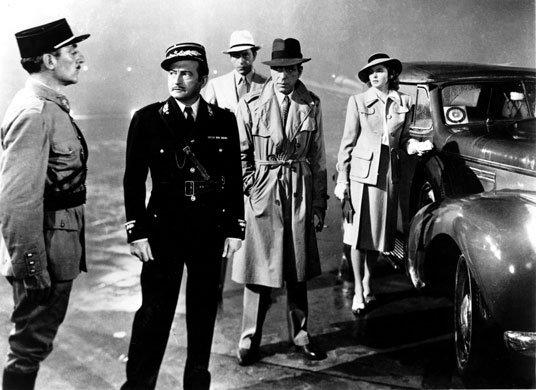
  4. FOR LOVE OR VIRTUE?  The major conflict of “Casablanca” resides in Rick’s last-minute decision: in the famous and final plane hangar scene, gauzed in fog and especially beautiful in black-and-white, the boozy club-owner in a white tuxedo must hang onto the woman he loves or help her and her husband, a Czech resistance leader, escape Morocco (with the Nazi noose tightening) in order to continue the collective fight against Hitler?  Alongside another World War II dilemma, “Sophie’s Choice” (1982), there’s forty years before, Rick’s choice in “Casablanca.”
  5. LIGHTS, CAMERA, ACTION!  Directed by Hungarian-American Michael Curtiz (“Yankee Doodle Dandy,” “White Christmas”), “Casablanca” is that rare film in which production , plot, and performance are all perfectly matched.   Amazingly, Warner Brothers, in the early 1940s, pumped out a picture nearly once a week and Curtiz’s classic was just one on the assembly line.  And yet  “Casablanca” is the exception; like fine wine, it just gets better with age.  Naturally, this film has a phrase for that, too.  As Sam sings, it’s “You must remember this/as times goes by…”

Review: “Extremely Loud & Incredibly Close”

26 Thursday Jan 2012

Posted by colincarman in Film Reviews

≈ 10 Comments

Tags

asperger's syndrome, david foster wallace, drama, eric roth, extremely loud & incredibly close, jeffrey, jeffrey wright, john updike, jonathan safran foer, max von sydow, sandra bullock, september 11, stephen daldry, thomas horn, tolkien, tom hanks, viola davis, world war I

“Building a Mystery”

Grade: B (RENT IT)

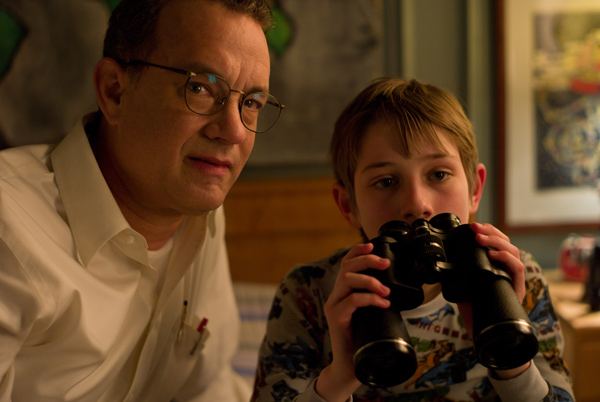
IT’S BEEN A dark decade for America. Our economy crumbled in the terrifying, twin shadows cast by the events of September 11, 2001, or as it’s remembered in Stephen Daldry’s new drama, “Extremely Loud & Incredibly Close,” the “worst day.”  The film begins in the wake of that worst day as Oskar Schell, our 11-year-old protagonist and wunderkind, attends his father’s funeral alongside mother Linda (a muted Sandra Bullock in mournful beige).  The Schells are interring the empty casket of father Thomas (played by Tom Hanks in flashbacks) and, seated apart inside a limousine, strike us as not the closest mother and son.  “Extremely Loud & Incredibly Close” is about the hard work of recovering that interpersonal closeness, of living loudly in the face of seemingly insurmountable loss.  A victim of the 9/11 attacks, Thomas leaves behind a key, and like Chekov’s gun, that key has to open something by the last act.  It comes with the cryptic word “Black,” and soon enough, with the names of 472 New York residents named Black, Oskar sets out to unlock the mystery.  Along the way he meets a fine supporting cast including Viola Davis (“The Help”), Jeffrey Wright (“The Ides of March”), and Max von Sydow (in an Oscar-nominated role as the speechless “Renter” and Oskar’s guardian angel).

In Oskar’s memories of his father, Thomas Schell towers over him like a demigod: a map-maker who builds puzzles for his prodigy son to solve, an intellectual who searches The New York Times each morning for grammatical typos, a jeweler who leaves behind the ultimate treasure-hunt (another cartographic conundrum involving a mythical “Sixth Borough”) for his son to solve.   Mr. Hanks remains one of cinema’s most likeable leading men, and buried, as he is here, by the rubble of Oskar’s grief, his warm presence radiates throughout.  The warmly-lit interior of the Schells’ Upper West Side apartment is a refuge from the senseless world outside and within it, father and son wage a war of oxymorons with Thomas shouting “Now then” and “Found missing” to little Oscar’s retort: “Jumbo shrimp!”

In adapting the 2005 novel by Jonathan Safran Foer, screenwriter Eric Roth (“Forrest Gump,” “The Insider”) retains much of the high jinks and gimmickry – close-ups of elephants tears, YES and NO written on palms, even the flip-book that concluded the novel and sent the image of a falling man back up into the World Trade Center – that divided readers of the novel, which delivered on David Foster Wallace’s call to construct postmodern narratives with an unironic heart.  Yet the most affecting scene of the film is its sparest: an angry Oskar, confounded by the senselessness of his dad’s death, tells Linda: “I wish it had been you.”  We’re not a little shocked when Linda doesn’t strike him but responds with “So do I.”  If only Roth had preserved the conclusion to Foer’s novel in which Oskar finally understands his mother’s own ordeal, telling us, on the page: “Her looking over me was a complicated as anything ever could be.  But it was also incredibly simple.  In my only life, she was my mom, and I was her son.”

And the page is where Foer’s Oskar Schell belongs because on screen, he comes across as petulant and not a little irritating.  As Oskar, newcomer Thomas Horn over-enunciates his lines and lacks the warm relatability that an actor like Hanks has in spades.  He comes across as that precocious little boy who sidles up to the adults table at family functions to show off his knowledge of Tolkien and trigonometry, the one whose mother has to politely ask him to play with the other children.  There’s a suggestion that Oskar suffers from Asperger’s syndrome, but it’s never developed and it’s a shame because his most puzzling behaviors, like hiding the answering machine on which his father left his final messages and replacing it with a new one to keep his mother in the dark, make no sense on the screen whereas the literary Oskar, as the novel’s narrator, is easier to sympathize with.

Foer’s novel wasn’t to everyone’s liking – described as “overextended and sentimentally watery,” it took a drubbing by the late great John Updike in a 2005 review in The New Yorker ­– but it’s naïve to think that a fictionalization involving September 11th survivors could ever please everyone.

It’s not, as many have alleged, that “Extremely Loud & Incredibly Close” is exploitative.  Rather, it’s manipulative and especially so on screen, stripped of the pacifistic and political dimensions of Foer’s novel, which forced us to bring a brain and heart.  Daldry’s reductive take on that work asks only that we bring our Kleenex.

The Best and Worst Films of 2011

02 Monday Jan 2012

Posted by colincarman in Film Reviews

≈ 9 Comments

Tags

aaron sorkin, amanda seyfried, brad pitt, bridesmaids, charlize theron, christopher plummer, comedy, crazy stupid love, drama, drive, ewan mcgregor, george clooney, hugo, jason reitman, jessica chastain, joel shumacher, justin timberlake, kristen wiig, martin scoresese, michael fassbender, moneyball, nicolas cage, nicole kidman, oscars, owen wilson, paris, ryan gosling, sarah jessica parker, sean penn, shailene woodley, take shelter, taylor lautner, the descendants, the help, The Ides of March, the tree of life, thriller, trespass, woody allen, young adult

THE BEST FILMS OF 2011:

1.       “Midnight in Paris” (written and directed by Woody Allen) – Whoever thought you’d someday utter the words “Woody Allen” and “magical” in the same sentence?  After all, it’s been a long time since his “The Purple Rose of Cairo” (1985).  America’s greatest living filmmaker gives us not just his biggest box-office hit in forty years but the longest running movie of 2011.  A delightfully literary meditation on time travel and the Lost Generation.  No one can assemble a cast like Allen; Owen Wilson channels Allen without parodying his jokes and gestures in the City of Lights.

2.      “Drive” (directed by Nicolas Winding Refn) – This ultra-violent vehicle for Ryan Gosling, as the anonymous “Driver,” is a rough patch of LA noir, vicious and thrilling.  It also solidifies Gosling as the most versatile leading man to watch – politically mercurial in “The Ides of March” and a sartorial stallion in the comedy “Crazy Stupid Love” – in 2011.  “Drive” is on track to become a lasting cult favorite.

3.      “Take Shelter” (dir. by Jeff Nichols) – A harrowing meditation on paranoia and climate anxiety with the indomitable Michael Shannon (a sure-fire contender for the Best Actor Oscar) as an Ohio man coming apart.  Jessica Chastain (“The Help,” “The Debt”) was the ingénue of 2011, giving here, as a foil to her bubbly Southern belle in “The Help,” a restrained performance as the wife of a man either mentally ill or clairvoyant.  You decide.  Another powerful psychodrama, set in the heartland, from the writer-director of “Shotgun Stories.”

4.      “The Tree of Life” (written and directed by Terrence Malick) –  It appears only the “little things” in life matter to Malick (“Badlands,” “The Thin Red Line”).  His moving meditation on childhood, love, family, dinosaurs, Texas, the cosmos that had Americans demanding a refund must be worth the price of admission.  Believe it or not, in 2011, many movie-houses had to enforce their NO-REFUND policy for those left dazed and confused by 2011’s only poem-on-film (also the Palme d’Or winner at Cannes).  Costar Sean Penn even admitted that he had no real idea what Malick’s movie is about.  Actors!  Like any thoughtful work of art, it demands a lot from its viewer, but this tree’s roots stretch far and wide.

5.      “Bridesmaids” (dir. by Paul Feig) – Sure, it’s the female “Hangover” – replete with scatological slip-ups and crudely sexual candor – but “Bridesmaids” will get you to the church on time and, potentially, buzzed on the drive there.  Kristen Wiig dropped the over-the-top personae she brings to life on “Saturday Night Live” and surrounded herself with a hilarious ensemble cast that turned the chick-flick genre on its head.  That image alone of Wiig riding the automatic gate to Don Draper’s love pad is comic gold.

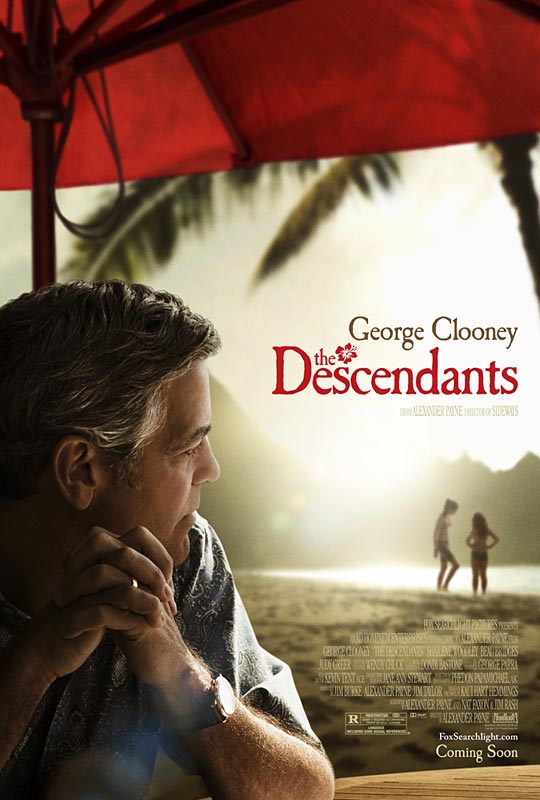
6.      “The Descendants” (directed by Alexander Payne) – After reading George Clooney boast to Rolling Stone that he’d be “surprised” if “The Descendants” didn’t go on to become a Best Picture nominee, I went into a showing of Alexander Payne’s new dramedy with my critical force-field up.  Yet its achingly honest tone and gallows humor eventually win you over.  Clooney’s light is less intense than newcomer Shailene Woodley as his truth-telling daughter.  The family bonds forged here feel real rather than Hollywood hokum.

7.      “Beginners” (dir. by Mike Mills) – It’s hard to believe that the man who, nearly fifty years ago, played Georg van Ludwig Von Tropp in “The Sound of Music” has the gumption, not to mention the joie de vivre, to play a newly widowed man who belatedly comes out of the closet.  Playing Plummer’s son, Ewan McGregor is on hand to scratch his head and find love (and roller-skate) for himself.  Mike (“Thumbsucker”) Mills based the comedy on his father’s own coming out and cancer.  A more cross-generational cancer comedy than the also entertaining “50/50.”

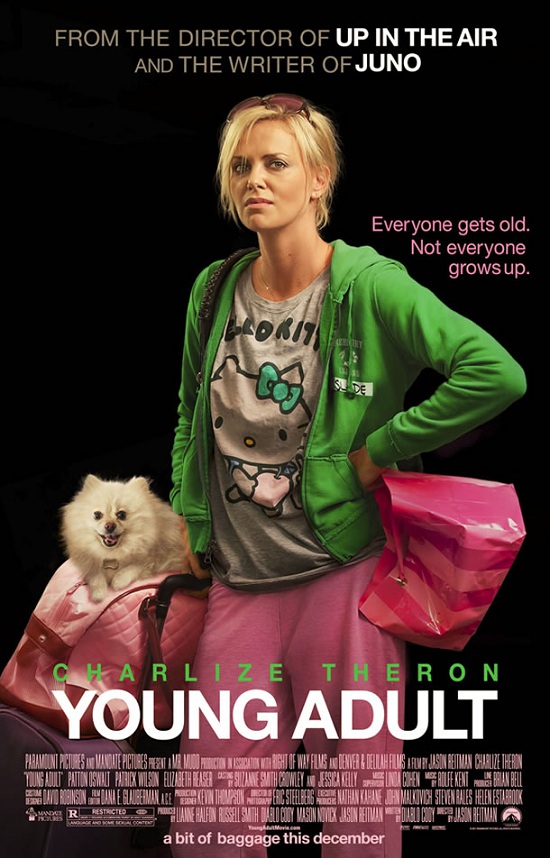
8.      “Young Adult” (dir. by Jason Reitman) – After stumbling with “Jennifer’s Body,” Oscar-winning screenwriter Diablo Cody (“Juno”) reestablishes herself by drawing up the virtually unlikable Mavis Gary, a “prom queen psychopath bitch” (lovingly described by a fellow native of Mercury, Minnesota unhappy to see her back in town and trying to break up a marriage).  Theron embodies another kind of “Monster” while Patton Oswalt delivers the laughs as a self-described “fat geek” who shares the most surprising love scene of ’11 with a wine-stained, cutlet-wearing Theron.

9.      “Hugo” (dir. by Martin Scorsese) – While contemporary Steven Spielberg stretched himself thin with “The Adventures of Tintin” and the mawkish “War Horse,” Martin Scorsese focused his attention – his 3-D attention, no less – on his first children’s film.  “Hugo” has a timeless feel, capturing the hurly-burly of an urchin inhabiting the walls of a Parisian train station and the advent of the motion picture in the age of Georges Méliès.  Is there anything Martin Scorsese can’t do? Oh, that’s right: comedy (see, or don’t see, his “After Hours” of 1985).

10.     “Moneyball” (dir. by Bennett Miller) – After last year’s “The Social Network,” screenwriter Aaron Sorkin hits another home-run with Brad Pitt  as Oakland A’s general manager Billy Beane.  Even a sports-phobe like myself could connect with a script this dizzy with details and  dialogue for grown-ups.  It’s probably time Pitt picks up his first Best Actor Oscar and why not for a willful film that venerates all of you who think outside the box – or better yet, the diamond?

THE (VERY) WORST FILMS of 2011:

1.    “Abduction” – Sorry, Twi-hards, but Jacob Black of the Twilight Saga film series committed a serious error here in the lobotomizing tale of a kid raised, unbeknownst to him, by secret agents.  Lautner is far from ready for his close-up, Mr. DeMille.  He has the vacant, Neanderthalic gaze of Kim Kardashian’s short-lived husband, Kris Humphries.  If only “Abduction” had felt as short as that marriage.

2.    “In Time” – A perfectly acceptable script from Andrew Niccol (“Gattaca”) was marred by the calling-it-in acting style of Justin Timerblake who, like Taylor Lautner, is best kept in the chorus.  Costar Amanda Seyfried resembles a dyspeptic goldfish as she and Timberlake chase across rooftops, trying to beat the clock in “In Time.”  An acting malfunction.

3.    “Shame” – For some inexplicable reason, Michael Fassbender is being praised for playing a Manhattan professional addicted to sex in the impotent “Shame.”  Never has sexuality been so boring, characters so undeveloped, and a narrative so negligible as in Steve McQueen’s self-serious sophomore effort.  If the audience isn’t laughing derisively by the time Brandon descends into an inferno of gay bars and Sapphic three-ways, they’re not paying attention.  I returned to the lobby to dispense liquid butter directly into my eyeballs to blur this nightmare of a “drama.”  Shameful, indeed.

4.  “I Don’t Know How She Does It” – The one-note Sarah Jessica Parker fails to mix it up a bit (again) in this wannabe feminist twaddle.  Parker plays Kate Reddy, a finance executive juggling professionalism and pampers.  If only Charlotte, Miranda, and Samantha had helped with babysitting duties, we might not have had to once again sympathize with the saccharine sentimentality of white woman bourgeois guilt.  Far from a breadwinner, this is a bread-loser that confirms the old adage that indeed you can’t have it all.

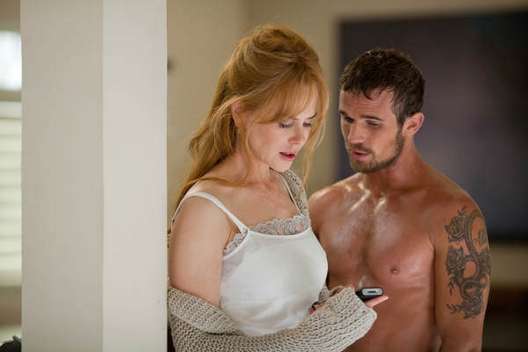
5.  “Trespass” – What was Nicole Kidman thinking to team up with the execrable Nicolas Cage and hit-or-miss director Joel Shumacher (“Dying Young,” “Phone Booth”)?  Cage plays a businessman and diamond-dealer victimized, alongside wife Kidman, during a sadistic house invasion.  If it’s pointless violence you’re after, “Trespass” has more than enough gore to go around.  If you play this loudly in your house, your neighbors will likely call the police due to its vociferous gunfire and relentless female shrieking.

In a year belonging to Woody Allen, it’s worth remembering a line from “Annie Hall” (1977).  (It’s a classic older than I am with insights immemorial.)  In the following, replace “television shows” with “movies,” especially the soulless “Trespass”:

Annie, in California: “It’s so clean out here.”

Alvy (Allen): “They don’t throw their garbage away. They turn it into television shows.”

Review: “Shame” and “Young Adult”

31 Saturday Dec 2011

Posted by colincarman in Film Reviews

≈ 3 Comments

Tags

4 non blondes, carey mulligan, charlize theron, comedy, cracker, diablo cody, drama, hunger, inglourious basterds, james badge dale, jason reitman, jennifer's body, michael fassbender, minnesota, new york, patrick wilson, patton oswalt, sex addiction, shame, steve mcqueen, the lemonheads, young adult

“Adults Behaving Badly”

Grade: “Shame” (D+/SKIP IT) and “Young Adult” (B+/SEE IT)

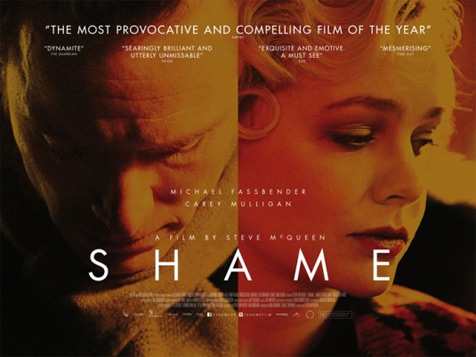
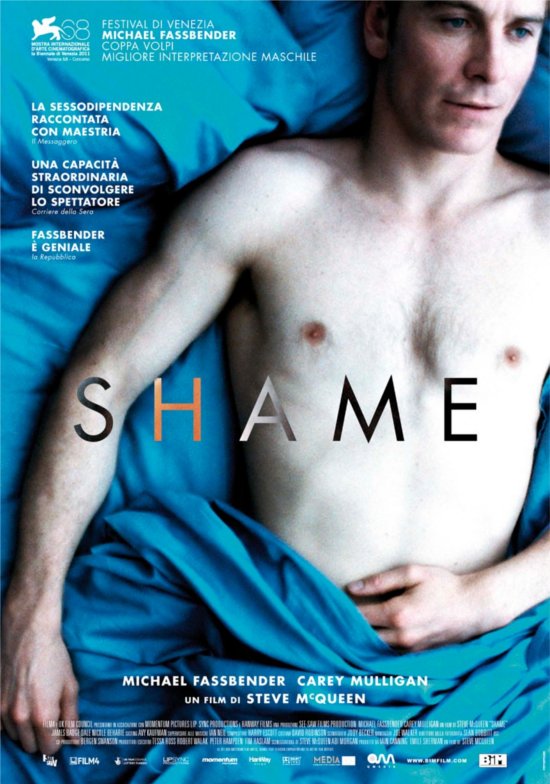
IT’S EITHER FEAST or famine for British artist-turned-filmmaker Steve McQueen.  His last film, the nakedly honest “Hunger” of 2008, involved the 1981 Irish hunger strike while his latest, “Shame,” is a melodrama of excess, appropriately set in the city of too-much-ness: Manhattan.  The star of both those films, Michael Fassbender (“Inglourious Basterds,” “A Dangerous Method”) plays Brandon, a handsome professional addicted to sex.  When his sister Sissy (played by Carey Mulligan) comes to town, he’s forced to confront the error of his ways and with deadening effects.  Just as Brandon loses his stamina when canoodling with a woman he actually likes and admires, “Shame” is an impotent flick – a noodley, unfulfilling affair.

Perhaps the most remarkable thing about “Shame” is that it’s NC-17.   My own 9:30 screening was preceded by a word of caution from a well-meaning usher, dispatched to tell us that the film is “intense” and that we may want to visit the bar upstairs before it closes at 10 PM.  “Shame” will no doubt spur the urge to drown your sorrows.  With a plot so thin it’s diaphanous, “Shame” follows Brandon from the depths of the subway, where he makes eyes at a beautiful stranger, to the towering heights of his office space where it’s unclear what Brandon does for a living, except that his hard drive has been confiscated by his employers.  His womanizing boss (James Badge Dale) gives him a mere slap on the wrist, calling his Internet history “filthy,” but happily joins him during his late-night sexcapades.

Brandon’s home life is no less troubling: sister Sissy beds his boss right before his eyes and her wrists are scarred from previous suicide attempts.  She’s also an aspiring singer, and we’re subjected to Ms. Mulligan’s painful rendition of “New York, New York” inside a lazily-lit lounge.  It’s also, aptly, her only number in a one-note film lacking any dimensionality.  Gone are such plot devices as rising action and character development.  The great irony of “Shame,” a film purportedly about sex addiction, is that it’s missing a climax.

Sex addiction remains a contentious matter.  Is it a real affliction or a cop-out for those lacking self-control?  Who else but the very beautiful could decry the problem of too much sex?  “Shame” sheds little to no light on this question.  If the red-flag of compulsion is a destructive impact on one’s professional and personal life, Brandon’s erotic preoccupations fail to qualify.  Only a puritan would treat Brandon’s love of pornography (unquenched by his onanistic trips to the men’s bathroom while at work) with such shock and revulsion.  Even more shameful is the way gay sexuality is inserted into Brandon’s downward spiral.  “Shame” suggests that Brandon has only truly hit rock bottom once he enters a red-lit gay bar, desperate for gratification, followed up by a threesome with two women.  The heavy orchestral music that accompanies Brandon’s conquests makes the whole affair laughably lugubrious.  As a Garden State native, I take particular offense to Sissy’s remark to Brandon, “We’re not bad people – We just come from a bad place,” since that place is New Jersey.  First, Snookie – now this.


IF IT’S CHARACTER and complexity you’re looking for –real people with real interiorities – look no further than Diablo Cody’s acerbic new comedy, “Young Adult” starring an unsmiling and spectacular Charlize Theron.  Like the protagonist of “Shame,” Theron’s character repeatedly wakes up, face-down, in her high-rise apartment.  She’s another rudderless and lonely thirtysomething for whom the thrill is gone.  She’s Mavis Gary, the high school prom queen who left her hometown of Mercury, Minnesota for Minneapolis (admiringly dubbed the “Mini-Apple” by locals).  Mercury residents think Mavis leads a glamorous life as a writer of young adult novels, but instead, she inhabits a dreary apartment littered with Diet Coke cans, pee-pads for her Pomeranian named Dolce, and a TV always tuned to the E! channel.  Upon learning that her old beau, Buddy Slade (played by a scruffy Patrick Wilson), has become a new father, she drops what she’s doing – including the one-night-stand still asleep in her bed – to win him back.  Mavis is driven by delusion, so much so that you’ll want to throttle her.  “Buddy Slade and I are meant to be together,” she insists, “and I’m here to get him back.”

A proud and aspiring homewrecker, Mavis is one of the most unforgettable female figures of the year.  Cody’s script flies in the face of every romantic comedy convention since her anti-heroine, Mavis, isn’t just flawed but ferociously unlikable: about as warm as the tundra, narcissistic, and like many of Cody’s characters, especially those in her uneven foray into horror (2009’s “Jennifer’s Body”), downright mean.  When Mavis runs into an old classmate, Matt Freehauf (a perfect Patton Oswalt) at a dive bar called Woody’s, she remembers Matt only as the “hate crime guy” who was brutally attacked by jocks – his leg and pelvis shattered by a crowbar – and replies coldly to his misfortune: “Didn’t you get to miss a lot of school for that?”

As in all of Diablo Cody’s scripts, the devil is in the details: a love of slang, socially awkward moments, and the banalities that define American life (its Pizza Huts, its Hampton Inns, its broken computer printers).  Director Jason Reitman (“Up in the Air,” “Thank You For Not Smoking”) also directed Cody’s breakout, “Juno,” and his keen sense of pacing and comic timing serves her script well, once again.  No one looks more out of place than the impossibly beautiful Theron inside a generic sports bar, but Reitman manages to go beneath that surprising surface.  When Mavis’s humanity finally emerges, at a Slade family party that she predictably turns upside down, you genuinely feel for her as some details of her and Buddy’s past come, kicking and screaming, to light.

Of all the Nineties tunes wafting through this little gem of a film (Cracker’s “Low,” 4 Non Blonde’s “What’s Up”), “It’s a Shame About Ray” by the Lemonheads may be the most telling.  It’s a shame about “Shame” but “Young Adult” is a full-grown work.

Review: “The Descendants”

29 Tuesday Nov 2011

Posted by colincarman in Film Reviews

≈ 2 Comments

Tags

alexander payne, comedy, drama, george clooney, hawaii, jack nicholson, jim rash, judy greer, kaui hart hemmings, nat faxon, patricia hastie, shailene wooley, shakespeare, the descendants

“Welcome to Paradise?”

Grade: A- (SEE IT)

NOT SINCE THE invention of the kitchen food-processor has a vegetable endured such abuse.  In Alexander Payne’s affecting new tragicomedy, “The Descendants,” an unfaithful thrill-seeker of wife named Elizabeth (Patricia Hastie) lies comatosed in a Honolulu hospital while various family members stomp their feet and shout at her.  Even her lover’s wife (a mousy and marvelous Judy Greer) comes around, bearing flowers with seemingly good intentions, and soon rages against the dying woman.  The lasting notion of Payne’s drama is that Elizabeth is a blank screen upon which her family members project their worst ideas about her.  Because she never speaks, because she’s prematurely sent to what Hamlet famously called that “undiscovered country, from whose bourn/No traveler returns,” her own side of the story remains the great missing puzzle piece behind her infidelity and ensuing family fracture.

Elizabeth’s husband, Matt King, a real estate lawyer subtly played by George Clooney, has a long list of grievances, principally that their 17-year-old daughter Alex (Shailene Woodley) spotted her with another man not long before the boating accident that put her in a persistent vegetative state.  A bikini’d Alex returns from rehab, angry and adolescent, and in a nod to “The Graduate,” sinks to the bottom of a leaf-strewn swimming pool upon hearing that her mom will soon be taken off life-support.  Left to fill Elizabeth’s shoes is a cuckolded Clooney who tells us in the film’s opening voice-over: “I’m the back-up parent, the understudy.” Going to the movies means that more often than not, Humpty-Dumpty families have to put themselves back together again – that’s what fiction means – but “The Descendants” is so sardonically real, so life-like, in its representation of modern families that the predictable reconciliation in the final reel doesn’t feel forced or fantastical.  It can be as quotidian and Friday-night as watching “The March of the Penguins” on the sofa while sharing ice cream as a family.

Based on his previous two knock-outs, “About Schmidt” and “Sideways,” Mr. Payne is a master of loco-description, bringing particular places (and all their eccentricities) to life. (This is the dramedy filmmaker, after all, who made an everyman out of the usually larger-than-life Jack Nicholson.)  Just as Nebraska and California wine-country were central to those earlier films, the lush landscape of Hawaii, particularly Kauai, is hardly backdrop in “The Descendants.”  The hibiscus patterns, beach-bums, and Tommy Bahamas are all there, but stripped of their far-off exoticism.  For once, Hawaii on screen is a place you don’t want to someday visit.  Clooney utters the film’s most powerful analogy: “A family is an archipelago, part of the same whole but drifting apart.”

Working from Payne’s (and Nat Faxon and Jim Rash’s) of adaptation of a novel by Kaui Hart Hemmings, the plot is devastatingly domestic: after Elizabeth’s accident, Matt has to lead a gaggle of children and friends toward coming to terms with her loss.  When daughter Alex informs him of the affair, he runs flat-footedly in loafers to a nearby house to demand the truth from Elizabeth’s closest friends.   In “The Descendants,” Clooney is buoyed by the best ensemble cast of the year:  as the flippant Alex, Ms. Woodley (“The Secret Life of the American Teenager”) is a revelation; so, too, is Robert Forster who, as Elizabeth’s doting father, appears in only two scenes and fills each with his wounded rage.  After a word of warning, he cold-cocks Alex’s teenage boyfriend, Sid, who, in a lesser film, would have remained a stoner stereotype but here instead shares a brief bit of dialogue with a sleepless Matt about his own grief.  It’s these realistic touches that make “The Descendants” hard, like family, to shake off.

← Older posts
Newer posts →

Unknown's avatar

Recent Posts

  • Review: “Monsters: The Lyle and Erik Menéndez Story” (Netflix; 2024)
  • Sign Posts!
  • What Killed Jane Austen?
  • Was Austen a Holy Roller?
  • 5 Objects of Vivid Interest

Enter your email address to subscribe to this blog and receive notifications of new posts by email.

Join 256 other subscribers

Top Posts & Pages

  • Colin Carman
  • Review: "Crazy Stupid Love"

Jane Austen

action alien alpha dog amanda seyfried animals anton yelchin blue valentine bradley cooper brad pitt bromance carey mulligan charlize theron chawton christina hendricks christopher plummer colin farrell comedy crazy stupid love crime daniel craig dickens dracula drama emma stone england ewan mcgregor family frankenstein freud gay george clooney hampshire hbo horror jack russell terrier Jane Austen jessica chastain john lithgow joseph gordon levitt jude law kurt cobain mad men madonna mansfield park mary shelley matthew mcconaughey michael fassbender naomi watts oscars paris paul rudd philip seymour hoffman poetry politics portsmouth pride and prejudice romantic romantic comedy ryan gosling science fiction september 11 sex shakespeare shelley steven soderbergh summer blockbuster the hangover the help the social network thriller tim burton true blood twilight vampires viola davis

Blog Stats

  • 55,662 hits
  • RSS - Posts
  • RSS - Comments

Colin Carman Twitter

Tweets by ColinCarman

Colin Carman

Colin Carman

Archives

  • January 2025
  • July 2019
  • May 2013
  • April 2013
  • March 2013
  • February 2013
  • January 2013
  • December 2012
  • November 2012
  • October 2012
  • September 2012
  • August 2012
  • July 2012
  • June 2012
  • May 2012
  • April 2012
  • March 2012
  • February 2012
  • January 2012
  • December 2011
  • November 2011
  • October 2011
  • September 2011
  • August 2011
  • July 2011

Blogroll

  • Cinema Train
  • Dan the Man's Movie Reviews
  • Fogs' Movie Reviews

Category Cloud

Film Reviews Jane Austen Poems and Plogs (Poem-Blogs) Uncategorized

Blog at WordPress.com.

  • Subscribe Subscribed
    • Colin Carman
    • Join 171 other subscribers
    • Already have a WordPress.com account? Log in now.
    • Colin Carman
    • Subscribe Subscribed
    • Sign up
    • Log in
    • Report this content
    • View site in Reader
    • Manage subscriptions
    • Collapse this bar
 

Loading Comments...