• Review: “The Great Gatsby”
  • Review: “Mud”
  • Review: “The Place Beyond the Pines”
  • Review: “Ginger & Rosa”
  • Review: “Stoker”
  • Review: “Side Effects”
  • Review: “Mama”
  • Review: “Zero Dark Thirty”
  • Review: “Gangster Squad”
  • Review: “Les Misérables”
  • Review: “This Is 40”
  • Review: “Any Day Now”
  • Review: “Anna Karenina”
  • Review: “Silver Linings Playbook”
  • Review: “Hitchcock”
  • Review: “Lincoln”
  • Review: “Life of Pi”
  • Review: “Flight”
  • Review: “Skyfall”
  • Review: “Argo”
  • Review: “The Perks of Being a Wallflower”
  • Review: “Looper”
  • Reviews: “Arbitrage” and “The Master”
  • Review: “The Words”
  • Review: “Celeste and Jesse Forever”
  • Review: “Lawless”
  • Review: “The Campaign”
  • Review: “Total Recall”
  • Review: “To Rome with Love”
  • Review: “The Dark Knight Rises”
  • Review: “Moonrise Kingdom”
  • Review: “Magic Mike”
  • Review: “The Amazing Spider-Man”
  • Review: “Brave”
  • Review: “Abraham Lincoln: Vampire Hunter”
  • Review: “Prometheus”
  • Review: “Snow White and the Huntsman”
  • Review: “Bernie”
  • Review: “The Dictator”
  • Review: “The Raven”
  • Reviews: “Salmon Fishing in the Yemen” and “Jiro Dreams of Sushi”
  • Review: “Chimpanzee”
  • Review: “The Cabin in the Woods”
  • Review: “American Reunion”
  • Review: “Detachment”
  • Review: “The Hunger Games”
  • Review: “Casablanca” (In Re-Release; 1 Night Only)
  • Review: “Silent House”
  • Review: “Wanderlust”
  • Review: “This Means War”
  • Review: “Safe House”
  • Review: “The Woman In Black”
  • Review: “The Grey”
  • Review: “Extremely Loud & Incredibly Close”
  • Review: “Contraband”
  • Review: “Shame” and “Young Adult”
  • Review: “War Horse”
  • Review: “The Girl with the Dragon Tattoo”
  • Review: “Like Crazy”
  • Review: “Hugo”
  • Review: “The Descendants”
  • Review: “My Week with Marilyn”
  • Review: “J. Edgar”
  • Review: “In Time”
  • Review: “Take Shelter”
  • Review: “The Thing”
  • Review: “The Ides of March”
  • Review: “Dream House”
  • Review: “50/50”
  • Review: “Moneyball”
  • Review: “Abduction”
  • Review: “Drive”
  • Review: “Contagion”
  • Review: “The Debt”
  • Review: “Our Idiot Brother”
  • Review: “The Help”
  • Review: “Fright Night”
  • Review: “Beginners”
  • Review: “Crazy Stupid Love”
  • Review: “Rise of the Planet of the Apes”

Colin Carman

~ Jane Austen Scholar & Culture Vulture

Colin Carman

Author Archives: colincarman

Welcome to Austenland

02 Tuesday Jul 2019

Posted by colincarman in Jane Austen

≈ 8 Comments

Tags

British literature, chawton, colorado mesa university, england, frankenstein, Jane Austen, lord byron, mary shelley, pride and prejudice

Ah, l’aimable Jane!

scan-3

This is a blog where, recipe-by-recipe, I re-create the famous French meals popularized by Julia Child, including her Chef Boyardee. Oh wait, that’s been done before! Instead, this is a blog where I leak top-secret government files and document my time spent inside the Ecuadorian embassy while on roller-skates. Rats, it’s all been done before!

No, no, this is a blog where I document a four-week research trip to Austenland in Hampshire, England. Please don’t tell me to “keep calm” — tranquillity is overrated — but I’ll allow this, just this once:Read Austen

If you’re still reading, you haven’t clicked away because you’re (1) a fan of Austen, (2) a close family member of mine, or (3) someone with a browser that froze. If you fall into the third category, and especially if you own a PC, just throw a heating blanket over the monitor and hope for the best.

Welcome to Austen-Leaks or, better yet, Wiki-Darcy. What do you call a cat-lover’s version of an Austen novel? Answer: Purr-suasion.

Whatever you call it, this is a blog that begins on the Butts, the Butts Road in Alton, England, that is. This is the only English-speaking country on the face of the earth — didn’t they invent English, after all, with the help of Beowulf, or was it Virginia Woolf? — that can label a street “Butts Road” without a hint of self-consciousness. Please do not wake up the Butts! They need their rest. The Butts family tree is available upon request. It’s in my back pocket.

IMG_0062

New to the area, I originally thought that a family with the most unfortunate of surnames resides in this house but, alas, the Butts takes you toward Chawton Village where one of the world’s greatest storytellers lived for the last eight years of her life. Her name was Mary Shelley – oh wait, Mary Shelley was the subject of my first book. This blog, and germinating second book, is about Jane Austen (1775-1817). Thanks to the sponsorship of The Jane Austen Society of America, I was awarded the international visitor position for a research trip. That’s the academic version of solitary confinement but the cuisine is better. But this is England, folks, so just barely.

Today the lovely and welcoming people at Chawton even made me a name tag – Colin Carman, Ph.D. J.A.S.N.A. I.V.P. (yeah, you know me) – so it’s official. (The more abbreviations after your name, the more useless you are in everyday life. Once my car broke down, so I sold it to the roadside assistant and just drove off in his; it was a Geo.) There’s even a slight discount on sandwiches and tea in the dining room.

Today, I offered a potato chip to the house dog – Toby (photo-ready below) – who came by the table where I was taking notes, but he didn’t want the chip. Could he be cuter? Having two Labrador Retrievers back in the States, I was shocked to meet a dog that actually refused a table scrap. Our dogs will eat anything that doesn’t eat them first. I also had a clearer head today, on my second day in Hampshire, than I did on my first day: jet-lag, a discount on Cornish ales in the pub just down the road from the room I rented, et cetera. Toby remains unimpressed.

IMG_0101


Before I got a real job at the univ, I maintained this blog and wrote film reviews. I also taught yoga, which means your life is pretty much going nowhere fast. I take that back: you can achieve nirvana but also bankruptcy. You see, watching films and reading literary fiction are my two favorite past times but to really drum-up traffic, on Twitter or in the blogosphere, you have to really (and contentiously) engage with other bloggers and Tweeters and I haven’t the time. This is called “dragging,” as in “Oooh, don’t drag me, bro.” You won’t find me in many comments sections as it’s a rather giant W.O.T. (or, waste of time). That was five or so years ago, before I taught a course on Jane Austen at my home university, Colorado Mesa University, and before I wrote a book about Mary Shelley, her poet-husband Percy Bysshe Shelley, and their engagement with the natural world. Thank you to my alma mater for providing me with unlimited shower caps for life.

Having spent a lot of time reading and thinking about the English Romantics, I thought it might be wise to shift my focus to another Romantic heavyweight, Jane Austen, and sustain my interest in environmentalist philosophy. Austen is generally thought to be a “social” writer and chronicler of nineteenth-century courtship and marriage. She is still unfairly pegged as a “woman writer” with “feminine” interests but we’ll return to that misconception later on. I can’t help myself, so here is a Shelleyan collage from last summer when I visited Mary Shelley’s grave in Bournemouth. Check out the guy who photobombed my pic. He actually growled at me to get out the way. The only requirement at the Shelley gravesite is that you don’t rob it, and that’s not a lot to ask! Oh and don’t plug the corpse into any available outlet.

MS GraveFor now, here are four important facts about Jane Austen, her life and works.

#1. Jane Austen was the seventh of eight children and her only sister Cassandra’s junior by two years. They had five brothers, which meant sizable Tesco bills for their father, the Reverend George Austen and his wife Cassandra. Three sons in three years: good grief! Here is Mrs. Austen’s grave in the churchyard just below the manor house owned by the Austen sisters’ older (and considerably richer) brother Edward. Every good writer needs a benefactor, after all! The third eldest of the Austen boys, Edward was adopted by the very wealthy cousins of his father, the Knight family, which meant that his financial situation went from black to white, or day to Knight, in the blink of an eye. I have a pretty wealthy uncle myself — he invented the surgical glove two centuries ago — but he hasn’t yet put me on the payroll. Uncle Nathan, stop acting like you have a new phone and responding: “Who dis? New phone.” You can only use that excuse twice.

Saint Nicholas

The year 1808 was a bad year for Edward’s wife, who died, but a good year for the unmarried Austen sisters who wasted no time in moving from Southampton to Chawton. The former place is the port city where a little-known vessel called the Titanic embarked on its fatally frosty voyage. The Titanic, as you know, did not live up to its illustrious name but that’s the just the tip of the iceberg. Two years prior to the death of Edward’s wife, the Austens gathered in Chawton and by 1809, they made this tiny village in the west country their home.

The two Cassandras, Jane’s sister and mother, are interred adjacent to the sanctuary of Saint Nicholas, which you can see jutting out from the trees below. This is a stone-built chapel dating from the thirteenth century. Jane’s father officiated for thirty years at Saint Nick’s, which is 870 fewer years than the yew tree has stood outside and, at one time, held the keys to the front door inside. Remember to lock the doors tightly, so the swallows don’t conduct their own service. But don’t be such a cassandra about it! Not the end-of-the-world. Why are mother and daughter buried side-by-side? I’ll look into that. What do you call a cremated Romantic? (I don’t have a punchline for that one, so feel free to contribute in the comments.) Are you asleep already? For the textual equivalent of Melatonin, here is my book on the Shelleys.

Mother Sister Graves

#2. A tad more biography: before Christmas in 1775, Jane was born to her clergyman father during a bitterly cold stretch of winter, so cold, in fact, that lambs froze in the fields. Lamb shoulder is a thing in the UK, btw. Do they have shoulders, really? Were lamb shoulder pads a thing in the 1980s? Reverend Austen, who had forfeited his scholarship at Oxford University, because he wished to start a family with Cassandra, walked in the snow to lay holly at Saint Nicholas and to serve the sacrament. This was soon after his second and youngest daughter was born at home, without the aid of a physician (common for the time period), and christened at Steventon Rectory. Jane Austen’s birthplace has been since torn down. I was born and raised in New Jersey, which means that my baptismal font served a dual function as a punch bowl at Dunkin’ Donuts.

#3. Jane Austen isn’t simply a proper English writer but, by now, an industry unto herself. In fact, her novels could easily rival that single work of her contemporary, Mary Shelley, in terms of screen time. There are more than one hundred Frankenstein-inspired films – “Frankenweenie” anyone? – and nearly that many loosely based on Austen’s fiction. There’s even Pride and Prejudice with Zombies, a book that can be judged by its cover since the title is the most memorable part. I’m currently re-writing a work of J.D. Salinger’s, tentatively called The Catcher in the Rye with Zombies, so Brian Grazer or other Hollywood producers, if you’re out there, just shoot me an email and it’s yours. It’s too bad she predates movie royalties. She and Cassandra would travel by donkey — no joke — to Alton to get groceries; had she lived to see her novels’ success on screen, the sisters would have traveled by Tesla and thrown their candy wrappers out the window.

#4. Jane Austen only saw real success during the last seven years of her short but productive life; she likely died of Addison’s Disease but the cause of death remains a debate in medical history. Adrenal failure is certainly no fun; what is fun is this little tidbit: when Austen completed a draft of what would become her most popular novel, Pride and Prejudice, she was just twenty years old (only one year older than Mary Shelley when she composed Frankenstein) though she would not see the novel in print for another thirty seven years! And you thought your pointless doctoral dissertation on apiarian promiscuity in the works of Margaret Atwood was taking forever! This means that Austen was same age as her classic heroine, the strong-willed Elizabeth Bennet, when she wrote it and nearly as old as Eliza’s mother when it finally reached the reading public in 1813. From there, she lived like a Romantic-era rock star: sex, drugs, and rock n’ roll. Actually, no, that was Lord Byron’s job and the unmarried Austen lived out her days without children, or, as I like to say, “child-free.” In fact, she regarded her novels as her children and, having gotten a taste of success, remarked that the success of Pride and Prejudice and Sense and Sensibility “only makes me long for more.” Get it, girl!

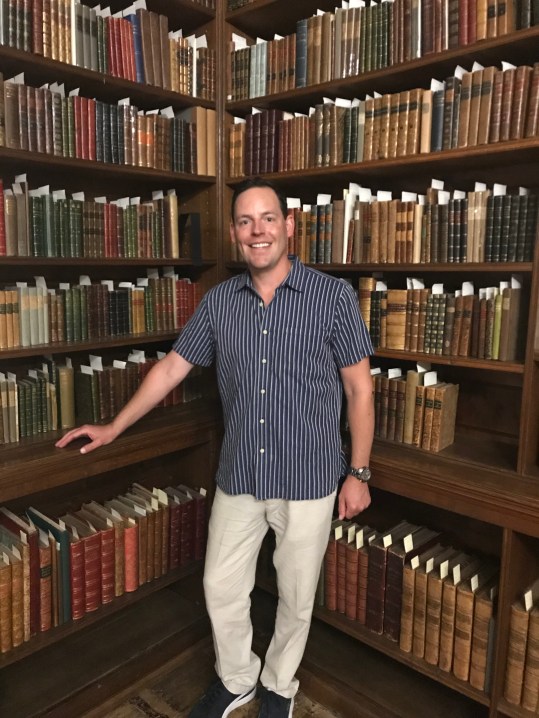
Speaking of longing, I need some much-needed sleep and that Cornish ale I mentioned before, so, for now, c’est moi inside the private reading room in the Chawton Library. I’m sensitive about my big shiny forehead because I keep my brains in there. Thus, there is no comments section. This place has really gone to the dogs if they (Toby, included) let the likes of me in! I kid, of course, as this blog is at times irreverent. It’s the Shelleyist in me to not respect authority. And it’s the Janeite in you that, I hope, will keep you reading about this research trip. Toby will also be contributing.

Thanks again to the lovely people at Chawton House! They seem so happy, and as my uncle Jim put it, why wouldn’t they be!? As we stupidly reply to obvious statements, in the States, “Right?!?”
IMG_0033

Onward! PS: What does Morrissey think of Jane Austen? His far-right stances as of late have me worried for his mental health and, worse yet, I bought tickets to see him in Utah in September. But back to Jane…
Review: “The Great Gatsby”

12 Sunday May 2013

Posted by colincarman in Film Reviews

≈ 10 Comments

Tags

baz lurhmann, carey mulligan, drama, joel edgerton, leonardo dicaprio, the great gatsby, tobey macguire

the_great_gatsby_movie-wide

“The Last Tycoon”

Grade: B+

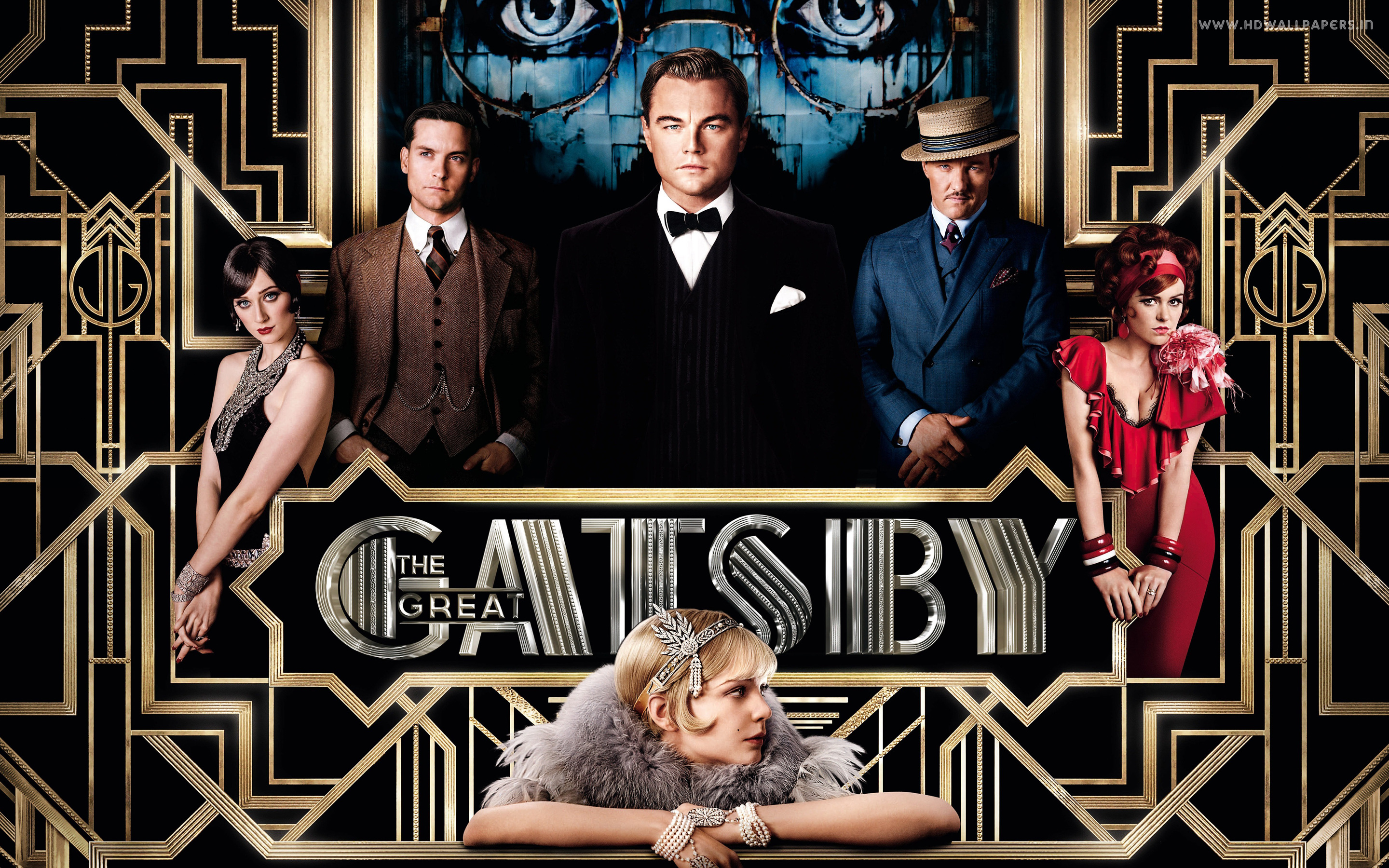
IN THE AFTERGLOW of a loud, lavish and limousine-laden party – thrown for the sole purpose of winning back an old girlfriend named Daisy Fay – host Jay Gatsby tells Nick, his neighbor and friend, that the past is never set in stone.  “You can’t repeat the past,” Nick protests, to which the consummate self-made man, Gatsby, replies: “Can’t repeat the past? … Why of course you can!”

It’s a crucial difference in opinion and one that captures the American essence of the F. Scott Fitzgerald classic “The Great Gatsby,” printed in April of 1925 and foisted on 20120719144128!Gatsby_1925_jackethigh-school freshmen ever since. (The paperback edition, which was already selling more than a half million copies annually, is currently back on top.) The novel’s titular tragic hero is the very emblem of the nouvelle riche and as the lord of Long Island Sound, he’s been catapulted from an anonymous Midwestern existence as a Great War veteran to the mysterious man-of-the-hour.  Lots of Gatsby’s neighbors are in Nick’s ear about whether he’s a killer, a bootlegger, or truly the owner of a successful franchise of pharmacies. Nick is played by the typically neuter Tobey Maguire.

But if Gatsby is the American Dream incarnate, a man who emphatically holds that the past and the future can be bent toward any ambitious man’s objectives, his life plays out as a kind of lonely nightmare. (Don Draper of “Mad Men” is just a reworking of the Gatsby archetype.)  His rosebud Daisy is now a married mother and Daisy’s husband, Tom Buchanan, is one of many looking to expose him as anything but great.  Possessing what Fitzgerald describes as a “cruel body,” Tom is a racist and a philanderer with a married mistress named Myrtle waiting in the wings.  A hostile Tom – I can remember Mrs. Maroney, my high school English teacher, exclaiming “I hate Tom!” – denigrates his rival as “Mr. Nobody from Nowhere.”

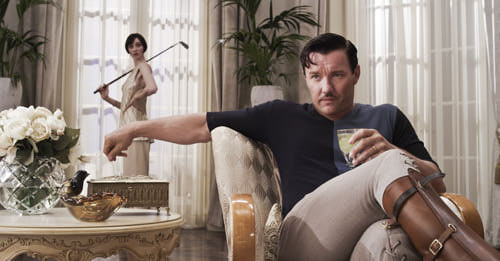
Now 38 years old, Leonardo DiCaprio fits the role of Gatsby to a (sun-tanned) T.  We’ve watched this actor transform from the cat-eyed androgyne of “What’s Eating Gilbert Grape” and “Titanic” to the square-headed hulk of “J. Edgar” and “The Aviator.”  Those latter biopics, centered on reclusive and enigmatic men, have prepared DiCaprio well for the role of James Gatz/Jay Gatsby, who roams his stately pleasure-dome likeLeonardo DiCaprio Charles Foster Kane.  As Daisy, Carey Mulligan (“Drive,” “Shame”) is mostly mute, torn as she is between her own flame and the unfaithful husband who provides her a mansion of her own across the bay. Tom is played by the Australian actor Joel Edgerton (“Zero Dark Thirty”) whose blue eyes flicker ferociously back and forth when he is finally confronted by Gatsby in a swelteringly hot Manhattan hotel room.  “Your wife doesn’t love you,” Gatsby tells Tom, “She’s never loved you.  She loves me.”

Much of what I’ve already laid out here are plot points, because they remain every bit as compelling and air-tight as they are on the page.  Unfortunately, what stands in the way of “The Great Gatsby” becoming as great a film as it is a novel is largely due to the direction of Baz Lurhmann, the Aussie director famous for the MTV-style editing and splashy art direction he brought to “Romeo + Juliet” and “Moulin Rouge.”  Those films succeed as great-gatsby-joel-edgertonstagey spectacles – stabbings, solos, cancan lines – whereas the source material here is a more hushed, low-key affair.  (Even the climactic murder, in the novel, is described after the fact and left to the reader’s imagination.) Lurhmann’s hyperactivity is well suited to the gaudy opulence of Gatsby’s high-points – described by Fitzgerald as a “universe of ineffable gaudiness” – but he can’t seem to represent the man’s emotional lows.  It was a mistake to make the place from which Nick narrates his tale a sanitarium, and awfully literal-minded as well to type out some of the novel’s more famous lines across the screen, as if a Power-Point presentation were needed to heighten the drama.  Lurhmann’s touch is really more of a stranglehold.

This is not to say that “The Great Gatsby” doesn’t lend itself to flashiness, especially in terms of the novel’s automobiles which are, in Lurhmann’s kaleidoscopic reimagining of the tale, as gorgeous as the interiors of Gatsby’s wedding-cake mansion.  DaisyTHE GREAT GATSBY CAST FILM IN SYDNEY Fay, back in her Louisville days, had a “little white roadster,” writes Fitzgerald; there’s Tom’s blue coupé and the so-called “death car” that sets the double demise of Myrtle Wilson and Jay Gatsby into motion.  Even Nick frames his libido (or lack thereof) in automotive terms, saying that he is “slow-thinking and full of interior rules that act as brakes on my desires.”  Putting the brakes a bit on Lurhmann’s style would have made this “Gatsby” greater – less tinsel and more teeth.

Note:

I want to thank all of my followers but after two years of writing film reviews for CINEMAWOLF, I realize that keeping a truly state-of-the-art blog is a full-time job and the demands of my professional life prevent me from staying current here, so this is likely my final film review.  You can find my reviews in print in The G&LR and elsewhere.  I wish all of you a long life as grand as Gatsby’s!

Review: “Mud”

06 Monday May 2013

Posted by colincarman in Film Reviews

≈ 7 Comments

Tags

drama, jacob lofland, jeff nichols, joe don baker, mark twain, matthew mcconaughey, michael shannon, mississippi river, mud, ray mckinnon, reese witherspoon, sam shepard, sarah paulson, toni morrison, tye sheridan

Mud Banner Poster

“Mississippi Moon, Won’t You Keep On Shinin’ On Me”

Grade: A-

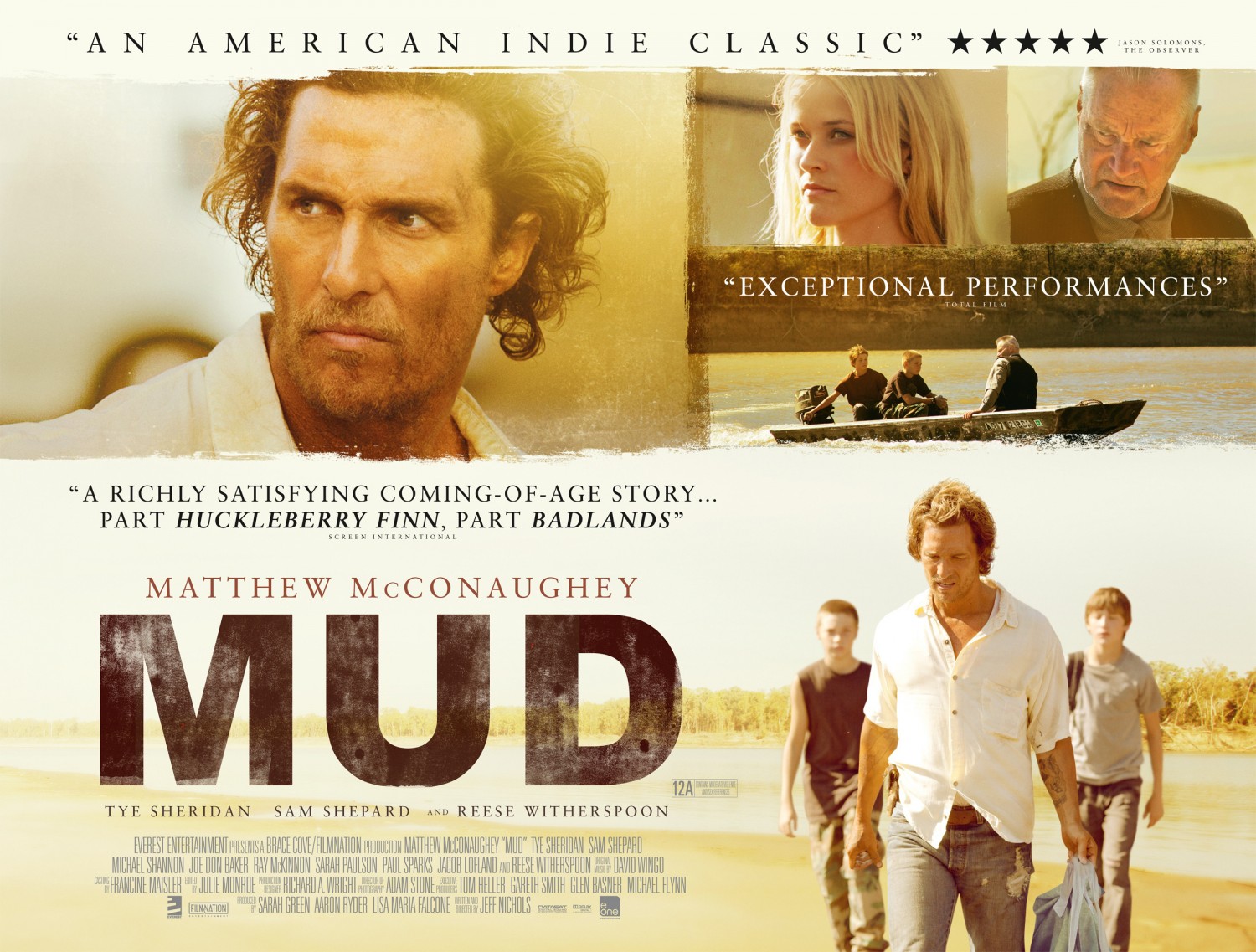
MARK TWAIN NEVER forgot the Mississippi.  In 1856, he left Ohio for Louisiana by steamboat, intending to travel on the Amazon.  Fortunately, Twain changed his mind and apprenticed for a Mississippi riverboat pilot and the rest is (American literary) history.  “The great Mississippi, the majestic, the magnificent Mississippi, rolling its mile-wide tide along, shining in the sun,” he wrote in one of his earliest sketches about that river.  Twain would no doubt have found the new film “Mud” from Jeff Nichols – who reportedly asked his cast to read the author while on set – a marvel, rich as it is with local color, narrative density, and feeling.  It’s full steam ahead for Nichols, whose previous films include the little masterpieces, “Shotgun Stories” (2007) and “Take Shelter” (2011).

A coming-of-age tale, “Mud” centers around two boys named Ellis (Tye Sheridan of “Tree of Life”) and Neckbone (Jacob Lofland).  American kids don’t really explore the 000020.17055.MUD_Film_Still1woods and streams anymore – there are apps for that now – which is why the boys’ backwoods existence evokes a golden age when childhood was the closest thing to freedom.  Ellis and Neckbone discover a remote island with a boat inexplicably wedged in the treetops up high. There’s a well-executed panning shot – compliments of director of photography Adam Stone – in which the boys first encounter the island’s sole inhabitant, a stranger with an even stranger name: Mud (Matthew McConaughey, in his best starring role to date).  Mud’s too amicable and avuncular to be dangerous – Ellis takes an immediate liking to him – and for a while, the boys shuttle between their families (played by Ray McKinnon and Sarah Paulson as Ellis’s feuding parents) and ornery neighbor Tom Blakenship (a buzz-cut Sam Shepard), bringing Mud the canned food he needs to survive on the lam. Michael Shannon, the star of Nichols’ previous films, is Neckbone’s guardian, Uncle Galen; he’s busy scouring the river bottom for oysters and banging around in the equipment of a deep-sea diver.

But no man, of course, is an island, and Mud’s criminal past connects the boys to a whole host of problems in their tiny Arkansas town.  Mud’s back story is a romantic one: he’s killed the Texas lover of his on-again-off-again girlfriend named Juniper x.MUD_.0426(Reese Witherspoon) who has brought him nothing but trouble.  Driven by what Toni Morrison calls one of those “deepdown, spooky loves” that make one “so sad and happy,” Mud and Juniper are the kind of couple that send restraining-orders as love-notes.  Tom Blakenship blames all of Mud’s trouble on Juniper and, as a ex-military sharpshooter, he comes in handy when the father of Mud’s victim (Joe Don Baker) brings a bunch of hired guns to town to track Mud down.  It’s all in the nonverbal dialogue when Juniper spots Mud (temporarily off the island) from the balcony of her run-down motel; it’s Nichols’ riff on “Romeo and Juliet” with the same collision of eros and violence.

Gender politics, as usual, muddy the waters and the script’s only failure is that its conflicted relation to women and femininity feels, well, Twain-era. It becomes clear that Ellis and Mud are leading parallel lives, for the Huck-like Ellis is crushing on an older girl named May Pearl (Bonnie Sturdivant) who breaks his heart in the way JuniperIMG_3962.CR2 breaks Mud’s over and over again. Because Ellis’s father is estranged from his mother (the underrated Paulson), he warns his son that all women are snakes, selfish and impossible to please.  “Mud” doesn’t really disavow Ellis (or the audience) of that biblical bunk except for Mud’s corrective, which comes later in the moments before a river-boat shoot-out.  Mud assures the boy that women are worth loving, but is “Mud” really on board?  The film’s women remain archetypal and far-off.

Mud’s island, meanwhile, is a wondrous place; it’s the ultimate man-cave wherein he’s planning his escape by river but also a dangerous place replete with a hissing snake pit (foreshadowed well from the film’s start).  Nichols’ “Mud” is that rare work of art that achieves something tantamount to Twain’s best stories (for adults and children): it reminds you, simultaneously, of what it was like to be a child but also what it’s like to feel – however incompletely – all grown-up.

Review: “The Place Beyond the Pines”

06 Saturday Apr 2013

Posted by colincarman in Film Reviews

≈ 13 Comments

Tags

ben coccio, ben mendelsohn, bradley cooper, crime, dane dehaan, darius marder, derek cianfrance, drama, emory cohen, eva mendes, fathers and sons, harris yulin, ray liotta, rose byrne, ryan gosling, the place beyond the pines

the-place-beyond-the-pines-ryan-gosling-600x399

“Into the Woods”
Grade: B+/A- (SEE IT)

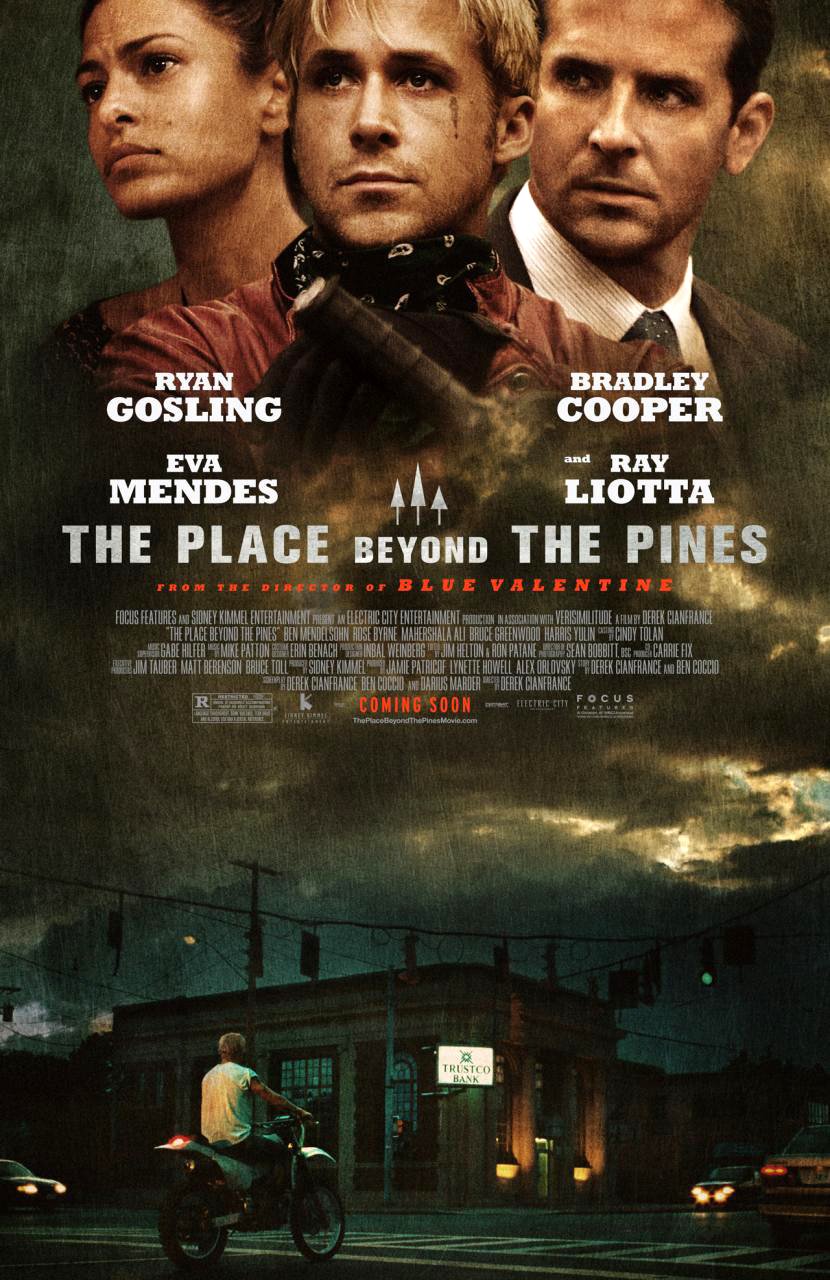
“IF YOU RIDE like lightning you’ll crash like thunder.”  Those are cautionary words delivered by Ben Mendelsohn, a car mechanic and former bank robber, to Ryan Gosling in “The Place Beyond the Pines.” It’s a worthy follow-up, from director Derekthe-place-beyond-the-pines-dane-dehaan-emory-cohen Cianfrance, to his “Blue Valentine” of 2010 and every bit as grittily realistic and desperately somber.  A peroxide-blond Gosling plays Luke, a stunt biker and drifter who, in an already much-discussed opening shot, walks from his carnival tent to a giant metal cage in which he and two other bikers zip around upside down and sideways. Cianfrance maintains that frenetic pace as Luke is soon reunited with Romina (Eva Mendes) whom he saw the last time he was in town and, unbeknownst to him, impregnated.

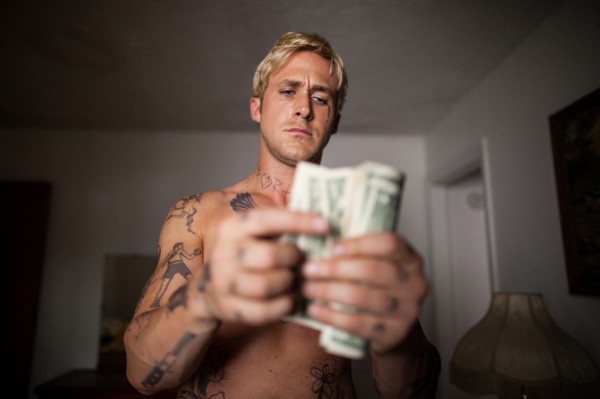
Luke vows to pull his life together and support his wife and child but is drawn to the allure of danger and easy money.  Ben Mendelsohn’s character Robin schools Luke in how to rob banks in the Schenectady area, which he does successfully, at least, for a The-Place-Beyond-The-Pines-posterwhile. Gosling’s character is heavily tattooed – Frankenstein’s visage adorns his hand – but all the writing on his neck and fingers belies the fact that Luke is virtually unreadable.  Gosling can play this too-cool-for-school macho role with his eyes closed – we’ve seen it before in “Drive” where there, too, he played another stunt man with a heart of gold – but here, he makes us sympathize with this daredevil turned family man.  “Pines” artfully captures the exhilaration of crime as we watch Luke speed off, heist after heist, to Robin’s getaway truck, which carries him out beyond the pines where the men chain-smoke and count their cash.

Like “Blue Valentine,” “Pines” spans a swath of time – fifteen years, to be exact – and it would spoil the plot to reveal how exactly Luke and Bradley Cooper’s character Avery cross paths except to say that film’s second half belongs not to the criminal but to the cop who stops Luke dead-in-his-tracks.  Avery is the son of a judge (played by Harris Yulin) and a new father himself, and though his life looks honest and respectable in comparison to Luke’s, we find that he’s surrounded by crooked cops (including a typecast Ray Liotta).  Flash-forward 15 years and both Luke and Avery’s sons – AJ (Emory Cohen) and Jason (Dane DeHaan) – are teenagers in the same high school, and here we see the leitmotif of the sins of the father played out as Jason slowly realizes his friend’s father’s involvement in his own family history. ‘Nuff said.

“The Place Beyond the Pines” is driven chiefly by the magnetism of its actors.  This is surely Eva Mendes’ best performance to date, but because “Pines” is interested mainly in men and the patrilineality of violence and regret, she’s forced to bring everything she has to a somewhat trite and undeveloped role.  The same is true for Rose ByrneMV5BMjI5NDY5NTY4MF5BMl5BanBnXkFtZTcwMDE5ODEyOQ@@._V1._SX640_SY427_ who (dis)appears later in the film as Bradley Cooper’s wife Jennifer.  It’s the singular failure of Cianfrance’s film – and a script by Ben Coccio and Darius Marder – that a woman’s only job is to wait on the sidelines and worry about her man.  AJ is entirely misplayed by Emory Cohen – too “street” for a DA’s son – whereas Dane DeHaan brings real pathos to the part of Jason, a fatherless child who, in the last scene, only wants to feel what his outlaw father must have felt as he drives his motorcycle out beyond the pines.  It’s a lasting image and one of an achingly real predicament: a teenager who, lost in his own grief, can’t see the forest for the trees.

Review: “Ginger & Rosa”

29 Friday Mar 2013

Posted by colincarman in Film Reviews

≈ 9 Comments

Tags

alessandro nivola, alice englert, annette benning, christina hendricks, cuban missile crisis, drama, elle fanning, ginger & rosa, jodhi may, oliver platt, sally potter, timothy spall

-Ginger-Rosa-2012-Posters-alice-englert-32604818-1181-886

“New Radicals”

Grade: B

IN LATIN, THE words for friend (“amicus”) and lover (“amans”) are derived from the same root – “amo,” which is to love. In Sally Potter’s “Ginger and Rosa,” a film about the highs and lows of female friendship, there is that same slippage between friendship and love. Elle Fanning (“Somewhere”) and Alice Englert play the title roles in thisGinger & Rosa sensitive, intelligent film set in London in 1962.  The adults around them are up in arms about nuclear arms during the anxious days of the Cuban Missile Crisis.  There’s the commanding Christina Hendricks as Ginger’s mother Natalie and Jodhi May as Rosa’s mother Anoushka.  They met in a maternity ward during World War II and their daughters have been besties ever since.  They share a bathtub and examine each other’s underwear like water-nymphs; they discuss existentialist philosophy with Ginger quering “Do you think Simone de Beauvoir has a bubbly personality?” and “Do you think there’s a ‘forever’?”

But is there really such thing as a B.F.F.?  Sexuality, integral to Potter’s coming-of-age tale, has the potential to ruin everything between them and Rosa’s sexual relationship with Ginger’s handsome father Roland (Alessandro Nivola) drives an understandable wedge.  ginger-and-rosa09There’s an excruciating scene on a boat – and we feel Ginger’s agony because of Fanning’s precise performance (not to mention her dead-on British accent) – in which Ginger can hear Roland and Rosa’s lovemaking in a room next door. She presses a pillow to her ears to deaden the sounds of sex and betrayal.  The secret affair is another ticking time bomb and the circle of activists and artists that surround her – her gay godfathers (Oliver Platt and Timothy Spall) and Annette Benning as their feminist gal-pal – threaten to find out that Roland is sleeping with his daughter’s lifelong friend.

Political liberals on film are usually portrayed as sexually incontinent, so are college professors (i.e. “The Squid and the Whale,” “Wonder Boys,” “The Life of David Gale,” “Smart People” – okay, I’ll stop there).  According to the movies, our beliefs in love, reform and pacifism must infuse a sex life that knows no bounds. Roland fits this stereotype to a T – “I’m not sure I’m father material,” he under-states – and we want to see him found out. The film’s resolution is rushed and its pace overall plodding.  Roland tells Ginger “You were born radical,” but “Ginger & Rosa” ends on a fairly conservative note with Ginger having learned one of life’s hardest lines: eros trumps philia every time.  This must be what The Smiths were getting at, in “Ask” from 1986, when Morrissey sang: “If it’s not love then it’s the bomb that will bring us together.”

Review: “Stoker”

19 Tuesday Mar 2013

Posted by colincarman in Film Reviews

≈ 15 Comments

Tags

bram stoker, dracula, horror, matthew goode, mia wasikowka, nicole kidman, oldboy, park chan-wook, stoker, wentworth miller

Stoker - 2013 movie

“American Gothic”

Grade: C+/B- (RENT IT)

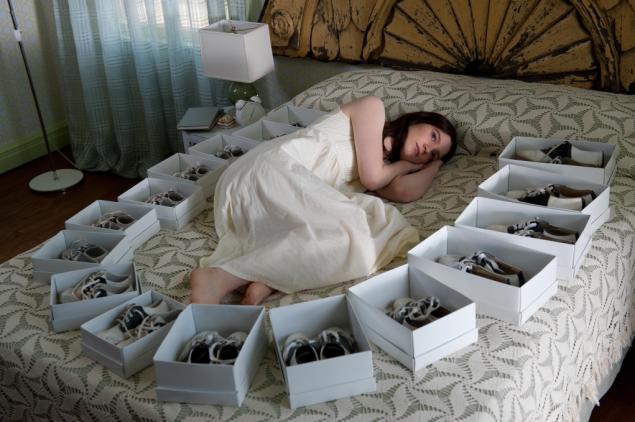
A SURPLUS OF style, a dearth of drama, “Stoker” falls significantly short of its famous name.  The namesake of Park Chan-wook’s new film is Abraham “Bram” Stoker who was born in Dublin in 1847 during the Irish potato famine. He wouldn’t become a master of horror until he published his novel Dracula exactly fifty years later. Stokerstoker1f-1-web hardly invented the vampire legend – Byron’s private doctor, John Polidori, beat him to the punch with The Vampyre, his contribution to the same ghost-telling contest that inspired Mary Shelley’s Frankenstein in 1816.  What Stoker did was package a mixture of vampirism and eroticism that Victorians could truly sink their teeth into: an American edition of Dracula followed its English publication, and an abridged edition appeared in 1901.

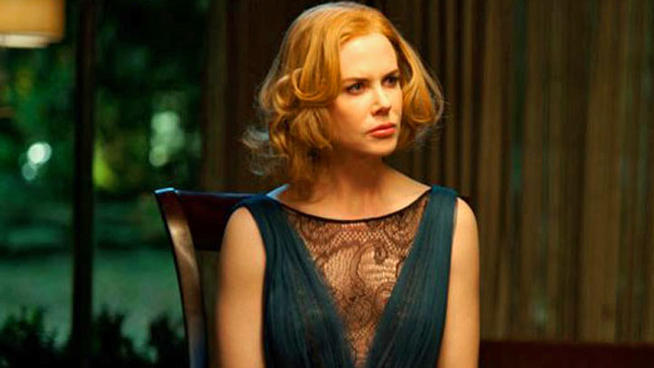
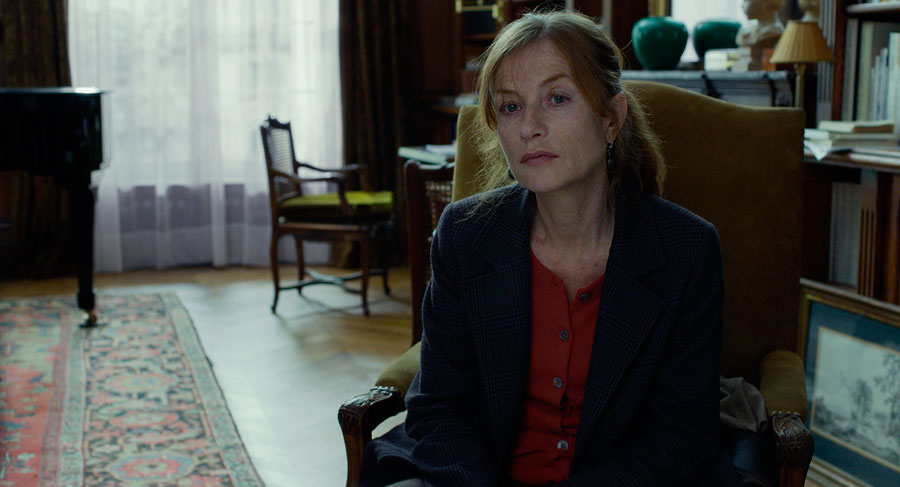
The film “Stoker,” written by actor-screenwriter Wentworth Miller, has all of the goriness of Dracula but it moves more at a zombie’s pace than a real bloodsucker’s.  It centers around a melancholic girl named India Stoker (Mia Wasikowska) in what is essentially Hamlet from a daughter’s perspective: India’s father Richard (Dermot Mulroney) has died a nicole-kidman-stokermysterious death upstate and his dashing brother Charlie (Matthew Goode) suddenly appears on the scene where he flirts with his widowed sister-in-law Evelyn Stoker.  She’s played by Nicole Kidman, who had long chosen risky roles (“Eyes Wide Shut,” “Birth”), and Wasikowska could be seen as something of her Aussie protégé (“Albert Nobbs,” “The Kids Are All Right”).  Over the course of “Stoker,” she has to transform from a shrinking violet into shrieking and violent and it’s a tour-de-force performance inasmuch as she appears practically possessed.  “We don’t need to be friends,” India tells her uncle coldly, “We’re family.”  At first, it appears as if Uncle Charlie is the evil influence until we sense that India is far from a passive receptor but something truly wicked.  She goes from girl to gorgon.

The shower scene in which India masturbates to memories of a recent killing is laughable – stupid even, but Wasikowska never wavers in her eerie embodiment of a girl metamorphosing into something horrible.  It’s a bloodbath in every sense of the Matthew-Goode-and-Mia-Wasikowska-in-Stoker-2013-Movie-Image2word.  South Korean director Park is best known for his “vengeance trilogy” (including “Oldboy) and his heavy hand, stylistically speaking, strangles the film, both in terms of timing – the opening credits needlessly hiccup and reset themselves – and storytelling.  What exactly is the story of “Stoker” and what relation does it bear at all to vampirism?  We live in the age of the vampire (“True Blood,” “Twilight,” “Let Me In,” et al) but Park’s family gothic adds nothing to the lore. It only takes, and in the process, drains your time and your patience.

Review: “Side Effects”

17 Sunday Feb 2013

Posted by colincarman in Film Reviews

≈ 6 Comments

Tags

catherine zeta jones, channing tatum, drama, jude law, psychology, scott z. burns, side effects, steven soderbergh

side-effects-film

“Happy Pills”

Grade: B+ (RENT IT)

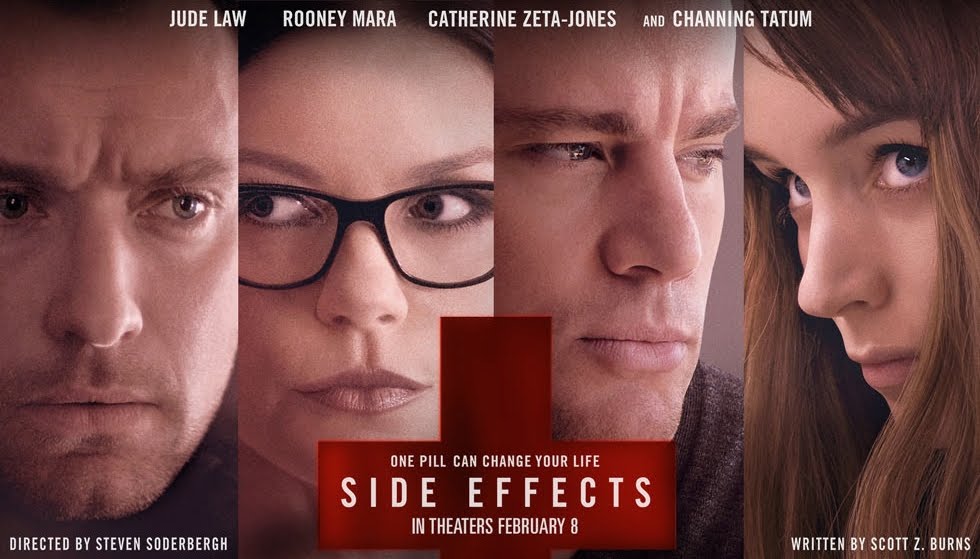
IF INDEED STEVEN Soderbergh is retiring from filmmaking with “Side Effects,” his last film will be as perverse a spectacle as his first, 1989’s “Sex, Lies, and Videotape.”  (The 50-year-old Atlanta native says he wants to pursue painting full-time.)  At 26,Side-Effects-Viral-Site-Jude-Law Soderbergh became the youngest director to win the coveted Palme d’Or at Cannes.  He has made more than twenty-five feature films since then, and “Side Effects” is a devious doozie of a psycho-drama to go out on.  It’s also the first good film of 2013.

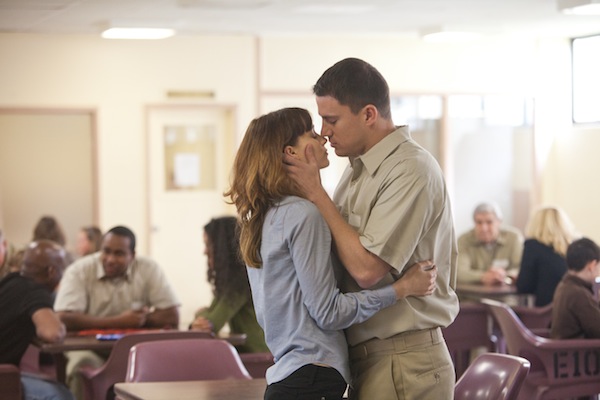
“Side Effects” centers around a depressed twentysomething named Emily (Rooney Mara) whose husband Martin (Channing Tatum) has just been released from prison after a four-year sentence for insider trading.  “I can get us back to where we were,” _MG_6630.CR2the jailbird pledges, “I promise.” Mara, in a Linda Blair haircut, mopes around their Manhattan apartment, unable to put on a happy face.  When she deliberately crashes her car into a wall, she invites the scrutiny of a British psychiatrist named Jonathan Banks (Jude Law) who offers her a veritable pharmacopeia of anti-depressants.  Halfway through “Side Effects,” Mara finally smiles and it’s the result of a powerful pill called Ablixa. Its side effects include somnambulism, crying jags, and suicidal ideation. Dr. Banks is earning 50 thousand annually as a pharmaceutical consultant for Ablixa, and when he bumps into Emily’s previous doctor (played by Catherine Zeta Jones) at a conference on ADHD, the two swap stories and a few happy pills Jones’ character has at the bottom of her purse.

And just as “Side Effects” begins to look like a critique of our chemical culture, screenwriter Scott Z. Burns (who wrote Soderbergh’s “Contagion” as well) twists the plot into something else entirely.  It reshapes itself, in the Hitchcockian mode ofside_effects_still18_catherine_zeta_jones murder and double-crossers, and forces us to shift our attention, and our sympathies, from Emily to Dr. Banks in a maze of deceit and trickery. There is something old-timey about the film’s representation of lesbian women, as duplicitous man-haters, and it’s difficult to discuss further without spoiling the film’s secrets, but the payoff is appreciable.  We can only hope that Soderbergh puts down his paintbrushes and returns to the directing chair before too long.

2012 Best Actress: Will it be Riva?

07 Thursday Feb 2013

Posted by colincarman in Film Reviews

≈ 15 Comments

Tags

alexandre tharaud, amour, best actress, emmanuelle riva, euthanasia, jean louis trintignant, michael haneke, oscar 2012, romance

amour_t614

“Hospice Pair”

Grade: B+ (RENT IT)

“AMOUR” IS THE provocative title to Michael Haneke’s latest and most funereal film to date.  Anyone familiar with either “The White Ribbon” or “Funny Games” will look skeptically on such a director delivering any kind of love-story in the traditional mold.  Yet, like its nakedly romantic title,” “Amour” is indeed a romance – Haneke-style.  It centers around the agonizing last days of Anne Laurent, a lifelong music teacher and Parisian esthete who inhabits a quiet apartment alongside her husband Georges.  The9 Laurent home is sparsely decorated – a few fine rugs, a grand piano, a ceramic lamp in Hermès orange – and it reflects their quiet, introverted lifestyle. They are visited by their daughter Eva (Isabelle Huppert) on occasion, but they prefer their record collection and nightly glass of wine (alone).  Still, they foster nothing but intimacy between each other and with Eva who confesses to her father that her husband is having an affair and that her marriage is in crisis.  Sitting at a distance, Georges listens with the impassive stare of an analyst.

Anne looks a bit livelier when their former student Alexandre Tharaud (as himself) comes to call; when the man inquires about his maestro’s recent illness, Anne changes the subject and asks him to play the piano for them.  It was Tharaud whom the couple had gone to see at the film’s start.  Haneke gives us the wide shot of the music hall – Alexandre Tharaud480a shot reminiscent of the puzzling last scene in his “Caché” – and we must find the Laurents politely waiting for the recital to begin. The shot lasts longer than one expects and it demands that we look harder at Anne and Georges, and, it would seem, ourselves as another audience, another mirror.  Less ingenious is the symbolism of the pigeon which keeps trapping itself in the Laurents’ apartment; at first, it’s set free and later, it’s wrapped in a blanket and held closely to Georges’ chest.  Such catch-and-release can be found at the end to James Ivory’s “The Remains of the Day” (1993) where the bird is an obvious stand-in for a character whose wings have been clipped.

Anne is played with the deepest pathos by Emmanuelle Riva, who is 85-years-old and now the oldest nominee for Best Actress in Oscar history.   She will likely lose to a 22-Amour_love_liebe_poster_jean_louis_trintignantyear-old named Jennifer Lawrence for “Silver Linings Playbook.”  But don’t overlook, as Georges, Jean-Louis Trintignant.  He and Anne carry on like any ordinary elderly couple:  morning, noon and night, they occupy a cozy corner of their kitchen where they share tea and nostalgia. All that changes when Anne experiences a lapse in consciousness, the first tremor of her impending illness.  Georges panics as Anne stares into space, and even more so after she appears to have no recollection of her seizure-like absence.   Anne’s health deteriorates quickly and after a series of strokes, she finds herself confined to bed and reliant on Georges to feed, dress, and wash her paralyzed body.

“Amour” is about one woman’s dignity in the face of certain death, but it’s also about a husband and the burden of devotion.  Georges has a slight limp and we watch as he labors about the apartment, as if under house-arrest, in his new role as Anne’s nurse.  We are almost certain, given the opening shot of Anne in her funeral bier, that Georges will become Anne’s mercy-killer. Which is to say that Haneke’s idea of true love is that it is always a commitment and only sometimes a crime.

Review: “Mama”

28 Monday Jan 2013

Posted by colincarman in Film Reviews

≈ 10 Comments

Tags

andres muschietti, frankenstein, freud, guillermo del toro, horror, jessica chastain, mama, nikolaj coster waldau, pans labyrinth

MAMA11

“Visitation Frights”

Grade: B+ (RENT IT)

THE FREUDIAN FREAKSHOW that is “Mama” features some genuine hair-raisers.  The movie’s monster is an undead mother who climbs the walls like a human tarantula and whose undulating hair is rivaled only by the ginger heroine in last year’s “Brave.” Linguistic analysts have shown that the syllabic repetition of “Ma-ma” originates in the infant’s primal pronunciations, in that original cry for food, warmth and only later on,936full-pan's-labyrinth-poster self-doubt and Hallmark cards. The film’s producer is Guillermo del Toro and you need only glance at the poster for his “Pan’s Labyrinth” (2006) to grasp his adeptness at melding horror and vaginal symbols; he’s like the gothic Georgia O’Keefe.  In “Mama,” the film’s orphans – Victoria and little sister Lily – are haunted not just by the titular specter but by oozing crevices that ruin perfectly good wallpaper, out of which flutter moths and Mama herself, sometimes in the form of a vacuum-powered toupee.

“Mama” begins with that most psychoanalytical of scenarios: abandonment. The opening, which precedes a beguiling title sequence of creepy drawings in a child’s hand, is a rush: Victoria and Lily’s father has killed his coworkers, his estranged wife, and whisked away his daughters only to veer off a snowy highway into the valley below.  He comes upon a cabin in the woods where he attempts to kill his daughters in cold blood but, low and behold, the cabin is owned and operated by a more powerful and over-protective force: Mama Mia!  Fast film-review-mama-fca7bc20726c2efaforward to the aftermath of the girls’ disappearance and their worried uncle played by Nikolaj Coster Waldau of “Game of Thrones” and girlfriend Annabel (a rocker Jessica Chastain).  Everything about Chastain’s character is thin; she sports a Joan Jett haircut, plays bass in a band, and curses like a sailor because, well, she’s hardcore. Did I mention she’s a brunette here?  She’s also a rival to Big Mama who has managed to transplant herself to the girls’ closet thanks to a pseudo-scientific study of their rehabilitation. (Why, by the way, are there no spy-cams in this joint?)  Annabel must play mother to the girls inside a home that looks like the suburban one in “Home Alone” (1990) but, of course, this is a crowded house (with ghosts and things that go bump in the night). Annabel speaks to the film’s central contrivance when she herself asks the good doctor: “This is a joke, right?”  And a hokey one at that.  Like the Ramones T-shirt she dons to demark her air of twenties cool, her character is standard issue.

hqdefaultWhat is far from standard is the fact that we see more and more of the ghoulish Mama as her secret is found out.  She has her own tragic back-story and when the girls’ surrogate family returns to the very cliff where Mama took her life, we begin to sympathize with the film’s glass-eyed ghoul. (This was Mary Shelley’s conceit in her 1818 Frankenstein.: “I’m malicious because I’m miserable!”)  This is anything but standard in your conventional horror flick: the killer isn’t entirely unkind but kind of kin.  Here, in “Mama,” we get that old familiar feeling that the thing we all love and fear the most is, well, family.

2012 Best Actress: Will it be Watts?

22 Tuesday Jan 2013

Posted by colincarman in Film Reviews

≈ 21 Comments

Tags

action, alvarez belons, best actress, disaster films, ewan mcgregor, indian ocean, juan antonio bayona, naomi watts, the impossible, tom holland, tsunami 2004

the-impossible-movie-review

“Water Works”

Grade: B

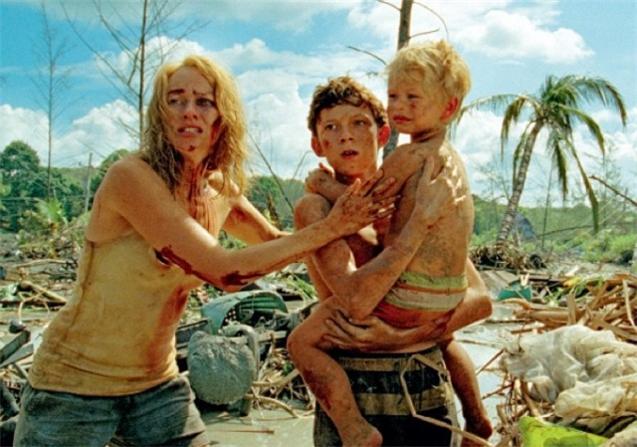
TWO ASPECTS OF Juan Antonio Bayona’s disaster film “The Impossible” will haunt you.  The first is the tsunami itself, which slammed into south-west Asia on the 26th of December, 2004, killing nearly a quarter-million people and leveling scores of luxury hotels.  “The Impossible” begins and ends with the Bennett family, Maria and husband Henry (Ewan McGregor), flying to and fro a high-end Thai resort where they open Christmas gifts and lounge poolside. The film’s first fifteen minutes are the lull before the storm and Bayona is even able to extract a frisson of terror out of something as quotidian as a red rubber ball that the Bennett boys – Lucas, Thomas, and Simon – bop around the pool area; they’ll soon find themselves floating out to sea like the ball itself.  Wilson!  A loose page is blown out of the book Maria is reading and gradually, the vacationers notice that something sinister is in the air.  One of the most terrifying images is of the palm trees just beyond the hotel walls being felled, one after another, as the Indian Ocean violently overruns the lazy sunbathers.  Bayona gives us numerous underwater shots in which we see a soup of twisted metal, palm trees, bodies, automobiles reduced to matchbox cars, even a drowned elephant.

The-Impossible-PosterBeyond such verisimilitude, which is agonizing indeed, there is also Naomi Watt’s performance as Maria, a doctor who has temporarily hung up her stethoscope to raise her three young sons while living abroad in Japan.  Bayona built the biggest water tank in Europe to simulate the disaster and, currently making the rounds on TV talk shows prior to Oscar night next month, Watts reports that she was strapped to a chair, submerged, and brought to the brink of drowning in order for the director to elicit true terror from her.  But Watts’s performance is a marvel not simply because of her lung-busting cries – she gave us plenty of those one decade ago in “The Ring” – but because of her relationship with Lucas (Tom Holland), the eldest of her sons. There’s that uncomfortable moment when Lucas is ashamed to see his mother’s mangled and exposed breast; there’s another when Maria insists on helping an abandoned boy whom she and Lucas hide in the treetops. Dehydrated, leg badly injured, Maria shares a soda can with the two boys and stares up at the younger one like he’s a cherub on high.  A good actor, like a good tennis partner, brings out the best in her scene-mate and Watts is able to elevate Holland so that he, too, becomes the emotional core of “The Impossible.”  You don’t doubt for a second that it’s her love for Lucas and the other family members that keep her fighting for her life.

The film’s title is trite, the family’s reunion never really in question, and Bayona (“The22003 Orphanage”) either forgot or simply didn’t feel the need to close the film with the official death toll or some kind of acknowledgment that most, if not all, the tsunami-victims weren’t as lucky as the upper-class Bennetts who had health insurance and private planes at their disposal.  It’s as if every other survivor is put there to either facilitate or frustrate the family’s predictable reunion. The Bennetts are actually an Anglicization of the real-life family that survived the disaster, the Alvarez Belóns of Spain, and it’s a shame that European actors were swapped out for blond-blue-eyed ones. Nevertheless, it’s Watts who powers “The Impossible.”  That’s her kilowatts.

← Older posts
Newer posts →

Unknown's avatar

Recent Posts

  • Review: “Monsters: The Lyle and Erik Menéndez Story” (Netflix; 2024)
  • Sign Posts!
  • What Killed Jane Austen?
  • Was Austen a Holy Roller?
  • 5 Objects of Vivid Interest

Enter your email address to subscribe to this blog and receive notifications of new posts by email.

Join 256 other subscribers

Top Posts & Pages

  • Colin Carman

Jane Austen

action alien alpha dog amanda seyfried animals anton yelchin blue valentine bradley cooper brad pitt bromance carey mulligan charlize theron chawton christina hendricks christopher plummer colin farrell comedy crazy stupid love crime daniel craig dickens dracula drama emma stone england ewan mcgregor family frankenstein freud gay george clooney hampshire hbo horror jack russell terrier Jane Austen jessica chastain john lithgow joseph gordon levitt jude law kurt cobain mad men madonna mansfield park mary shelley matthew mcconaughey michael fassbender naomi watts oscars paris paul rudd philip seymour hoffman poetry politics portsmouth pride and prejudice romantic romantic comedy ryan gosling science fiction september 11 sex shakespeare shelley steven soderbergh summer blockbuster the hangover the help the social network thriller tim burton true blood twilight vampires viola davis

Blog Stats

  • 55,917 hits
  • RSS - Posts
  • RSS - Comments

Colin Carman Twitter

Tweets by ColinCarman

Colin Carman

Colin Carman

Archives

  • January 2025
  • July 2019
  • May 2013
  • April 2013
  • March 2013
  • February 2013
  • January 2013
  • December 2012
  • November 2012
  • October 2012
  • September 2012
  • August 2012
  • July 2012
  • June 2012
  • May 2012
  • April 2012
  • March 2012
  • February 2012
  • January 2012
  • December 2011
  • November 2011
  • October 2011
  • September 2011
  • August 2011
  • July 2011

Blogroll

  • Cinema Train
  • Dan the Man's Movie Reviews
  • Fogs' Movie Reviews

Category Cloud

Film Reviews Jane Austen Poems and Plogs (Poem-Blogs) Uncategorized

Blog at WordPress.com.

  • Subscribe Subscribed
    • Colin Carman
    • Join 171 other subscribers
    • Already have a WordPress.com account? Log in now.
    • Colin Carman
    • Subscribe Subscribed
    • Sign up
    • Log in
    • Report this content
    • View site in Reader
    • Manage subscriptions
    • Collapse this bar
 

Loading Comments...