• Review: “The Great Gatsby”
  • Review: “Mud”
  • Review: “The Place Beyond the Pines”
  • Review: “Ginger & Rosa”
  • Review: “Stoker”
  • Review: “Side Effects”
  • Review: “Mama”
  • Review: “Zero Dark Thirty”
  • Review: “Gangster Squad”
  • Review: “Les Misérables”
  • Review: “This Is 40”
  • Review: “Any Day Now”
  • Review: “Anna Karenina”
  • Review: “Silver Linings Playbook”
  • Review: “Hitchcock”
  • Review: “Lincoln”
  • Review: “Life of Pi”
  • Review: “Flight”
  • Review: “Skyfall”
  • Review: “Argo”
  • Review: “The Perks of Being a Wallflower”
  • Review: “Looper”
  • Reviews: “Arbitrage” and “The Master”
  • Review: “The Words”
  • Review: “Celeste and Jesse Forever”
  • Review: “Lawless”
  • Review: “The Campaign”
  • Review: “Total Recall”
  • Review: “To Rome with Love”
  • Review: “The Dark Knight Rises”
  • Review: “Moonrise Kingdom”
  • Review: “Magic Mike”
  • Review: “The Amazing Spider-Man”
  • Review: “Brave”
  • Review: “Abraham Lincoln: Vampire Hunter”
  • Review: “Prometheus”
  • Review: “Snow White and the Huntsman”
  • Review: “Bernie”
  • Review: “The Dictator”
  • Review: “The Raven”
  • Reviews: “Salmon Fishing in the Yemen” and “Jiro Dreams of Sushi”
  • Review: “Chimpanzee”
  • Review: “The Cabin in the Woods”
  • Review: “American Reunion”
  • Review: “Detachment”
  • Review: “The Hunger Games”
  • Review: “Casablanca” (In Re-Release; 1 Night Only)
  • Review: “Silent House”
  • Review: “Wanderlust”
  • Review: “This Means War”
  • Review: “Safe House”
  • Review: “The Woman In Black”
  • Review: “The Grey”
  • Review: “Extremely Loud & Incredibly Close”
  • Review: “Contraband”
  • Review: “Shame” and “Young Adult”
  • Review: “War Horse”
  • Review: “The Girl with the Dragon Tattoo”
  • Review: “Like Crazy”
  • Review: “Hugo”
  • Review: “The Descendants”
  • Review: “My Week with Marilyn”
  • Review: “J. Edgar”
  • Review: “In Time”
  • Review: “Take Shelter”
  • Review: “The Thing”
  • Review: “The Ides of March”
  • Review: “Dream House”
  • Review: “50/50”
  • Review: “Moneyball”
  • Review: “Abduction”
  • Review: “Drive”
  • Review: “Contagion”
  • Review: “The Debt”
  • Review: “Our Idiot Brother”
  • Review: “The Help”
  • Review: “Fright Night”
  • Review: “Beginners”
  • Review: “Crazy Stupid Love”
  • Review: “Rise of the Planet of the Apes”

Colin Carman

~ Jane Austen Scholar & Culture Vulture

Colin Carman

Author Archives: colincarman

Review: “My Week with Marilyn”

26 Saturday Nov 2011

Posted by colincarman in Film Reviews

≈ Leave a comment

Tags

adrian hodges, arthur miller, ben smithard, blue valentine, brokeback mountain, colin clark, derek jacobi, eddie redmayne, joe dimaggio, judi dench, kenneth branagh, marilyn monroe, michelle williams, my week with marilyn, shakespeare, simon curtis, zoe wanamaker

“Good-bye Norma Jean”

Review: “My Week with Marilyn”

Grade: B+ (RENT IT)

“MY WEEK WITH Marilyn” – not to mention this year’s Oscar for Best Actress – belong to Michelle Williams (“Blue Valentine,” “Brokeback Mountain”) for her luminous embodiment of Marilyn Monroe or, as she was known in 1956 (the year in which Simon Curtis’s new film is set): Mrs. Marilyn Miller.  That was the year of Marilyn’s third marriage, this time to playwright Arthur Miller, which was a significant victory for American eggheads since the century’s greatest sex symbol had left Yankee Joe DiMaggio for the author of Death of a Salesman and The Crucible.  It was also the year in which Monroe crossed the pond to costar with Britain’s leading Shakespearean actor, Laurence Olivier, in “The Prince and the Showgirl.”  In many ways Olivier’s heir, Kenneth Branagh plays the great thespian, disappointed and angered by Marilyn’s ineptitude on set.  It’s the ultimate clash between English modesty and American super-stardom, and exasperated by Monroe’s acting coach (Zoë Wanamaker) and her many lapdogs, he barks: “Teaching Marilyn to act is like teaching Urdu to a badger!”  Olivier is gruff, arrogant, caked in makeup, and when he drops an F-bomb upon Marilyn entering the room, she asks in her characteristic breathiness: “Oh, they have that word in England, too?”

Based on his memoirs The Prince, The Showgirl and Me and My Week with Marilyn, both by British filmmaker Colin Clark, the film follows a 23-year old Colin, recently hired as a third assistant director on Olivier’s picture.  As Colin, freckle-faced Eddie Redmayne (“The Good Shepherd,” “Savage Grace”) goes all weak-in-the-knees upon meeting the bombshell though he quickly becomes something more to her, both the shoulder-to-cry-on as she feuds with Miller and yet another man whose erotic veneration Monroe needed as badly as the air she breathed.  Apart from Colin, the only other Brit pleasant to her on set is Dame Sybil Thorndike (played by another Dame, Judi Dench), who speaks to the film’s major conceit – the paradoxical pleasure and pain of unrequited love – when she tells Colin “First love is such sweet despair.”

Screenwriter Adrian Hodges (“Tom and Viv”) has a light touch here, well-suited to the both the source material, “The Prince and the Showgirl,” and the fact that Marilyn let Colin close but not too close.  A splendid scene follows an off-set excursion to Windsor Castle where Colin’s godfather, Sir Owen (Derek Jacobi), provides the pair with a private tour of the royal family’s library.  Once skinny-dipping ensues, director of photography Ben Smithard (“The Damned United”) lingers over their bodies with suitable sparkle and softness.  To reach that Marilyn-like glow, Williams reportedly required three hours of hair and makeup each morning and it shows: she radiates but also breaks your heart. “My Week with Marilyn” transcends verisimilitude to dramatize the fact that Marilyn’s off-screen role was just as laborious and ill-fitting as her onscreen persona; we get the sense that she’s trapped by expectations as sound stage bells ring and crazed fans crush in around her.  After a lovelorn week, Marilyn moves in close to Colin for a final kiss, whispers the line “Thanks for being on my side,” but after that, it’s goodbye Norma Jean.

Review: “J. Edgar”

14 Monday Nov 2011

Posted by colincarman in Film Reviews

≈ 1 Comment

Tags

a. mitchell palmer, angels in america, armie hammer, bryan burrough, charles lidnbergh, clint eastwood, clyde tolson, dustin lance black, eleanor roosevelt, F.B.I., geoff pierson, j. edgar, james cagney, joe mccarthy, judi dench, leonardo dicaprio, machine gun kelly, martin luther king, naomi watts, orson wells, shakespeare, tony kushner

d

“Secret Agent Man”

Review: “J. Edgar”

Grade: B+ (RENT IT)

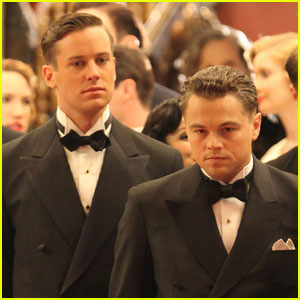
“WHAT DETERMINES a man’s legacy is what isn’t seen.”  This from J. Edgar Hoover, studiously embodied by Leonardo DiCaprio, in Clint Eastwood’s new bio-pic, “J. Edgar,” a tragedy in which quite a lot of Hoover’s secrets are begrudgingly brought to light.  The secret files shredded by his lifelong secretary Helen Gandy (played by Naomi Watts) at the film’s conclusion serve as a potent symbol for Eastwood’s study more generally: the files may be history, but our fearful fascination with Hoover remains just as potent as it was back in 1963 when the head of the F.B.I. was busy wire-tapping Martin Luther King, Jr. and deriding Eleanor Roosevelt as “old horse face” and lesbian.

With “Milk,” screenwriter Dustin Lance Black turned to gay-lib crusader Harvey Milk for an open book of love, laughter and liberation.  Turning to a droll anti-radical like John Edgar Hoover, the very antithesis of Milk, was a bold way to balance two extremes in twentieth-century American culture.  Hoover’s public achievements, of course, are extremely well-known.  Appointed director of the Bureau of Investigation (later the F.B.I.) in 1924, Hoover served eight presidents before his death in 1972.  Eastwood’s “J. Edgar” gives us the sense that, at the zenith of his Orwellian power, it was really Hoover’s Washington while everyone else, including the Kennedy brothers, were merely his special guests.  Jeffrey Donovan, as Robert F. Kennedy, has to remind Hoover that communism is no longer an internal but external threat to effectively beat back the bulldog.

Spanning that long career, from a librarian to a crime-fighter, “J. Edgar” begins with a bang, literally, as the Washington home of A. Mitchell Palmer (Geoff Pierson) is bombed by anarchists in 1919.  Determined to destroy the source of the attack, Palmer soon recruited a 24-year-old law school graduate named John Edgar Hoover to arrest and deport those suspected of anti-American activities.  But Hoover was no Joe McCarthy, a scourge dismissed by Hoover as an “opportunist.”

As the new acting director, Hoover fought the cancer of communism on American soil with the same ferocity he fought facial hair and bowties amongst his employees.  Hoover’s involvement in the so-called “Crime of the Century” – the fatal abduction of Charles Lindbergh’s infant son, Charles Jr., from the second story nursery of the aviator’s New Jersey home in 1932 – brought instant notoriety.  So, too, did Hoover’s pursuit of gangsters Machine Gun Kelly and Vi Mathias.  It was the age of the Tommy Gun and James Cagney and Hoover saw himself as the tireless watchman at the center of it all. And centralize he did: Hoover’s innovations included a fingerprint database and state-of-the-art forensics.  Bryan Burrough, author of Public Enemies: America’s Greatest Crime Wave and the Birth of the FBI, observes that “in late 1933, the FBI was still only a shadow of the professional crime-fighting organization it was to become” since “Hoover’s College Boys were long on energy but short on experience.”

Eastwood’s “J. Edgar” also turns to Hoover’s lack of experience when it came to the opposite sex and draws a rather reductive line between Hoover’s alleged homosexuality and his closeness to his mother Anna Marie (a puppet-master in petticoats played by Dame Judi Dench).  She lurks about the house they share, asking “Are you abandoning me again tonight?” on hearing her little Edgar has plans.  One harrowing scene features a forlorn DiCaprio standing before the mirror, mother over his shoulder, telling her through euphemism: “I don’t like to dance with women.”  It’s staggering to think that DiCaprio, who could have easily passed as one of the Fanning sisters in his “Romeo and Juliet” days now looks like a young Orson Wells.  What follows DiCaprio’s pained admission is Dench’s narrative about the suicide of a gay man she called “daffy” (for daffodil), adding: “I’d rather have a dead son than a daffy son.”  DiCaprio and Dench’s scenes together elevate the psychology of “J. Edgar” to something like Shakespeare’s Coriolanus and Volumnia, another oedipal duo in which a boy’s best friend, as Norman Bates put it, is his mother.  Cinematographer Tom Stern keeps the film half-lit to match an ambience of secrets and lies.

But the ambitious young man nicknamed “Speed” gets all tongue-tied upon meeting the handsome Clyde Tolson (played by Armie Hammer, the “Winklevi” twins in “The Social Network”).  Hoover and Tolson become fast friends and they remained so until the Director’s death, after which Tolson accepted the U.S. flag draped on his friend’s coffin and inherited Hoover’s half-a-million dollar estate.  Still, Black’s script is a work of historical revisionism, just as dependent on rumors and suspicions as Hoover’s own secret files.  No one knows for sure what Hoover and Tolson shared, but Black’s script, taking a cue from Tony Kushner’s treatment of Roy Cohn in “Angels in America,” casts the repression of Hoover’s own sexuality as the engine that drives his ruthless oppression of others.  It’s a bit simple but it forms the humanizing core of “J. Edgar,” a gay film from an unlikely source: cowboy auteur Clint Eastwood.

Eleven years before his death in 1975, Tolson suffered a stroke. Like an old married couple at the breakfast table, Hoover, every bit the control-freak, orders that Clyde better enunciate his words.  Tolson was later buried in the Congressional Cemetery only yards away from J. Edgar where perhaps the all-seeing Director could eternally keep an eye on him.  As Hoover’s secretary put it before every appointment, “The director will see you now.”

Review: “In Time”

07 Monday Nov 2011

Posted by colincarman in Film Reviews

≈ 1 Comment

Tags

alpha dog, amanda seyfried, andrew niccol, andy warhol, batman begins, cillian murphy, ethan hawke, gattaca, in time, justin timberlake, kardashian, mad men, matt bomer, olivia wilde, reality TV, red eye, roger deakins, sci-fi, the social network, thriller, vincent kartheiser, white collar

“Clock-Blocked”

Review: “In Time”

Grade: D+ (SKIP IT)

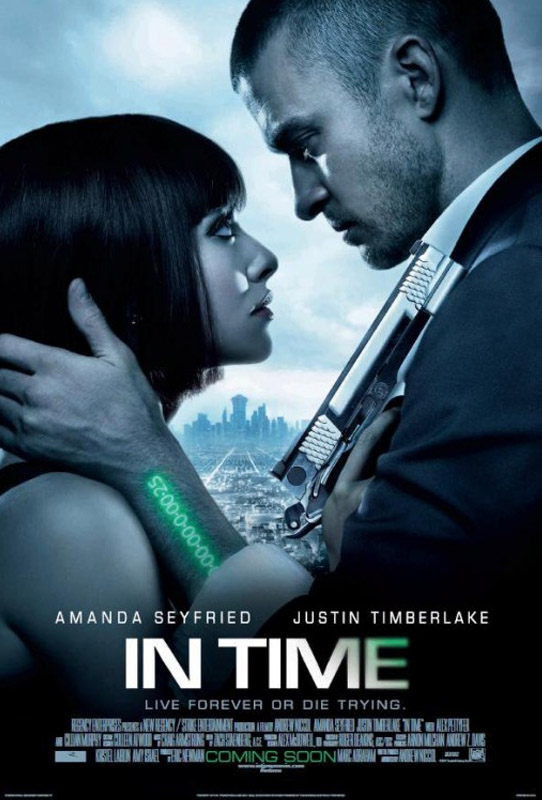
TIME IS OF the essence in another dystopic installment from thinking-man’s director Andrew Niccol whose “Gattaca” (1997) remains one of the best of its sci-fi kind and no stranger to high school biology classes in which eugenics and questions of the “perfect” DNA perennially spur spirited debate.

That’s part of the disappointment behind Niccol’s latest, “In Time,” a fascinating premise blighted by thin dialogue and a too-cool-for-school performance by Justin Timberlake.  His sidekick is named Sylvia Weis – she’s played by Amanda Seyfried who, appropriately, resembles a Felix the Cat wall-clock – who helps to lead the resistance against a culture that takes ageism to a lethal level.  As the palindromic Will Salas, Timberlake is a working-class resident of a segregated Time Zone known as Dayton; he’s also 28 and living on borrowed time since everyone dies – or, as it’s euphemistically known, “times out” – at age 25.  That’s the point at which everyone stops aging and starts dying after the glow-in-the-dark time code on their forearm begins its countdown from 365 to 364 and so on.  Will’s opening narration sets the scene: “I don’t have time […] Time is now the currency we earn and spend.”  Toll roads charge two months, as do hotels, and prostitutes beckon with “I’ll give you 10 minutes for an hour.”  The culture has brought sexy back and, nightmarishly, forever.

Like the character Vincent Freeman (played by Ethan Hawke) in “Gattaca,” Will is an outsider who subverts his perfection-obsessed environs from within.  Unlike Vincent, Will doesn’t so much outsmart the bad-guys but flirt, play cards, and run across rooftops with villains Cillian Murphy (always in the role of the blue-eyed devil, i.e. “Red Eye” and “Batman Begins”) and the sublimely smug Vincent Kartheiser of “Mad Men” hot on his trail.  As Raymond, Murphy is a “timekeeper” sent to take back the time given to Will by Henry Hamilton (Matt Bomer of TV’s “White Collar”), a 105-year-old who gives Will his years and plunges him into a world of trouble.

Shot in ambers and grays, and in digital, cinematographer Roger Deakins imbues Niccol’s vision with the look of permanent midnight.  “In Time” has an amusing opener in which Niccol startles us into his world’s weirder realities: Will’s mother (Olivia Wilde) is 50 years old and literally running out of time, but she looks not a day over 24.  He could have done more with this off-putting oedipality.  There’s additional shock value in Kartheiser proudly displaying his wife, mother-in-law, and daughter when all three look like triplets rather than a family tee.  But as time goes on, the puns and plays on temporality fatigue and bore the viewer.  Beyond the “99 second store,” Niccol’s script references “timeshares,” “quality time,” “minute men,” et cetera.

Worse yet, there’s Timberlake who is charming as supporting cast in “The Social Network” and “Alpha Dog,” but has neither the voice nor the physical presence of a leading man.  Andy Warhol famously predicted that in the future, everyone will be famous for fifteen minutes.  Reality television and the Kardashians made that prediction a present-day reality, and while Timberlake’s talent is timeless as a song-and-dance man…JT, the movie star?  Could Timberlake pass what I like to call the Hamlet test?  Can you actually imagine him as the gloomy Dane on stage, asking “For who would bear the whips and scorns of time?”

Not in a million years.

Review: “Take Shelter”

03 Thursday Nov 2011

Posted by colincarman in Film Reviews

≈ 3 Comments

Tags

boardwalk empire, brad pitt, clooney, dicaprio, hbo, jessica chastain, john nichols, kathy baker, mental illness, michael shannon, ohio, oscars, paranoid schizophrenia, prednisone, prophets, revolutionary road, shotgun stories, take shelter

“Fall Out Boy”

Review: “Take Shelter”

Grade: A- (SEE IT)

OSCAR SEASON IS upon us and the great Michael Shannon as Curtis in John Nichols’ nerve-wracking new film “Take Shelter” shouldn’t lose his seat amongst the usual suspects – DiCaprio, Clooney, and Pitt – when the 2011 Academy Awards convene next year.  Whether he’s playing Nelson Van Elden, the repressed Protestant and Federal Prohibition agent on HBO’s “Boardwalk Empire” or the wild-eyed prophet in “Revolutionary Road” (2008), Shannon is hands-down the most electrifying actor on screen today and “Take Shelter” is his tour-de-force.

But Shannon will also break your heart in part because this brilliant examination of mental illness in an age of American anxiety refuses to pin him down as either a schizo or a Tiresias.  Either way, his family and neighbors begin to worry when Curtis LaForche, a faithful husband, father and hard-worker in his heartland community, begins to build a panic room out back.  “Missed you at church this morning, Curtis,” says a neighbor to which he replies flatly (his mind, in this film, always someplace else): “I’m thinking of cleaning up that storm shelter out back.”

What prompts his growing panic are hair-raising nightmares in which his dog Red bites him, his deaf daughter Hannah is snatched by shadowy figures, and his wife Samantha (this year’s ingénue Jessica Chastain) menaces him with a kitchen knife.  The unifying theme in all of Curtis’s dreams is persecution: ominous storm clouds rolling in and swaths of dive-bombing birds like Hitchcock’s birds except on Prednisone.  After checking out Understanding Mental Illness from the local library, he visits his mother (Kathy Baker) whose own paranoid schizophrenia led her to a lifetime inside a health-care facility.  “There was always some panic that took hold of me,” she tells Curtis, “people listening to me.”  Like mother, like son?  You be the judge.

Yet “Take Shelter” isn’t exactly a thriller as it aims ultimately for the kind of ambiguity normally forbidden on the big screen.  As director Nichols (who also cast Shannon in 2007’s “Shotgun Stories”) recently explained: “We carry a lot of anxiety and fear and stress about our lives and the world around us staying on track and I thought that was something a lot of people could identify with and I thought it was worth making a film about.”  Worth it, indeed.  Are Curtis’s portentous dreams the work of a madman or an everyman prophet?  Only the film’s dazzling last scene points toward a possible answer and like Shannon’s wrenching performance, it’s impossible to shake.

Review: “The Thing”

19 Wednesday Oct 2011

Posted by colincarman in Film Reviews

≈ 3 Comments

Tags

a. wilford brimley, alien, black christmas, E.T., eric heisserer, final destination 3, horror, howard hawks, jaws, john carpenter, kurt russell, mary elizabeth winstead, matthijs van heijningen, men at work, men in black, prequel, psychology, ronald d. moore, sigourney weaver, spielberg, starship troopers, the thing

“Take Me to Your Bleeder”

Grade: D (SKIP IT)

WHAT ALIEN IN movie history has ever come in peace?  With the exception of E.T. and the space-oddities of “Men in Black,” how many little green men touch down with nothing but the best intentions?

The lethal leviathan at the gory core of “The Thing” is no exception to the rule.  Jeannette Catsoulis, a film critic at The New York Times, has already remarked on the creature’s resemblance to a “toothy, tentacled vagina,” which neatly sums up the film’s conflicted relationship with the gentler sex.  Not since the hideous “Starship Troopers” (1997) has the vagina dentata (that psychoanalytic trope of male horror) roared quite as ferociously as this gyno-gremlin.  It’s a shame that we see so much of the creature in the film’s latter half – have screenwriters Eric Heisserer and Ronald D. Moore learned nothing from Spielberg who intentionally left his man-eater half in the shadows to scare the bathing suits off us? – when the film’s most unnerving scene is also its least expensive:  every guy on base must subject himself to a dental exam and prove, since the alien spits out metals as it parasitically absorbs its victims, that he’s not the creature incognito by showing his fillings.  “What?” one member protests.  “So I’m the alien just because I floss?”  Open wide!

Perhaps the saving grace of this prequel to John Carpenter’s 1982 “The Thing” (itself a remake of Howard Hawks’s “The Thing” of 1951, inspired by the John W. Campbell story “Who Goes There”) is that a strong female has been dropped down in the center of it all.   That’s scream queen Mary Elizabeth Winstead (“Final Destination 3,” “Black Christmas”) as paleontologist Kate Lloyd recruited to the lunar landscape of Antarctica where an unidentified object, lodged in the ice for 10,000 years, has been unearthed by a team of Norwegians.  Kate, who is cleverly listening to Men at Work’s “Who Can it Be Now?” when called to action, is later caught star-gazing by the only other woman in this remote base-camp.  “I’ll never look at them the same way again,” Kate tells her short-lived friend.  What the team exhumes looks like a tarantula the size of an Escalade encased in ice.  It’s hard to believe that this sophisticated team of “experts” has only a power drill to break that ice and reach the specimen.  Once that happens – and yes, the team’s only black member, in the grand horror film tradition, is the first to leave the party to grab a six-pack stashed behind the Alien Popsicle – all hell breaks loose.  Because the creature can replicate itself on a cellular level, the remainder of “The Thing” is Dr. Kate repeatedly putting out fires.

This doomed Norwegian team’s first (and fatal) encounter with the Third Kind is hinted at in Carpenter’s earlier version, which makes Dutch commercial director Matthijs van Heijningen’s version here something of a “prequel.”  When franchises such as this one can’t keep growing forward, they regress backwards.  Thus this “Thing” ends with a husky having escaped into the tundra and huskies, if you recall the original gross-out, get a raw deal in “The Thing” of ’82.  Apart from the gore, there was nothing really innovative about Carpenter’s version except A. Wilford Brimley (sans moustache) wielding an axe and shooting at a shaggy Kurt Russell.  Painfully derivative of the great “Alien” of 1979, Carpenter’s “The Thing” featured a no-thing that fixes itself on your face like a surgical mask, lodges in your abdomen only to explode in the worst form of indigestion known to man.  Just close your eyes at the film’s finale and think of its real inspiration: Sigourney Weaver, as the indomitable Ripley, walking the vertebrae-looking halls of the alien’s hideout, blowtorch in hand.  Now that’s a real gut-buster.

Review: “The Ides of March”

11 Tuesday Oct 2011

Posted by colincarman in Film Reviews

≈ 3 Comments

Tags

audacity of hope, barack obama, beau willimon, Caesar, chuck schumer, drama, evan rachel wood, farragut north, george clooney, grant heslov, hbo, hilary clinton, howard dean, jeffrey wright, karl rove, marisa tomei, mildred pierce, ohio, paul giamatti, philip seymour hoffman, politics, president, Rome, ryan gosling, The Ides of March

“Et Tu, Brute?”

Review: “The Ides of March”

Grade: B+ (RENT IT)

Back in 2006, when President Obama was still on the top of the world, he wrote in his bestseller The Audacity of Hope that an American politician may not “lie” per se, but “understands that there is no great reward in store for those who speak the truth, particularly when the truth may be complicated.”  The fact that the system facilitates political prevarication, Obama asserted, remains a sufficient obstacle to making American politics cleaner and more transparent.  George Clooney’s fourth directorial effort, “The Ides of March,” could serve as another reality-check to Obama’s loftier aspirations.  In many ways, it’s not far off from Sarah Palin’s snide rejoinder: “How’s that hopey-changey thing working out for ya?”

Still, the truth is actually quite uncomplicated in “The Ides of March,” but it’s the cover-ups and team-switching to protect the lying politician at the center of it all that powers Clooney’s indictment of a corrupt and corrosive political arena.  The truth is simple because it’s sexual in nature: no spoilers here, but suffice it to say that when a fresh-faced intern named Molly Stearns (played by Evan Rachel Wood), strolls onto the scene, men in power quickly come unglued, or rather, unbuttoned.  As erotic napalm, Wood reprises the vixen role she played so expertly in HBO’s reboot of “Mildred Pierce,” but she’s more vulnerable here and ultimately, tragic.  The script smartly piles it on, too, inasmuch as Stearns is the DNC chair’s daughter and soon an important player in the Ohio state primary.  Thankfully, Clooney’s film also treats its viewer like a grown-up; when Morris’s top aid gets the axe, for example, all we see is actor Philip Seymour Hoffman step inside the governor’s Suburban, then, without dialogue, exit to a rainy alleyway.

Adapted from a Broadway play, entitled Farragut North (2008), by Clooney’s longtime collaborator Beau Willimon (and Grant Heslov), who worked on campaigns for Schumer, Dean, and Hilary Clinton, “The Ideas of March” has the realist pulse of an exposé based on firsthand experience.  Our man-on-the-ground is Stephen Myers (played Ryan Gosling, who has more or less commanded the screen since the summer), a thirty-year-old campaign advisor to Clooney’s Mike Morris (a governor and presidential contender with a few skeletons in his closet).

“The Ides of March” is ultimately a cynical and disillusioning film in which Marisa Tomei, as a jaded Beltway reporter, speaks to its central beliefs.  “He’s a nice guy,” she says of Morris, “They’re all nice guys.  He’ll let you down sooner or later.”  Tomei is just one of the film’s great supporting actors: in addition to a Karl Roveian Hoffman – can’t someone in the costume department help Hoffman tie a necktie so it reaches his belt-buckle? – there’s Paul Giamatti as the top aide to Morris’s opponent and Jeffrey Wright (briefly) as another influential senator.  Each has a secret agenda and if Stephen survives their machinations it’s because he’s cut from the same duplicitous cloth.  It’s a relief to find an unabashed anti-hero at the core of “The Ides of March”; love or hate him, at least Gosling’s Stephen will inspire some spirited discussion after the film.

Historically, the Ides of March refers not just to the Roman calendar but to the day Julius Caesar was stabbed twenty-three times on the Senate floor.  We may no longer carry out our assassinations in the open-air, but as Clooney’s fine political drama suggests, we’re every bit as dead-set on power and revenge.

Review: “Dream House”

09 Sunday Oct 2011

Posted by colincarman in Film Reviews

≈ 4 Comments

Tags

daniel craig, david louck, dream house, elias koteas, evil, freud, horror, james bond 007, jim sheridan, kubric, naomi watts, rachel weisz, stephen king, the shining, thriller, uncanny

“Burning Down the House”

Grade: F (SKIP IT)

For sale: three bedrooms, three full baths, garage, fully furnished, crown molding, stainless steel appliances, washer/dryer, storage.  House also includes poltergeists in the form of a murdered mother and her two dead daughters.  Any takers?

Only two: city-slickers Libby (played by Rachel Weisz) and Will, a publisher with pectorals played by Daniel Craig (a.k.a. 007 du jour), who move from town to country with bloody results.  The primary problem with “Dream House,” which is set in a New England town called New Ashford with Craig as an aspiring novelist, is that there’s not a shred of newness or novelty in this film (directed by the otherwise bright Irish film director, Jim Sheridan, of “In the Name of the Father” and “My Left Foot”).  As an anguished Libby tells Will, “There is something wrong with this house.”

Wrong, indeed. The less than dreamy house at the center of this turkey is already something of a suburban legend by the time Libby and Will start unpacking boxes.  Horror-queen Naomi Watts plays Anne, Will’s mysterious neighbor who keeps her distance, and won’t say what happened inside the Ward home five years ago.  After Will catches a gaggle of Goths holding a creepy séance in his cellar, and the ever-menacing Elias Koteas (of “Shutter Island,” a superior film built on the same concept of parallel plots) peering through his windows, he complains that he has an “infestation of teenagers in the basement.”  That’s the least of his problems.  Much to his disbelief, he comes to suspect that he is the house’s former occupant, a wife-killer named Peter Ward, and that Libby and his daughters are mere visions.  After paying a visit to Greenhaven Psychiatric Institute, Will comes to wonder: am I Ward?  Am I a widower or a wack-job?

Chances are you won’t stick around to find out and for good reason.  Screenwriter David Louck stuffs his script with laughable lines like “I’m not writing a book, I’m living in a fantasy!” and “Get me the chloroform now!” And when Will and Libby realize that the iniquity inside their walls cannot be suppressed, we get this: “You can’t paint over evil!”

Any smart spectator of this claptrap would be hard-pressed to find something intelligent to say about it, but if forced to lay a cerebral layer of paint over “Dream House,” Freud’s conceptualization of the “The Uncanny” (1919) comes to mind.  To prove that the uncanny relates to what he calls “themes of the double in all its grades and developments,” Freud describes being lost in an Italian piazza: “I suddenly found myself in the same street again [where] my swift departure resulted only in my ending up in the very same place, through a different detour, for the third time.  But then I was overcome by a feeling I can only describe as uncanny […] the unintended return of the same.”   The uncanny isn’t so much déjà vu but the compulsion to repeat and return over and over again.

“Dream House” not only repeats the central conceit of the King/Kubric classic, “The Shining,” in which murdered girls leave an infectious trace behind – come play with us, Danny! – but it goes in circles like the toilet bowl in which it belongs.  When a great conflagration eventually erupts in the final reel, you won’t feel the heat since, by that point, “Dream House” has already collapsed like a house of cards.

Review: “50/50”

03 Monday Oct 2011

Posted by colincarman in Film Reviews

≈ 5 Comments

Tags

50/50, 500 days of summer, adam sandler, angelica huston, anna kendrick, blog, bromance, bryce dallas howard, cancer, chemo, cruella de vil, dexter, dramedy, funny people, humor, inception, jonathan levine, joseph gordon levitt, noga arikha, patrick swayze, seth rogan, the help

“Spinal Trap”

REVIEW: “50/50”

Grade: B+ (RENT IT)

CANCER AND COMEDY aren’t as incompatible as one might think.  For centuries doctors worked from the assumption that the human body was comprised of four humors: phlegm, yellow and black bile, and blood. What’s called the humoural model (from fluid, or humon, in Greek and humor in Latin) dominated from the fifth century BC, with the work of Hippocrates, to the early twentieth century, the vestiges of which are now understood in terms of moods and temperament.  “English-speakers still have to humor the whims of a temperamental colleague,” writes Noga Arikha, author of Passions and Tempers: A History of The Humours, or “face a Monday with ill-humor, and remain good-humored throughout the week.”

But what about facing a stage-four spinal tumor with a sense of humor?  That’s the challenge facing Adam and indeed the larger dramedy based on his existential ordeal called “50/50.” Joseph Gordon-Levitt [“(500) Days of Summer,” “Inception”] plays Adam, a radio producer in Seattle, in a script by Will Reiser who himself battled and beat spinal cancer.  Adam gets by, and high, with a little help from his friends, chiefly Kyle (a sly and slimmer Seth Rogan), his hospital-appointed therapist (Anna Kendrick of “Up in the Air”) and smothery mother (an underused Angelica Huston).  When Adam informs her of his diagnosis over dinner, Huston shoots back: “I’m moving in.”

The film’s first frames feature Adam following all the rules: at 27, he exercises and patiently jogs in place at crosswalks while waiting for the light to change.  He’s smitten with girlfriend Rachael (Bryce Dallas Howard) who, as an abstract artist, fills his apartment with ugly canvases and worse, arrives an hour late at the hospital to pick him up.  Reprising her turn as Cruella de Vil in “The Help,” Howard tries her darndest to breathe life into a flat character in a film really about the bonds between men.

The emotional core of “50/50,” after all, lies in that fine bromance between Adam and Kyle.  Friends don’t let friends drive themselves to chemo.  And friends certainly don’t let friends shave their own heads, nor miss the opportunity to corral girls into sympathy sex.  “50/50!” exclaims Kyle, “If you were a casino game, you’d have the best odds.  And lots of people beat cancer.  That guy from ‘Dexter’ and Patrick Swayze.”  “Swayze?” Adam retorts, “That guy is dead.”  “Really?” Kyle backtracks, “Well, don’t think about him.”

Rogan’s casualness as a comic actor makes him instantly likable, and citing “night-blindness” as a reason to share Adam’s cancer-pot, he also reprises a role already seen on screen: 2009’s “Funny People” in which there, too, he nurses a terminal Adam Sandler back to life and laughter.   Directed by Jonathan Levine, “50/50” has none of that inferior film’s acerbic nihilism.  Instead, and in large part because of Levitt’s tenderness – listen for his larynx-shattering howl on the eve of a crucial surgery – “50/50” keeps its head high in the face of despair.  There’s a term for that tactic, by the way; it’s called “gallows humor.”

Cancer Sucks so Blog for a Cure:

http://www.blogforacure.com/

My “Bromance” review (“Funny People,” “The Hangover,” and “I Love You, Man”) from the _GLR_:

http://www.thefreelibrary.com/’Bromance’+Flix+and+the+State+of+Dudedom.-a0216644249

Review: “Moneyball”

28 Wednesday Sep 2011

Posted by colincarman in Film Reviews

≈ 4 Comments

Tags

a few good men, aaron sorkin, baseball, brad pitt, casey at the bat, george w. bush, hoosiers, jason giambi, johnny damon, jonah hill, kerris dorsey, mets, michael lewis, moneyball, oakland As, paul depodesta, peter brand, philip seymour hoffman, professional sports, red sox, romantic, scott hatteberg, sports movie, stan chervin, steve zaillian, texas rangers, the natural, the social network, underdog, yale, yankees

“Ball Street”

Grade: B+ (RENT IT)

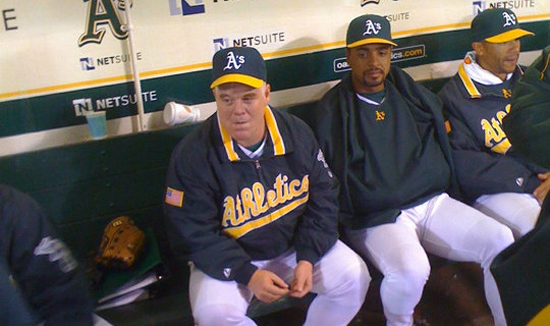
“HOW CAN  YOU not be romantic about baseball?” queries Brad Pitt, as the wildcard GM of the Oakland Athletics, in this talky new sports drama called “Moneyball.”  That loquaciousness, and the surprising fact that most of the film’s action takes place not on the diamond but on conference tables, is due in large part to the snap-crackle-pop of screenwriter Aaron Sorkin (sharing the credit with Steven Zaillian from a story by Stan Chervin and book, fully entitled Moneyball: The Art of Winning an Unfair Game, by Michael Lewis of “The Blind Side”).

It’s an ironic but endearing question from Billy Beane late in “Moneyball” because it was sheer number-crunching and player analysis not romantic notions of luck and discipline that led the A’s from a 5-3 loss to the pinstripes out East, in the Division Series of 2001, to an astounding comeback in the form of twenty consecutive wins years later.  It was Beane’s bean-counting that put the A’s back on the A-list of pro-baseball.  The grand notion of “Moneyball” is that when paradise is lost, it’s not regained but rebuilt from the ground-up.

After Beane loses outfielder Johnny Damon and heavy-hitter Jason Giambi to bigger and better teams, he likens his own to one big organ donor, farming out the heart and kidneys of the A’s to its competition.  But he swiftly rebuilds, much to the clubhouse’s chagrin, after enlisting the support of a Yale-educated economist named Peter Brand (played by the koala-bodied Jonah Hill).  (The brainy basis for Brand is Paul DePodesta, currently the VP for amateur scouting for the NY Mets; he and Beane theorized that walks are as important as home runs and relied on older and even injured players, and their patience at the bat, to succeed.  The script deftly introduces us to Scott Hatteberg, whose career as a catcher for the Boston Red Sox ended with a nerve injury, only to bring him back at a key and victorious moment.)   With aphorisms like “Baseball thinking is medieval” and “Pitches are like blackjack,” Brand helps Beane turn the game into a casino floor.  This approach is not without its detractors: an outraged scout who curses Beane out and the great Philip Seymour Hoffman as the A’s manager, Art Howe.  Seeing Hoffman, in a buzz-cut and starched white baseball jersey, is alone worth the price of admission.

“Moneyball” is entirely dependent on the work of two non-rookies: Sorkin’s script and Pitt’s intense focus. Pitt’s embodiment of Beane is the sine qua non of “Moneyball”; the film is really unthinkable without his cool grace under fire, when hiring and firing irate underlings, and his tenderness when interacting with daughter Casey (a guitar-strumming Kerris Dorsey).  An awkward scene in which Beane is forced to make small-talk with ex-wife (Robin Penn Wright) and her new husband while waiting for Casey to return home from a party provides some much-need pathos.

Sorkin, meanwhile, is the modern master of esoterica in light of the Beltway banter of “The West Wing,” the military and techno-politics of “A Few Good Men” and “The Social Network” (respectively) and here, in “Moneyball,” he and Zaillian reveal that major league baseball is not a far cry from Washington: money talks and walks in both realms.  Is it any wonder that another Yale grad, but just barely, George W. Bush, made that short step from the Texas Rangers to deranged foreign policy?

In the play-ball tradition of “The Natural” and “Hoosiers,” sports films that smartly transcend the track and field for something more meaningful, “Moneyball” flies because its pitch is way inside.

Review: “Abduction”

23 Friday Sep 2011

Posted by colincarman in Film Reviews

≈ 1 Comment

Tags

abduction, alfred molina, alien, avatar, boyz n the hood, cia, fast and furious, frida, jason isaacs, john singleton, lily collins, maria bellow, michael nyqvista, paris, phil collins, sigourney weaver, spiderman, taylor lautner, thriller, twilight

“Adventures in Baby-Snatching”

Film: “Abduction” (2011)

Grade: F (SKIP IT)


“TWILIGHT” STAR TAYLOR Lautner included, this flaccid timewaster of a “thriller” is full of shiny surfaces and zero substance.  BMWs, Apple Macbooks, even the pearly magic of Lautner’s dentistry are set before our eyes like glossy windup-toys headed right off the side of a cliff.   Putting the abs in “Abduction,” a toned but tonedeaf Lautner plays Nathan Price, a high school senior duped into thinking his parents (Maria Bello and Jason Isaacs) are his biological progenitors when instead, they’re undercover agents determined to arm and protect him from impending badguys.

Something’s fishy when your psychologist dissuades you from thinking too deeply about your dreams, especially that flashback of what could be your mother dead on a hotel floor in Paris.  Slumming it as Nathan’s psychiatrist, Sigourney Weaver plays Dr. Bennett, another adult actively involved in the cover-up of Nathan’s real origins.  (Are the “Avatar” and “Alien 1, 2, 3, 4” residuals really that paltry that Weaver needs “Abduction” for the moola because it can’t possibly be the script that called her great name?  The same goes for the equally distinguished Alfred Molina, of “Frida” and “Spiderman 2,” as a crooked CIA agent.)

Something’s even fishier when your dad picks you up from a ragin’ pool party – of course, a shirtless and hungover Nathan is strewn, alongside the obligatory red Dixie cups, on the lawn – only to bring you home and viciously defeat you in a kickboxing match.  “Drink like a man; fight like a man!” growls Isaacs as Nate’s dad.  It’s boot camp masquerading as tough love, and when danger finally comes a knockin’ – cue the Russian goon squad and the dead-eyed villain named Viktor Kazlow (Michael Nyqvist) who wants the encrypted information on Nathan’s cell phone – Nathan is ready to defend himself.  “Abduction” knows its demographic all too well for any real harm to come to its hero, and his haircut, and the film ends, improbably, with he and girlfriend (Lily Collins – Phil’s daughter) snuggling in an empty baseball stadium.  Hot dogs, get your hot dogs here!

If  director John Singleton (of “Boyz n the Hood” and “2 Fast 2 Furious”) musters little shock when Nathan eventually stumbles over his childhood photo on a missing persons’ database – I know my name is Steven! – it’s because Lautner too closely resembled the guy who misses quite a bit throughout his day: irony, algebra, carbohydrates.  Lautner isn’t so much an actor but the multiplex’s version of a chocolate Easter bunny: he may satiate your sweet tooth, but he’s all hollow inside.

Whatever “Abduction” names as its ransom, don’t pay it.

← Older posts
Newer posts →

Unknown's avatar

Recent Posts

  • Review: “Monsters: The Lyle and Erik Menéndez Story” (Netflix; 2024)
  • Sign Posts!
  • What Killed Jane Austen?
  • Was Austen a Holy Roller?
  • 5 Objects of Vivid Interest

Enter your email address to subscribe to this blog and receive notifications of new posts by email.

Join 256 other subscribers

Top Posts & Pages

  • Colin Carman
  • Review: "Life of Pi"
  • Review: "Crazy Stupid Love"
  • Gone Girls!

Jane Austen

action alien alpha dog amanda seyfried animals anton yelchin blue valentine bradley cooper brad pitt bromance carey mulligan charlize theron chawton christina hendricks christopher plummer colin farrell comedy crazy stupid love crime daniel craig dickens dracula drama emma stone england ewan mcgregor family frankenstein freud gay george clooney hampshire hbo horror jack russell terrier Jane Austen jessica chastain john lithgow joseph gordon levitt jude law kurt cobain mad men madonna mansfield park mary shelley matthew mcconaughey michael fassbender naomi watts oscars paris paul rudd philip seymour hoffman poetry politics portsmouth pride and prejudice romantic romantic comedy ryan gosling science fiction september 11 sex shakespeare shelley steven soderbergh summer blockbuster the hangover the help the social network thriller tim burton true blood twilight vampires viola davis

Blog Stats

  • 56,132 hits
  • RSS - Posts
  • RSS - Comments

Colin Carman Twitter

Tweets by ColinCarman

Colin Carman

Colin Carman

Archives

  • January 2025
  • July 2019
  • May 2013
  • April 2013
  • March 2013
  • February 2013
  • January 2013
  • December 2012
  • November 2012
  • October 2012
  • September 2012
  • August 2012
  • July 2012
  • June 2012
  • May 2012
  • April 2012
  • March 2012
  • February 2012
  • January 2012
  • December 2011
  • November 2011
  • October 2011
  • September 2011
  • August 2011
  • July 2011

Blogroll

  • Cinema Train
  • Dan the Man's Movie Reviews
  • Fogs' Movie Reviews

Category Cloud

Film Reviews Jane Austen Poems and Plogs (Poem-Blogs) Uncategorized

Blog at WordPress.com.

  • Subscribe Subscribed
    • Colin Carman
    • Join 171 other subscribers
    • Already have a WordPress.com account? Log in now.
    • Colin Carman
    • Subscribe Subscribed
    • Sign up
    • Log in
    • Report this content
    • View site in Reader
    • Manage subscriptions
    • Collapse this bar
 

Loading Comments...